The traditional, linear path from high school to a four-year degree is no longer the dominant story of higher ed. The Modern Learner moves in and out of education across decades, gaining experience and evolving their path as goals change, and lifelong learning trends are pushing institutions to rethink how they serve those learners.
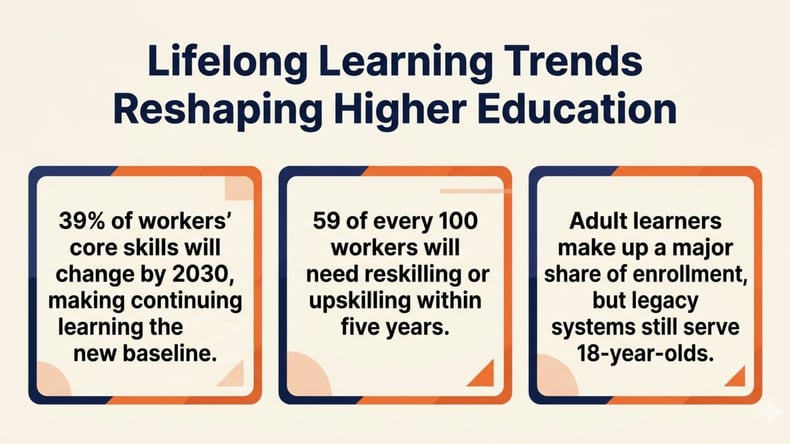
- Employers expect 39% of workers' core skills to change by 2030, making continuous learning a baseline requirement rather than a career bonus.
- Roughly 59 out of every 100 workers will need reskilling or upskilling by 2030, but only a fraction will receive the training they need without intervention.
- Adult students aged 25 and older make up a significant share of postsecondary enrollment, yet many institutions still operate systems designed for the traditional 18-to-22-year-old demographic.
The institutions moving ahead are evaluating their digital experience and academic operations through the lens of a 40-year relationship, not a four-year transaction.
For decades, higher ed followed a predictable script: enroll at 18, graduate at 22, get a job and stay out of the classroom for good. That script is fading fast.
Modern learners cycle through education many times, often while working, raising families or shifting careers. The pressure is structural, and the lifelong learning trends reshaping higher ed are accelerating. Employers expect 39% of workers' core skills to change by 2030. For every 100 workers, 59 are projected to need reskilling or upskilling in that window, and 11 of those 59 are unlikely to receive it. Purpose-built higher education technology can help institutions step in to serve learners at every stage of their careers.
Meeting that opportunity requires a new mindset. If you lead a college, continuing education division or registrar's office, your question has shifted to, "How do we build a 40-year relationship with each learner?"
What Do Lifelong Learning Trends Look Like?
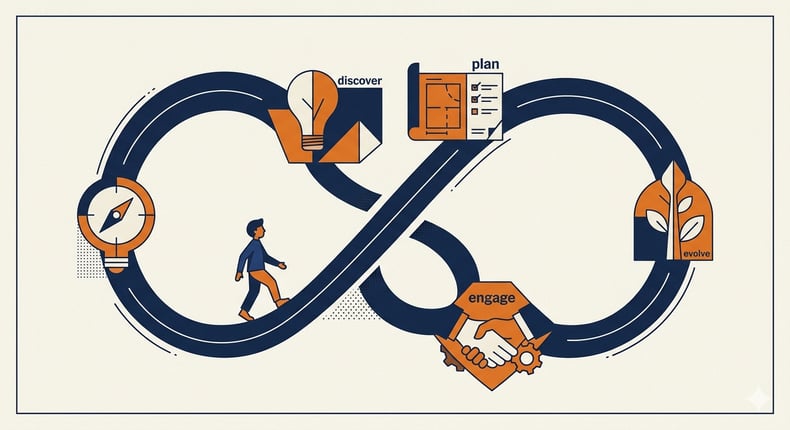
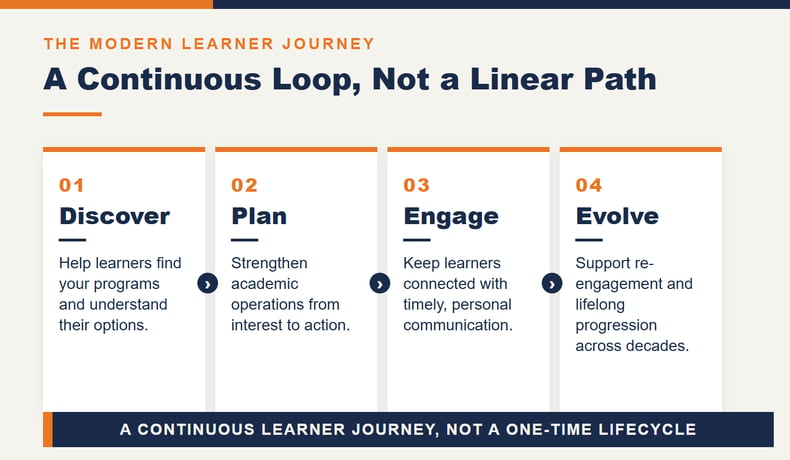
The Modern Learner doesn't follow a straight line. They start, pause, return, pivot and return again. Supporting them means moving from a one-time student lifecycle to a continuous learner journey with four stages institutions need to get right: Discover, Plan, Engage and Evolve.
Stage 1: Discover
Discover is about helping learners find their way to you. The Modern Learner explores programs that align with changing goals, comparing costs and credentials across many institutions in a single afternoon. Nearly 38 million working-age American adults have some college credit but no credential. That pool is roughly 10 times larger than the number of new high school graduates each fall, and it's one of the most impactful lifelong learning trends shaping enrollment strategy today.
Discovery happens almost entirely online, and it happens fast. At this stage, an institution’s job is to build a digital presence that works, so prospective students can find the right programs and take the next step with confidence.
Stage 2: Plan
Plan is where better operations create better outcomes. Once a learner identifies a path, academic operations have to deliver a clear, current, accurate picture of course sequences, prerequisites, transfer credits, financial aid and how the program fits into their existing life.
This stage is where many institutions lose adult learners. Catalogs are buried. Schedules are rigid. Advising hours might conflict with work shifts. When the planning experience feels designed for a 19-year-old with no other obligations, learners feel friction on the path from interest to action.
Stage 3: Engage
Engage is about keeping learners connected. This is where retention is won or lost, and it depends on meeting learners where they are with timely, personalized communication. The Modern Learner expects flexibility, such as evening classes, asynchronous options, mobile access and the ability to pause without losing progress. They expect communication that respects their time, including texts and timely nudges rather than emails buried in a portal they rarely log into.
Stage 4: Evolve
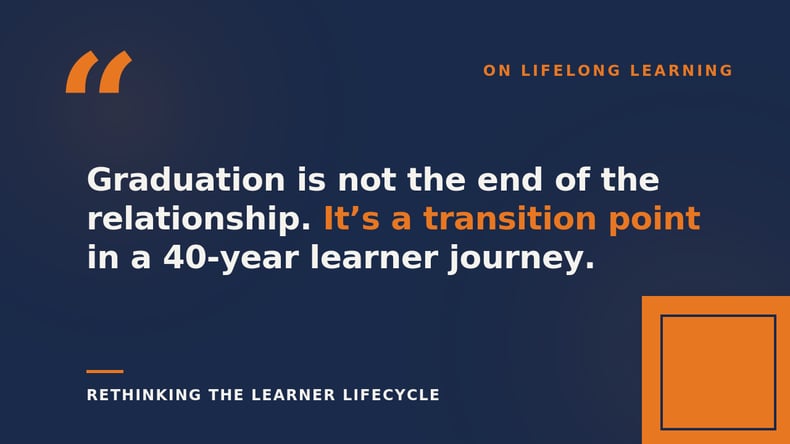
Evolve is about building for the Modern Learner. This is the stage institutions most often forget, but it's where lasting relationships are made. Graduation is a transition point, rather than the end of the relationship. A learner who finishes a certificate today may want a degree in three years, a leadership credential in seven and a personal-interest course at 65. By treating alumni as a future-enrollment audience rather than a fundraising audience, institutions are able to capture that lifetime value.
Where Are Institutions Falling Short?
The gap between what learners need and what most institutions deliver tends to show up in three places, and each one connects directly to the enrollment challenges in higher ed that leaders are already trying to solve.
Why Are Fragmented Systems Holding Institutions Back?
In many colleges and universities, the credit side and the non-credit side operate as separate worlds. The continuing education unit runs on one system, the registrar on another and marketing on a third. Data doesn't flow between them, so a learner who took a certificate in 2022 looks like a stranger when they return in 2025 to ask about a master's program.
That fragmentation has a cost. Staff members repeat work, while returning learners are treated like first-time applicants. At the same time, institutional leaders can't see a unified picture of who is at risk and who is ready for the next step.
Why Is Digital Discovery Still So Hard?
Higher ed websites are often the single biggest barrier between a curious adult learner and enrollment. Catalogs are buried in PDFs. Program pages don't show real-world outcomes. Search returns dead links. Mobile experiences are clunky.
For an adult learner who is researching during a lunch break or after the kids are in bed, that friction is enough to walk away. The right CMS for higher education is one that handles the unique complexity of academic content while giving non-technical staff the ability to keep that content current.
Why Does Re-Engagement Keep Failing?
Most institutions invest heavily in top-of-funnel recruitment and almost nothing in re-engagement. When a learner finishes a credential, they often disappear from the institution's radar until an annual fund letter arrives. That is a massive missed opportunity.
More than half of employers plan to increase their training budgets in the next two years, and more than 70% want institutions to deliver more flexible, work-relevant programs. Demand is clearly there. Few institutions have built the operational muscle to capture it.
What Do Adult Learners Actually Want?
Adult learners are not a monolith, but their priorities cluster in predictable ways. Understanding these adult learner trends is the foundation of any strategy to serve them well.
- Speed to credential. Programs that lead to a verifiable outcome in weeks or months, not years. The market for microcredentials and stackable certificates reflects this preference.
- Flexibility in format. Asynchronous, hybrid, evening, weekend and modular options that fit around work and family.
- Clear career alignment. Programs that show, on the program page itself, what jobs they prepare learners for and what those jobs typically pay.
- Recognition of prior learning. Credit for work experience, prior certificates and learning earned elsewhere, rather than starting from zero.
- Communication on their terms. Text-first nudges, mobile-friendly portals and reasonable response times from advisors.
When institutions design programs around these five priorities, enrollment in non-traditional offerings tends to follow. When they design programs around legacy assumptions, the gap widens, and institutions lose the opportunity to engage these learners.

How Can Institutions Adapt to Serve the Lifelong Learner?
The path forward is increasingly well understood. Institutions that are making real progress on the most stubborn enrollment challenges tend to focus on three areas in parallel.
Improve the Digital Experience First
A website is an institution’s enrollment funnel. If it can't answer, "What can I study, how long will it take, what will it cost, and what can I do with it?" in plain language, the rest of the strategy won't land. A higher-ed-specific content management system gives marketing and program staff the ability to update offerings quickly, keep accessibility standards in line and personalize content for different audiences without filing an IT ticket for every change.
Connect Academic Operations to Enrollment
Curriculum, catalog, schedule and registration data should feed the same learner record. When a prospective student looks at a program, they should see real, current information about when it runs, how it sequences and what it costs. When an enrolled student logs in, they should see their progress without having to email three offices to piece it together. Modernizing non-traditional student management often unlocks both efficiency gains for staff and enrollment gains for the institution.
Invest in Re-Engagement as a Discipline
Treat alumni and prior learners as a primary enrollment audience. Use what the institution already knows about them, including completed credentials, declared interests and stage of career, to deliver relevant offers at relevant moments. The institutions that do this well will find that the cheapest student to enroll is the one they have already taught.
What Does the Future of Higher Ed Look Like?
The most likely future of higher education is not the disappearance of the four-year degree. It is the integration of the degree into a longer, more flexible relationship between learner and institution. A first-time student at 19 becomes a certificate-seeker at 28, a graduate student at 35 and a non-credit explorer at 55. Each of those touchpoints is a chance to add value and reinforce loyalty.
The institutions that thrive will be the ones that stop thinking in terms of enrollment cliffs and start thinking in terms of learner lifetimes. According to data on adult learning, 42% of non-formal job-related learning activities last a day or less and another 40% last less than a week. That reveals two things. First, learners want short, focused experiences. Second, those short experiences are most valuable when they stack into something larger over time. Institutions that can deliver both in a single, coherent ecosystem will define the next era.
Frequently Asked Questions About Lifelong Learning Trends
What are the biggest lifelong learning trends in higher ed right now? The biggest lifelong learning trends include the shift toward short, stackable credentials, the rise of adult learners as a major enrollment segment, the move from one-time degree-seeking to repeated engagement across a career and the growing expectation that institutions deliver flexible, mobile-friendly digital experiences. Workforce alignment and clear career outcomes have also become non-negotiable in program marketing.
How is the adult learner population changing higher ed? Adult learners now represent a significant share of total postsecondary enrollment, and their priorities are different from traditional 18-to-22-year-olds. They tend to prize affordability and flexibility over the traditional campus experience. Institutions that successfully serve them invest in flexible scheduling, recognition of prior learning, transparent pricing and digital experiences that respect their time.
What are the main enrollment challenges in higher ed today? The biggest enrollment challenges in higher ed include a demographic decline in traditional college-age students, increased competition from alternative providers, growing skepticism about the ROI of a degree and rising expectations from learners for personalized digital experiences. Fragmented systems and inconsistent learner re-engagement compound these challenges, particularly as institutions face pricing pressure.
How does the future of higher ed affect institutional strategy? The future of higher ed favors institutions that can serve learners across a 40-year arc rather than a four-year window. That means investing in the infrastructure needed to support lifelong relationships, including continuing education, workforce development, microcredentials and seamless re-enrollment for returning learners.
Where Higher Ed Goes From Here
Education is no longer linear, and pretending otherwise is the fastest path to irrelevance. The institutions that will lead the next decade are designing experiences around the learner's actual life: a life of starts, pauses, pivots and returns. That means creating a connected learner journey and treating every credential as the beginning of the next relationship rather than the end of the last one.
Modern Campus serves as a strategic partner to more than 1,700 institutions across the full Modern Learner journey, connecting systems, experiences and data from discovery through lifelong learning. Explore the platform built for the Modern Learner and see what a connected experience can do for your institution.
Last updated: July 14th, 2026
.png)