Curriculum governance combines institutional policies and defined roles to guide how courses and programs are proposed, reviewed, approved and maintained.
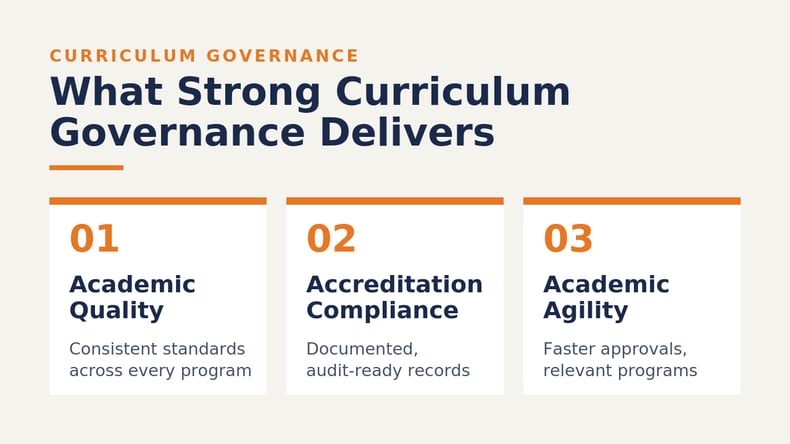
- Strong governance protects academic quality, supports accreditation compliance and lets programs adapt to fast-changing workforce needs.
- Manual, paper-based approval processes create record-keeping errors and delays that stretch from months to more than a year.
- Automated workflows create centralized version control and digital audit trails, turning governance from a bottleneck into a source of academic agility.
- Curriculum management software gives provosts and registrars a single source of truth across the institution and its academic catalog.
If an approval process can't keep pace with the modern learner, the governance model is overdue for a rethink.
Curriculum governance is how an institution decides what gets taught, who approves it and how those decisions stay accurate over time. It sounds procedural, but it's one of the most strategic levers institutions have. When employers expect 39% of core skills to change by 2030, the speed and integrity of the curriculum approval process shape whether programs matter to students and the workforce they're entering. Institutions that partner with learners across their education need governance that protects quality without grinding good ideas to a halt. This guide breaks down what governance is, why it matters to higher ed and how to fix the friction that slows it down.
What Is Curriculum Governance?
Curriculum governance is the framework an institution uses to develop, review, approve and continuously improve its courses and programs. Put simply, it's the rulebook and the routing system for academic change. Its job is to make sure every offering supports the institutional mission and meets both accreditation standards and workforce needs.
Faculty hold primary responsibility for curriculum, subject matter and methods of instruction, while deans, registrars, curriculum committees and governing boards each play defined roles. That shared structure separates a credible degree from an arbitrary one.
What's the Difference Between Curriculum Management and Governance?
Curriculum governance is about authority and accountability: who can propose a change, who reviews it and who signs off. Curriculum management is the day-to-day execution: building proposals, tracking versions, publishing the catalog and keeping data consistent across systems. Institutions need both. Governance without good management becomes bureaucratic, and management without governance becomes chaotic. Strong curriculum management practices provide the governance model with the operational muscle to actually function.
Who Is Involved in Academic Governance of the Curriculum?
Academic governance of the curriculum usually moves through several layers. A proposal often starts with a faculty member or department, then travels to a school or college committee, a registrar's office, a faculty senate and sometimes a board of trustees for new programs. Each checkpoint exists for quality, consistency, compliance and resource planning. The challenge is that every layer adds time, and every handoff adds risk when the process isn't well designed.
Why Is Curriculum Governance Important?
Curriculum governance protects academic integrity without sacrificing institutional agility. Done well, it protects accreditation while helping institutions launch relevant programs quickly. Done poorly, it creates friction for faculty and can leave programs outdated when enrollment opportunities arise.
How Does Governance Protect Academic Quality and Compliance?
Accreditors and state agencies expect documented, consistent processes for how curriculum gets approved and changed. When a governance structure supports clear roles and timely, well-documented decisions, institutions are better equipped to meet their governance responsibilities. A clear process also keeps learning outcomes and program requirements consistent from the catalog to the student information system. Students rely on that consistency when planning their path.
How Does Governance Drive Academic Agility?
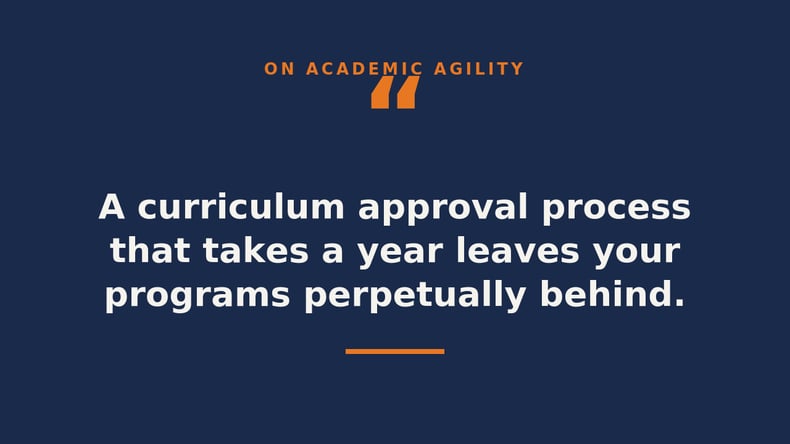
Here's the tension every provost feels: governance is supposed to ensure rigor, and rigor can't mean paralysis. When skills change this fast, a curriculum approval process that takes a year leaves your programs perpetually behind. Effective governance builds in speed by clarifying roles, removing redundant review steps and giving committees the data they need to decide with confidence. Agility and accountability aren't opposites. The right model delivers both.
What Challenges Do Institutions Face With Curriculum Governance?
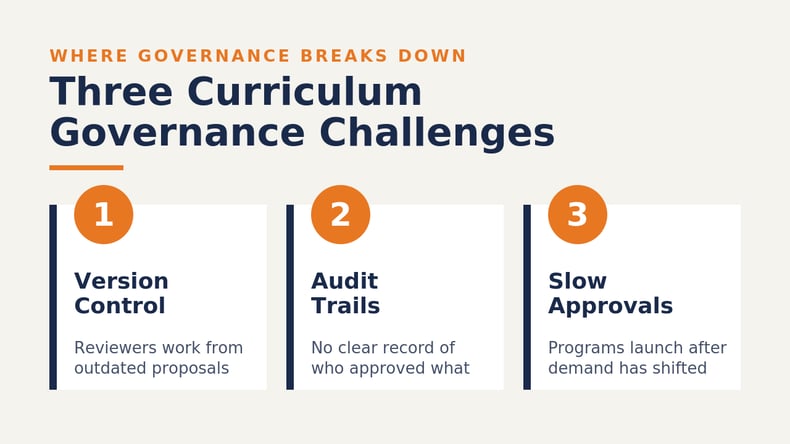
Most institutions struggle because their processes are fragmented and hard to track. Paper forms and spreadsheets, often passed back and forth over email, were never built to manage something as interconnected as a curriculum. Three problems show up again and again.

Why Is Version Control Such a Problem in Curriculum Workflows?
A single program change can ripple across dozens of courses, affecting prerequisites and shared requirements along the way. When curriculum workflows live in email and shared drives, it's hard to know whether a committee is reviewing the current version of a proposal or an outdated one. People comment on the wrong draft. Approved edits get lost. Hidden dependencies between courses go unnoticed until a student can't register. Centralized version control fixes these problems by maintaining one authoritative copy of every proposal with time-stamped changes.
What Happens When Audit Trails Are Incomplete?
Audit trails are the record of who changed what, when and why. Without them, accountability evaporates. If an accreditor asks how a program requirement was approved three years ago, the answer shouldn’t be a vague guess about a committee meeting somewhere. Incomplete audit trails create compliance risk, slow down reviews and make it nearly impossible to improve the process over time. Digital audit trails automatically capture every change and approval, so the history is always there when it’s needed.
How Do Slow Approval Processes Hurt Your Institution?
A slow curriculum approval process costs more than patience. When approvals stretch from several months to more than a year, faculty stop proposing improvements because the effort feels pointless. New programs miss the enrollment cycle they were built for. Workforce-aligned certificates launch after the demand has already shifted. Every delay is a missed opportunity to serve a learner who was ready to enroll.
Here are the warning signs a governance model is holding an institution back:
- Faculty avoid submitting proposals because the process is too cumbersome
- Catalog and other student-facing systems show conflicting course information
- Nobody can quickly answer who approved a change
- New programs routinely miss their intended launch term
How Does Workflow Automation Strengthen Governance?
Workflow automation is the biggest lever for improving governance without sacrificing oversight. Instead of chasing signatures across email, automated curriculum workflows route each proposal to the right reviewer in the right order, with reminders and clear status at every step. The result is faster decisions and a cleaner record.
Automation also makes governance more transparent. Everyone can see a proposal’s status and whether a decision has been made. Reviewers work from the current version every time. By enforcing established approval rules, the system creates consistency across departments without requiring micromanagement. Institutions that treat their curriculum system as core infrastructure find that automation strengthens governance rather than bypassing it.
How Does Automation Balance Speed With Academic Control?
Some leaders worry that automating the curriculum approval process means loosening control. The opposite is true. Configurable workflows encode an institution's governance rules, from committee review through final approval. You decide the guardrails. The system enforces them faster and more consistently than a paper trail.
How Does Curriculum Management Software Support Academic Governance?
Curriculum management software brings governance processes and data into one connected platform. Rather than stitching together forms and disconnected systems, institutions get a single source of truth shared across academic units and the catalog. For provosts and registrars managing change across multiple departments, that unification makes good governance scalable.

When evaluating options, focus on the capabilities that actually move governance forward.
What Should Teams Look for in Curriculum Management Software?
The best curriculum management features share a few traits. Here's what to prioritize:
- Configurable approval workflows that mirror the institution’s real governance structure, including multi-level committees and accreditation checkpoints.
- Centralized version control so every reviewer works from the current proposal and changes are automatically tracked.
- Complete digital audit trails that document every comment, edit and approval for compliance and reporting.
- A single source of truth that syncs approved changes to the academic catalog and student information system in real time.
- Reporting and dashboards that show where proposals sit and where bottlenecks form, helping institutions improve the process over time.
A platform with these catalog approval workflows turns curriculum governance from an administrative burden into a strategic capability.
How Does Curriculum Governance Connect to the Modern Learner Journey?
Curriculum governance isn't only an internal operations question. It shapes how well institutions can serve their students. A Modern Learner is an individual who moves in and out of education throughout their life, gaining experience and evolving their path as goals change, rather than following a single, linear journey from school to career.
That shift changes what the curriculum needs to support. The old model assumed a one-time student lifecycle: enroll, progress, graduate, done. Today's reality is a continuous modern learner journey, where people return to education again and again for new credentials and skills. Supporting that journey means programs have to continuously evolve, and governance has to keep pace.
The four imperatives of the modern learner journey each depend on sound governance:
- Discover: accurate, current catalogs help prospective learners find the right program and take action with confidence.
- Plan: strong academic operations create a friction-free path from interest to enrollment, which starts with governance that keeps curriculum current.
- Engage: consistent program information keeps enrolled students informed and on track.
- Evolve: agile governance lets institutions build new credentials and pathways as learners return with new goals.
Governance makes the Plan stage work. When academic operations are sound, every other stage gets easier.
Frequently Asked Questions
What Is Curriculum Governance in Simple Terms? Curriculum governance is the process your institution uses to decide what gets taught and how courses and programs get approved and updated. It defines who has authority at each step and keeps academic decisions consistent, with the documentation needed for compliance. It's the framework that keeps academic change orderly instead of ad hoc.
What Is the Difference Between Curriculum Governance and Academic Governance? Academic governance is the broader system of faculty and institutional authority over academic matters, from hiring to standards and policy. Curriculum governance is the part of academic governance focused specifically on courses and programs, including how they’re approved. In short, it's one important piece of the wider academic governance picture.
How Can Institutions Speed Up the Curriculum Approval Process? The fastest gains come from automating curriculum workflows, clarifying who reviews what and removing redundant approval steps. Curriculum management software helps by automating proposal routing and enforcing established rules, with real-time visibility throughout the process. Together, those changes cut delays without weakening oversight.
Does Stronger Curriculum Governance Reduce Faculty Control? No. Well-designed governance protects faculty authority over curriculum by making the process clearer and faster. Automation enforces the rules set by faculty, so committees spend less time chasing paperwork and more time on academic judgment.
Where Do Institutions Go From Here?
The institutions that thrive treat curriculum governance as strategic infrastructure, not paperwork. As learners move in and out of education and workforce needs keep shifting, your ability to quickly approve and publish curriculum becomes a competitive advantage. The goal isn't more control or less. It's the right control, applied faster.
The right partner makes the difference. Modern Campus helps institutions strengthen curriculum governance across the full modern learner journey, connecting workflows, version control and audit trails in one platform built for higher education. To see how it fits your institution, book a personalized demo.
Last updated: August 7, 2026
.png)