Students now judge an institution by the same standard they apply to every app, store, banking platform and streaming service they use, and the higher education digital experience is where that judgment begins.
- Personalized web experiences move prospective students toward enrollment. When a site adapts to who a visitor is and what they came for, learners keep going instead of returning to the search bar.
- Accessibility is a legal requirement, not a nice-to-have. Public institutions serving populations of 50,000 or more must meet WCAG 2.1 Level AA by April 26, 2027, with smaller institutions following in 2028.
- Mobile and self-service are baseline expectations. Learners browse programs and complete key tasks from a phone, and they expect it to work without a phone call.
- AI is changing how learners find institutions. Students increasingly discover and compare programs through AI tools, so web content has to be structured for people and machines alike.
Treat the website as the front door to a continuous learner journey rather than a static brochure, and design every interaction to help learners accomplish the thing they came to do.
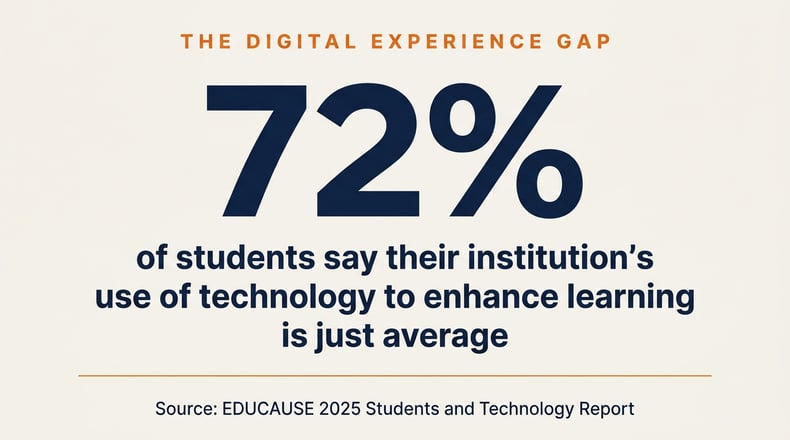
Prospective students land on a higher ed website already fluent in what a good digital experience feels like. They shop, bank and stream on platforms engineered to erase friction, and they bring those same reflexes to every college site they open. That sets a demanding bar for the higher education digital experience, and the evidence says most institutions are not clearing it. In one national study, 72% rated campus technology as average, while satisfaction climbed sharply at schools seen as cutting-edge. The gap between what learners expect and what they find is exactly where enrollment is won or lost.
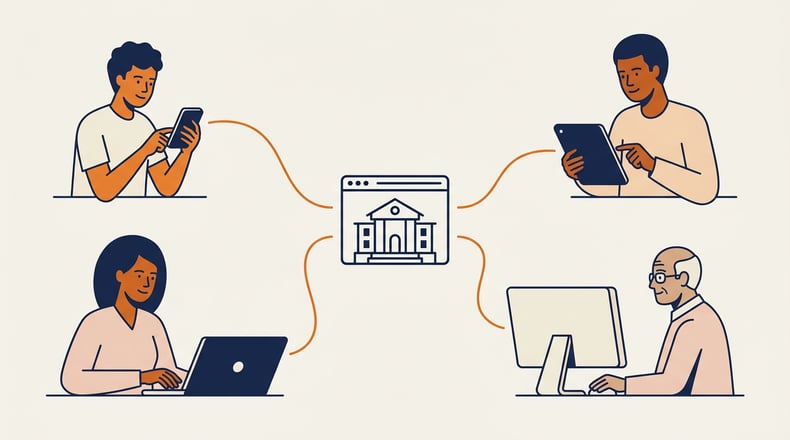
The people arriving at an institution’s site have changed, too. Today's student is a Modern Learner: an individual whose education continues throughout life, returning repeatedly as careers shift and new skills become essential. Institutions that want to deliver a modern student experience have to design a website that meets this learner wherever they are in that ongoing story.
What Does a Higher Education Digital Experience Mean to Today's Students?
A higher education digital experience is the sum of every interaction a learner has with an institution online, from the first time they search for a program to registration, payment, financial aid, and everything after. It is not one page or one form. It is the entire path a person travels through a site, and how little effort that path demands of them.
For a long time institutions built for a single, linear student lifecycle: apply once, enroll once, graduate once. Modern Learners do not move that way. They may return years later with different goals than the ones that brought them the first time. That shift replaces the one-time lifecycle with a continuous learner journey, and a website is the connective tissue that holds it together. When the digital experience is fragmented, learners feel the seams. When it is seamless, they keep coming back.
Why Do Student Expectations for the University Website Experience Keep Rising?
When a site can't keep up, learners notice at once. A clunky university website experience no longer reads as normal. It reads as a red flag about the institution behind it, and today's student expectations leave little room for error.
The data backs this up. When students were asked how their institution could improve, they pointed to more seamless experiences: easier access to web pages and online resources, along with simpler logins and fewer technical snags. These are not learning complaints. They are digital experience complaints, and they shape whether a prospective student trusts an institution enough to enroll.
Three forces keep pushing these expectations higher:
- Consumer-grade design is now the default reference point. Learners assume that the experience will surface the most relevant content, save their preferences, and provide an intuitive path to what they want.
- Choice has expanded. Learners now have more ways to gain new skills and credentials, so a frustrating experience sends them elsewhere.
- Value scrutiny is intense. When learners are already questioning the cost of education, every digital interaction becomes evidence of institutional quality.
Which Elements Define a Strong Higher Education Digital Experience?
A strong higher education digital experience is built from a handful of elements that work together. Miss one and learners notice. The five below are where learners expect the most, and where institutions have the most room to improve.
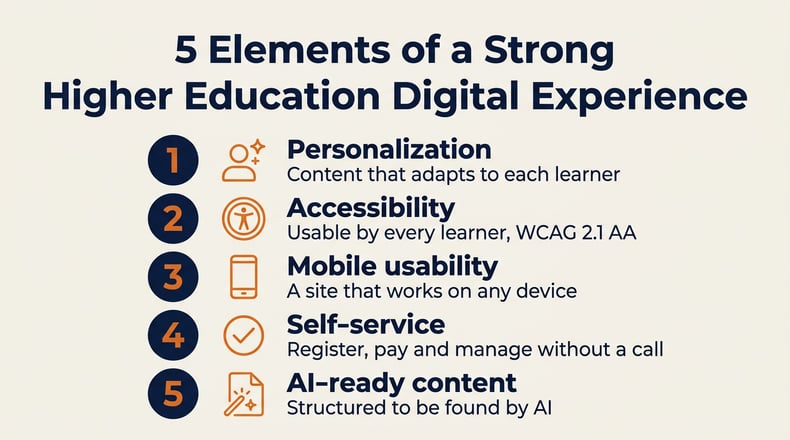
Are Your Web Experiences Personalized?
Personalization is what separates a site that speaks to a learner from one that talks at everyone. Personalized web experiences use signals like search history and referral source to adjust the content and calls to action a visitor sees. A learner who searched nursing programs should see nursing next time, not a generic homepage that makes them start over.
The payoff is real. Institutions that deliver personalized web experiences report meaningful jumps in engagement and conversion, because relevance keeps people moving toward action. For a practical starting point, this breakdown of how personalization shapes the student experience shows what scaling it actually takes. Personalization is no longer a differentiator. It is an expectation.
Is Your Website Accessible to Every Learner?
Accessibility determines whether every learner can use a site, and it is now a compliance requirement. Under the Department of Justice's Title II rule, the federal accessibility deadline requires public institutions serving populations of 50,000 or more to bring their websites and digital content into conformance with WCAG 2.1 Level AA by April 26, 2027. Smaller institutions have until April 26, 2028.
Beyond compliance, accessibility is simply part of a strong digital experience. Clear structure, readable contrast, captioned media and keyboard navigation help everyone, not just learners using assistive technology. Accessibility works best when it’s part of the design process rather than a last-minute audit.
Does Your Digital Experience Work on Mobile?
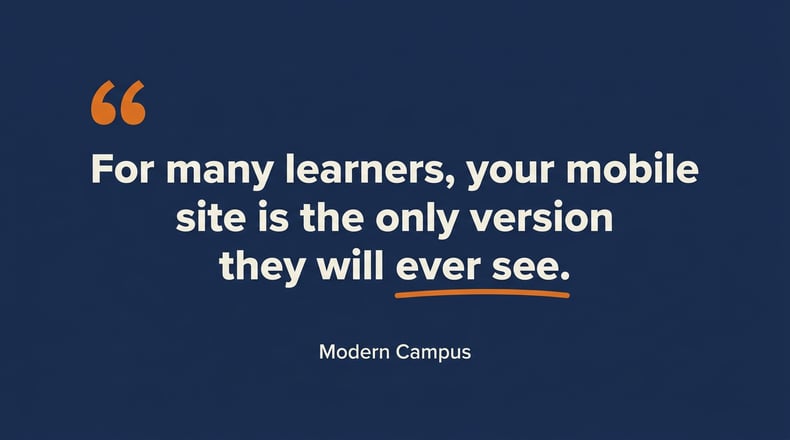
Mobile is no longer a secondary experience. For many learners it is the only version they will ever see. Pew Research Center data on smartphone ownership among young adults shows roughly nine in ten U.S. adults own a smartphone, with the highest rates among the traditional college-age group. A learner who encounters a poor mobile experience, whether it’s a jumbled layout or a broken form, will rarely switch to a laptop. Instead, they leave.
A strong mobile experience means intuitive navigation paired with fast, mobile-friendly forms. It also means consistency, so a learner who starts on a phone and finishes on a desktop never has to relearn where things are. For a fuller picture of where design is heading, these current website design trends are worth a look. Mobile-first design is now table stakes.
Can Learners Serve Themselves Without Staff Help?
Self-service is what a modern learner expects and what overworked staff need. Learners want to register, pay, check requirements and update their information on their own schedule. When a site forces them to email or call for routine tasks, it creates frustrations for learners and buries institutional teams in requests they should never have to field.
Good self-service means centralizing the information a learner needs and putting it a click or two away. Course details, start dates, costs and credentials belong up front, not scattered across pages. Login systems and account management should be simple enough that a learner never has to ask for help to do something basic. Every task a learner completes alone is time that staff get back for higher-value work.
How Is AI Reshaping the Digital Experience?
AI is changing the digital experience from both sides of the screen. Learners increasingly turn to AI assistants and AI-powered search to research their options before they ever reach a homepage. That means that content has to be structured clearly enough for these tools to surface it accurately.
On the site itself, AI-driven personalization can tailor what each visitor sees in real time, surfacing the programs and pathways most relevant to them. The opportunity is not to bolt a chatbot onto a broken site. It’s to build content and experiences that work for learners and for the AI tools they increasingly rely on. Institutions that get this right show up when it counts, while those that ignore it fade into the background.
What Are the Warning Signs of a Poor University Website Experience?
Sometimes the fastest way to improve is to name what is broken. If several of these sound familiar, the website experience is probably getting in learners’ way. Research into what frustrates students most about college sites points to many of the same issues.
- Learners have to click through many pages to find costs, start dates, requirements or other key information.
- The homepage shows the same content to everyone regardless of their interest or intent.
- The mobile experience looks or behaves differently from the desktop site.
- Registration or payment can’t be completed online without asking for help.
- The site fails basic accessibility checks for structure or navigation.
- Search returns too many irrelevant results or none at all.
Each of these adds effort, and effort is where prospective students drop off. Fixing even two or three, starting with a few clear personalization steps, can measurably lift engagement.
How Do These Elements Map to the Modern Learner Journey?
A strong digital experience is not a checklist of features. It is how an institution supports learners across a continuous journey, and four imperatives define what institutions must get right. Discover means building a digital presence so learners can find the right programs and act with confidence. Plan means strengthening the operations behind the site so the path from interest to enrollment stays friction-free.
Engage means meeting learners with timely, relevant communication that keeps them informed from first click through registration. Evolve means designing for re-engagement, so a learner who returns for a new credential years later finds a site that still knows how to serve them. Personalization, accessibility, mobile and self-service are not isolated fixes. They are how an institution delivers on all four imperatives at once and turns a single visit into a lasting relationship.

Frequently Asked Questions
What is a higher education digital experience? It is the complete set of online interactions a learner has with an institution, from searching for programs to registering, paying and managing their account. A strong higher education digital experience is personalized, accessible, mobile-friendly and easy to navigate without staff help. For another perspective on putting this approach into practice, explore this guide.
How do personalized web experiences improve enrollment? These experiences adjust content and pathways based on a visitor's interests and behavior, so learners see relevant information instead of a generic page. That relevance keeps prospective students engaged and moving toward enrollment rather than leaving to look elsewhere.
Why do expectations for the university website experience keep rising? Learners compare institutional sites to the frictionless digital experiences they have everywhere else, so every improvement in the consumer world resets their baseline. Expectations have risen, so a slow or confusing site becomes evidence of how an institution operates, which shapes both trust and enrollment decisions.
Are You Ready to Deliver the Experience Learners Expect?
The higher education digital experience has become one of the clearest signals learners use when deciding whether an institution is worth their time. Meeting today's student expectations means designing every interaction, from the first program search to a return visit years later, around the learner it is meant to serve. The institutions that get this right will build relationships that last across a lifetime of learning.
Modern Campus partners with institutions to support learners across that full journey, connecting the systems, experiences and data behind a truly seamless digital presence. To see how it can work for your institution, request a demo with our team.
Last updated: September 23, 2026.