How one of Canada’s pioneering continuing education institutions reimagined the learner journey with stackable pathways.
About Continuing Education at the University of Alberta:

“The goal isn't simply to create shorter programs. It's to create learning that has value at multiple points along that journey.”
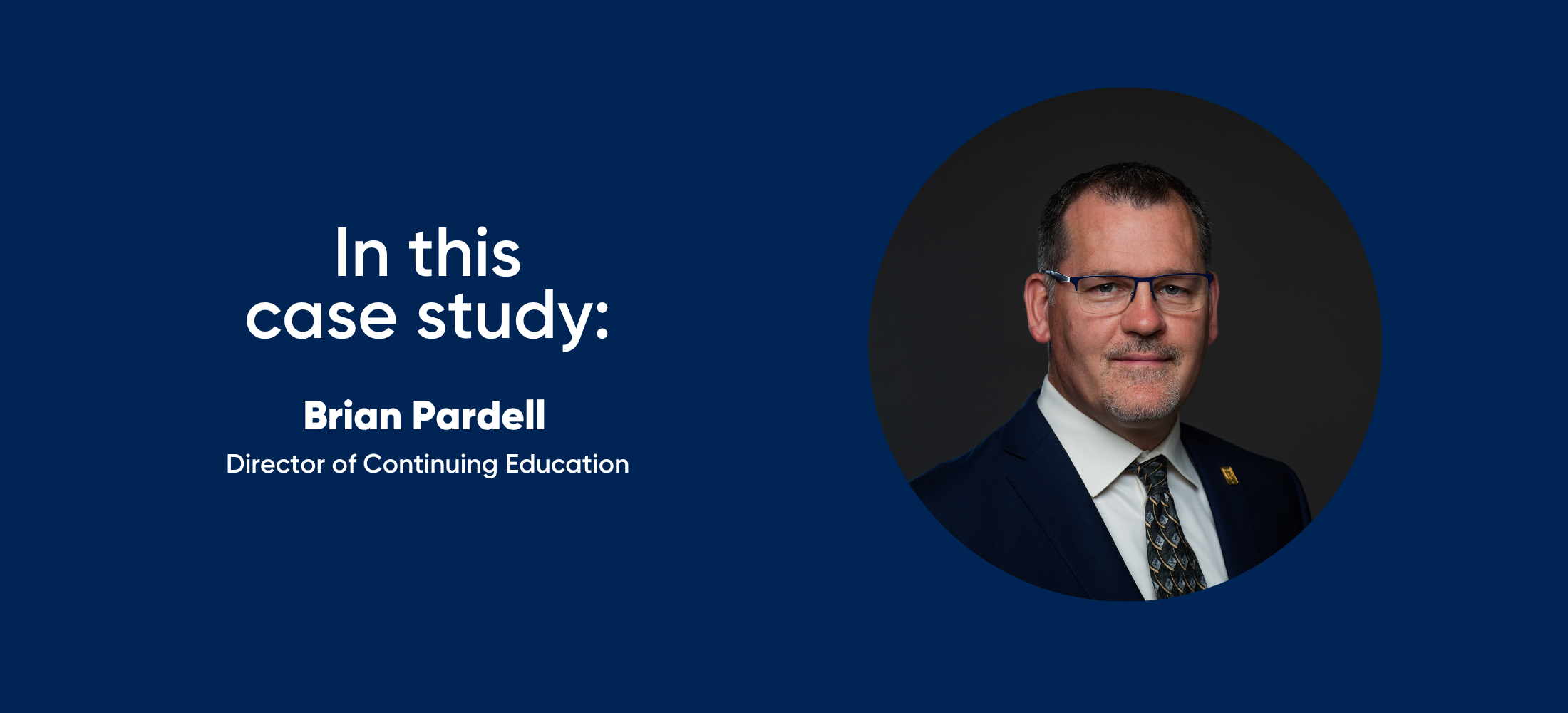
Brian Pardell | Director of Continuing Education at the University of Alberta
The Challenge
At the University of Alberta, Continuing Education has a history that stretches back over a century. Since its beginnings as the Department of Extension in 1912, the division has evolved alongside the changing needs of learners, from community development programs during the Depression and post-war years to its more recent focus on online learning and workforce development.
Today, Continuing Education serves as the university's centralized unit for non-credit learning, supporting both its own programs and those developed by faculties across the institution. When the division transitioned to a business unit in 2022, the team took the opportunity to examine its portfolio structure.
“One of the first things that we discovered was just how many different approaches existed within our portfolio,” said Brian Pardell, Director of Continuing Education.
Here’s what they found: at least eight different product labels had accumulated across the division, including series, certificates, citations, and advanced certificates. Each reflected a different way of organizing non-credit learning. Together, they became increasingly difficult to understand and increasingly complex to administer.
This complexity created challenges for learners as well. Many programs required learners to make a significant investment of both time and money before receiving formal recognition for their progress. There wasn't always enough flexibility for people balancing work, family, and other responsibilities.
“This became the impetus for us to ask the question: is there a better way to structure our learning experiences?” Pardell said.
The Solution
The answer began with a new framework for non-credit programming across the institution, supported by Modern Campus Lifelong Learning.
Rather than asking learners to commit to one large credential, the division standardizes non-credit offerings around a simple, stackable progression. This creates building blocks that can be combined into larger credentials while giving learners meaningful recognition along the way.
“A course can have value on its own, but it can also contribute towards something larger,” Pardell said.
The new framework organizes learning into four connected offerings:
- Micro-courses: Short, focused learning experiences designed around specific skills or competencies.
- Courses: A course can stand on its own as one defined learning outcome or become part of a larger learning pathway.
- Certificates: The first point of stackability. Three related courses combine into a focused credential that has value on its own while building toward a diploma.
- Diplomas: A broader non-credit credential built from three complementary certificates, allowing learners to build toward a broader goal over time.
“We needed a system to support the new way of thinking about our programming and not simply automate the old model.”
Brian Pardell
Modern Campus Lifelong Learning provides the infrastructure to make that new way of thinking operational. It serves as the platform for non-credit learning, bringing together registration, payments, and learner records. Integrations with Canvas LMS and MyCreds connect learning and credentialing into one ecosystem.
Through Bundle Pricing, learners can register for a single course or purchase an entire certificate at a discounted rate. Soon, Auto Association will automatically connect each course registration to its corresponding certificate pathway without a separate application or fee. For employers, Corporate Engagement Manager extends the same stackable programming through customized access and pricing.
“The Modern Campus model allows that flexibility to start to happen,” said Pardell.
Together, these capabilities turn the framework from a design principle into an everyday learner experience.
The Results
Learners gained more flexible, stackable pathways
Instead of making a significant upfront investment of time and money, learners can now enter each pathway one course at a time. Every milestone is a recognized achievement in its own right, allowing learners to progress at a pace that fits around work, family, and other commitments.
“Stackable models allow our learners to make smaller investments while still moving towards that larger credential,” said Pardell.
One framework now supports non-credit offerings across the institution
Instead of creating new program structures for every offering, teams now begin with a common model for non-credit learning. That brings greater consistency across Continuing Education, academic faculties, and corporate partnerships while reducing the administrative complexity of managing multiple program types.
Because the framework provides a consistent starting point, teams can spend less time designing credential structures and more time developing programs that respond to learner and workforce needs.
Continuing Education at the University of Alberta builds on a century of change
More than a century after its founding, Continuing Education at the University of Alberta has reshaped how non-credit learning is organized across the institution. The new framework creates a consistent model for today's programs while leaving room for tomorrow's opportunities.
“This transformation didn't happen in isolation. It was part of this larger, ongoing evolution of continuing education. It never stays static. It's always morphing and changing. This is just another step along the way.”
Brian Pardell