Continuing education has become a growth engine for higher ed, but managing it at scale takes more than good intentions and a spreadsheet.
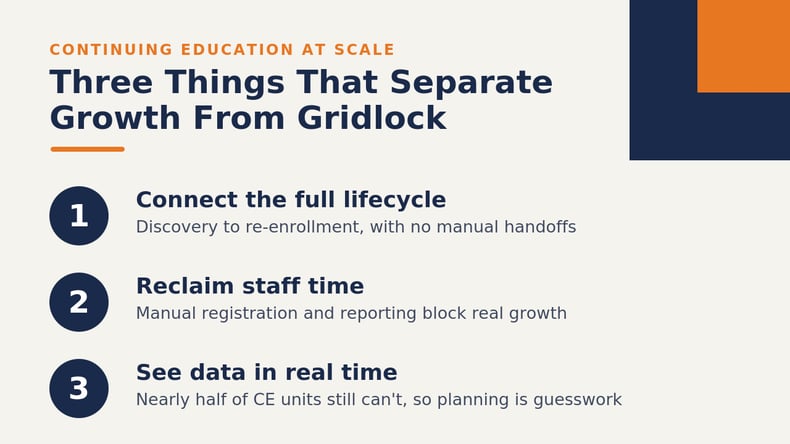
- The continuing education lifecycle spans discovery, registration, payment, delivery and re-enrollment, and every stage needs to work without manual handoffs.
- Staff time is the hidden cost. Manual processes, from registration and payment collection to reporting, pull skilled people away from program growth.
- Real-time enrollment data is still out of reach for nearly half of continuing education departments, which turns scaling decisions into guesswork.
- Purpose-built continuing education software ties the full journey together, so one team can run many programs at once.
If your continuing education operation is growing faster than your systems can handle, it's time to rethink the infrastructure behind it.
Continuing education has moved from the margins to the center of higher ed strategy. Certificates, micro-credentials, workforce training and professional development now generate real revenue, and they're frequently an institution’s fastest-growing programs. That success creates its own challenge. Continuing education program management gets harder as programs grow and diversify, and the manual workarounds that held things together at a small scale start to break. As of July 1st 2026, a new wave of federal funding for short-term programs will push demand even higher. For the institutions serving lifelong learners, the challenge is keeping continuing education operations aligned with demand.
How Do Universities Approach Continuing Education Program Management?
Continuing education program management is the work of running the full learner journey across many programs at once. That journey rarely looks like the traditional four-year path. Learners move in and out of education throughout their lives, and institutions have to be ready whenever they come back.
This pattern is where the idea of the Modern Learner matters. A Modern Learner is an individual who moves in and out of education throughout their life, building new skills as their goals evolve, rather than following a single linear journey from school to career. Those learners make up the core audience for non-degree programs.
The old model treated education as a one-time student lifecycle that ended with graduation and alumni status. The Modern Learner breaks that pattern. People might return for a credential at 28, a reskilling course at 40 and a leadership certificate at 52. Managing continuing education well means designing for that continuous journey instead of a single pass through the system.
What Does the Continuing Education Lifecycle Include?
The continuing education lifecycle starts when a prospective learner discovers a program, continues through registration and payment, runs through delivery and assessment and ideally loops back when that learner is ready for the next credential. Each stage generates data, as well as requiring staff attention. Each also shapes whether the learner returns. When these stages live in separate systems, the handoffs create friction for learners and busywork for staff.
Adult learner programs add more complexity. These students balance work and other responsibilities, so a clunky registration form or a delayed confirmation email is often enough to lose them. Supporting the full continuing education learning lifecycle means removing friction at every step because adult learner programs rely on convenience. Treat the lifecycle as one connected experience, not a series of disconnected transactions.
What Challenges Do Continuing Education Departments Face?
Most continuing education departments are short on time. They’re also short on visibility and systems that talk to each other. The hardest challenges tend to cluster around operations rather than academics.
- Fragmented systems. Registration lives in one tool, payments in another and reporting in a spreadsheet, so no one sees the whole picture.
- Manual administrative load. Staff spend hours managing enrollment and payment collection instead of developing new programs.
- Limited data visibility. Close to half of continuing education departments still struggle to access real-time enrollment data, which forces leaders to plan reactively.
- Decentralized ownership. When each academic unit runs its own non-credit offerings, learners get an inconsistent experience and the institution loses economies of scale.

Why Is Continuing Education Administration So Time-Consuming?
Continuing education administration eats time because so much of it is still done by hand. Someone has to process registrations, chase payments, reconcile revenue, issue receipts and pull reports manually. The day-to-day reality of continuing education department management means a small team often runs dozens of programs at once, and every manual step multiplies across that volume. Skilled staff get stuck on transactional work, and the strategic work of growing programs slips to the next quarter.
What Does the Staff Time Problem Really Cost?
Time lost to manual work affects growth, not just efficiency. Every hour spent reconciling payments is an hour not spent designing a new workforce certificate or marketing an existing one. When continuing education administration consumes a team's capacity, enrollment plateaus even while demand keeps climbing. Freeing staff from repetitive tasks is one of the best moves a department can make because it converts overhead into growth capacity.
How Do Institutions Scale Continuing Education Operations?
Scaling continuing education operations involves removing the manual handoffs that make each new program feel like starting from scratch. Institutions that scale well build connected operations with clear visibility into performance.
Can Centralizing Continuing Education Department Management Help?
Centralizing continuing education department management is one of the most reliable ways to scale. When registration, payments, catalog and reporting run on one shared system, academic units can focus on building and teaching programs while a central team handles the operational backbone. Institutions that have consolidated their non-credit operations are better positioned to improve data visibility and streamline administration. Centralizing the operations doesn't mean centralizing the creativity. Departments keep ownership of what they teach while shedding the administrative weight that slows them down.
How Does Automation Support Continuing Education Operations?
Automation makes scaled continuing education operations sustainable. Automated registration and confirmation messaging remove the repetitive tasks that consume staff time, without adding headcount. Adult learner programs benefit the most, since self-service registration and instant confirmations match the expectations of busy working students who might be enrolling at 10 p.m. between shifts. A few automations carry most of the weight:
- Automated enrollment and registration so learners can self-serve at any hour
- Integrated payment processing that handles the transaction and the receipt in one flow
- Real-time dashboards that surface enrollment and revenue as they happen
What Software Supports Continuing Education Management?
The right continuing education software holds the full lifecycle together. General-purpose student information systems were built for degree-seeking students on semester calendars, and they have difficulty keeping up with the flexible, fast-moving nature of non-credit work. Purpose-built continuing education software is designed for the realities of professional education programs: rolling start dates, varied pricing, corporate billing and stackable credentials.

What Should This Software Actually Do?
Strong continuing education software connects every step of the learner journey in one place. It should let a learner browse offerings and complete registration in a few clicks, and it should give staff a single source of truth for every program. It also needs to handle registration and payments cleanly because that's where learners most often drop off. The best systems turn a sprawling set of programs into something one team can actually run, which is the whole point of investing in dedicated technology.
What Are the Pillars of Scalable Continuing Education Program Management?
Strong continuing education program management at scale rests on a handful of repeatable capabilities. Here are six that separate institutions that scale smoothly from those that stall:
- Unified registration and catalog. One place for learners to find and enroll in every program the institution offers.
- Integrated payments. Registration and payment in a single flow, with automated receipts and corporate billing built in.
- Real-time reporting. Live enrollment and revenue data so leaders act on current demand instead of last quarter's numbers.
- Flexible program models. Support for certificates, micro-credentials, professional education programs and workforce courses without custom workarounds.
- Automated workflows. The system should manage approvals and confirmations without manual touches, while issuing certificates automatically.
- Centralized continuing education administration. A shared operational backbone that frees academic units to focus on teaching.
When you get these six abilities right, continuing education program management becomes a platform for growth.
How Does This Connect to the Modern Learner Journey?
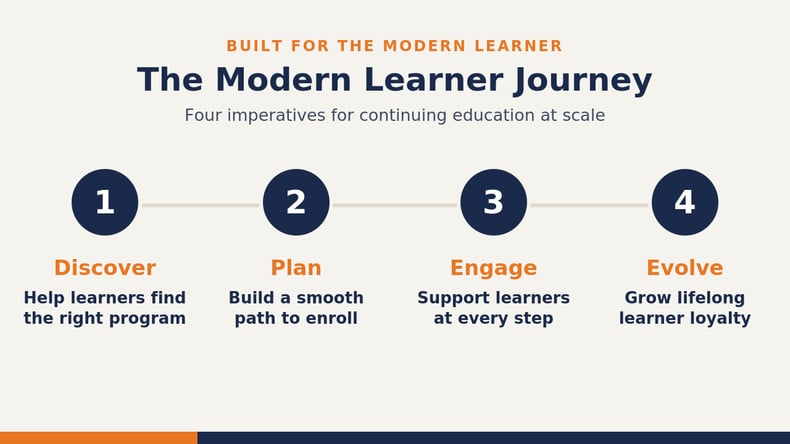
Scaling continuing education isn't only an operational exercise. It's how institutions support the Modern Learner across a continuous journey. Four pillars shape that work, and each one is something the institution must get right rather than something the learner does alone:
- Discover. Help learners find their way to the institution with a digital presence and catalog that let prospective students surface the right program and act with confidence.
- Plan. Build the academic operations that create a friction-free path from interest to enrollment because better operations drive better outcomes.
- Engage. Keep learners connected with timely, personalized communication that supports them from first touch through completion.
- Evolve. Build for re-engagement and lifelong progression so a one-time enrollment becomes a lasting relationship.
Framed this way, continuing education program management becomes the engine of the modern learner journey rather than a back-office chore. Every operational improvement you make is an investment in connecting adult learners to the workforce and to your institution over the long run.
Frequently Asked Questions
How do universities manage continuing education programs at scale? They centralize operations on purpose-built continuing education software that connects registration, payments, catalog and reporting, so one team can run many programs without manual handoffs.
What challenges do continuing education departments face most often? Fragmented systems, heavy manual administration, limited real-time data and decentralized ownership are the most common. Together, they slow growth and pull staff away from strategic work.
What software supports continuing education management? A purpose-built student information system designed for non-credit and professional education programs supports the full lifecycle, unlike general systems built for degree-seeking students on a semester calendar.
How is continuing education funding changing in 2026? Federal aid is expanding to short-term, workforce-aligned programs of roughly eight to fifteen weeks, which raises both the opportunity and the operational bar for institutions ready to launch and track them.
Ready to Build Continuing Education That Scales With Demand?
Continuing education is one of the clearest growth opportunities in higher education right now, and the institutions that win will be the ones with operations that can scale as fast as demand. That means trading manual workarounds for connected systems that free staff to focus on program growth and returning learners. Continuing education units are already among the most financially efficient divisions on campus, and short-term credentials are now the fastest-growing slice of enrollment.
Modern Campus partners with institutions to support learners across the full journey, connecting the infrastructure that makes continuing education work at scale. To simplify continuing education program management and grow enrollment, book a demo with our team.
Last updated: August 4, 2026
.png)