Digital badges have become a defining force in how colleges and universities credential workforce-relevant skills. Employer recognition, learner demand and platform infrastructure are all maturing at the same time.
- Digital badges now dominate the U.S. credential ecosystem, with over 1 million unique badges making up more than half of the credentials available across the country.
- Employers actively look for digital credentials, with 91% of HR and talent leaders reviewing them during hiring and 63% reporting they have hired a candidate at least partly because of a digital credential.
- Skills change faster than traditional degrees can adapt, and employers expect 39% of core worker skills to transform or become outdated by 2030.
- Universities like Penn State, the University of Wyoming, Moravian and Maine are using badges to validate co-curricular learning, accreditation outcomes, career readiness and professional upskilling.
Institutions succeed when they treat digital badges as infrastructure for workforce alignment rather than marketing collateral, and design every badge with a clear employer-recognized skill and a verifiable evidence trail.
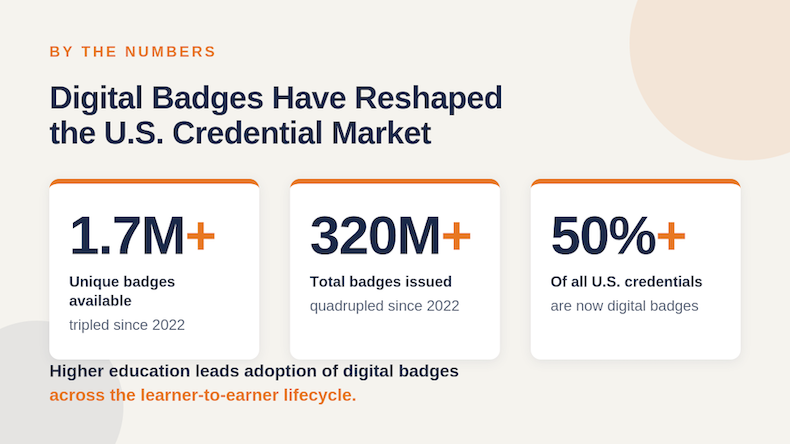
The credential market has tripled in size. The number of digital badges offered to learners jumped from roughly 521,000 in 2022 to more than 1.7 million in 2025, and the total count of badges issued quadrupled to over 320 million in that same window. Badges now make up more than half of the 1.85 million unique credentials offered across the United States.
Anyone working in continuing education, a registrar's office, or anywhere near workforce-aligned program design has probably seen this shift accelerate. Learners want shorter, faster, more career-specific proof of what they can do. Employers want a clearer signal than a transcript line item. Digital badges help bridge that gap, and a modern student experience depends on getting them right.
This guide unpacks best practices for how colleges and universities use digital badges, what employer alignment looks like in practice and what real-world programs across North America are teaching us about credential design.
What Are Digital Badges in Higher Education, and How Do They Differ from Traditional Credentials?
A digital badge is a verifiable, web-enabled visual credential that carries metadata describing what the earner did to receive it. Unlike a paper certificate, every badge contains embedded information about the issuer, criteria, evidence and often a link to the assessment that produced it. That metadata makes badges useful in a workforce context. A hiring manager doesn't have to guess what "Certificate in Project Coordination" actually means. Instead, they can click and see exactly which skills were assessed.
How Do Digital Badges Compare to Degrees and Certificates?
Degrees signal years of effort and breadth of study. Certificates signal completion of a structured program. Badges signal something narrower and more targeted: a discrete competency or a specific tool mastery. These three forms of credential are not in competition. The most effective programs treat them as nested layers, where badges feed into certificates, certificates feed into degrees, and learners can stop and start without losing recognition for what they’ve already mastered. This is what stackability looks like in practice.
Why Do Colleges and Universities Need Digital Badges Now?
In this environment, skills requirements are often shifting faster than program catalogs can update. Employers expect 39% of workers' core skills to be transformed or become outdated by 2030, and 63% of employers cite skills gaps as the single biggest barrier to business transformation. Roughly 59 out of every 100 workers globally will need some form of training by 2030.
Traditional degree pathways can't move that fast on their own. Digital badges in higher education can. They give institutions a way to credential emerging skills in months rather than years, keeping programs relevant to the labor market that learners are entering.
How Are Colleges and Universities Actually Using Digital Badges for Workforce Learning?
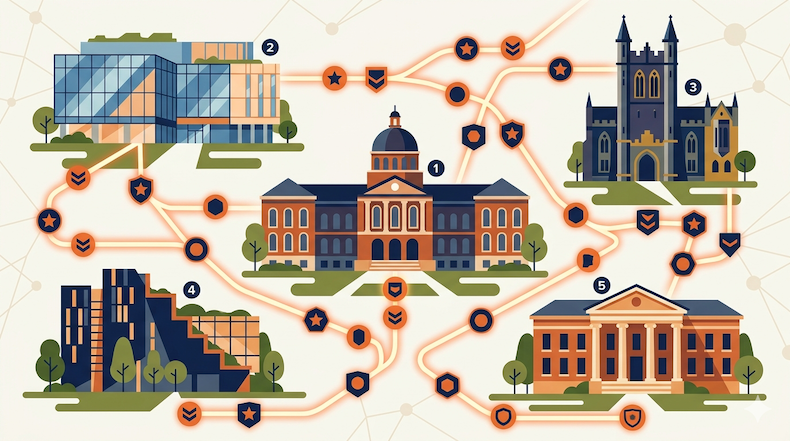
Theory is easy. Implementation is where most badge programs succeed or stall. Here are four well-documented digital badges examples from real institutions, each illustrating a different use case.
Penn State and Information Literacy Badges
Research from Penn State tracking more than 900 students in a digital badge program found a positive relationship between learners earning at least one badge and course grades. Information literacy badges were offered as co-curricular activities, and the data suggested that earning badges correlated with stronger academic outcomes. Well-designed badges reinforce learning rather than simply decorating a resume.
The University of Maine System and Workforce Microcredentials
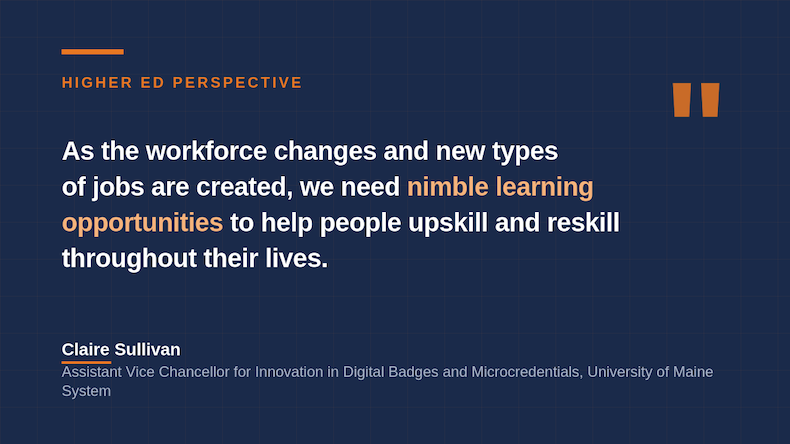
The University of Maine System has built a widely recognized badge and microcredential program. As Claire Sullivan, the system's assistant vice chancellor for innovation in digital badges and microcredentials, put it in research published with UPCEA, "As the workforce changes and new types of jobs are created, we need nimble learning opportunities to help people upskill and reskill throughout their lives." Maine treats badges as a deliberate workforce strategy.
The University of Wyoming SOAR Program
The University of Wyoming (UW) runs a competency-based program called SOAR that combines high-impact experiential learning with personalized digital badges and co-curricular transcripts. Students develop eight key skills employers want, with every badge built using input from UW departments to give learners a direct line from experience to future career.
Moravian University and Career Readiness
Moravian University's Career Readiness Digital Badging Program awards eight badges based on the competencies employers seek. Students earn points toward their badges by attending lectures, joining student organizations, participating in research and engaging in short-term travel programs. Completing all eight badges, paired with meeting a GPA expectation, qualifies students for the institution's Career Promise.
Are Employers Actually Looking at Digital Badges?
The data is encouraging. According to the 2025 State of Credentialing Report, which surveyed 502 HR and talent leaders, 91% actively look for digital credentials when reviewing candidates and 86% say they would be more likely to interview a candidate with a digital credential proving a key skill. On top of that, 63% of those surveyed have hired a candidate at least partly because of a digital credential.
The catch is that only 46% of HR leaders say they regularly see digital credentials on resumes, which means many learners still are not displaying them effectively.
What Makes Workforce Learning Credentials Useful to Employers?
Workforce learning credentials carry weight when they meet three tests:
- The badge represents a single, well-defined skill rather than a vague theme
- The metadata clearly describes the assessment, evidence and issuer
- The skill maps to a recognizable job role employers already hire for
The strongest badge systems in colleges and universities are designed in collaboration with local employers, industry advisory boards and labor market data.
Technology, healthcare and professional services have led adoption, often through corporate badge programs that institutions now learn from. IBM's badge program, administered through Credly, is an often-cited corporate example. The takeaway for institutions is that employers are already fluent in the language of digital credentials, which means that badges enter a marketplace with established expectations about quality and rigor.

How Should Universities Design Badge Systems That Employers Trust?
A poorly designed badge clutters a learner's profile and erodes institutional credibility. A well-designed one signals genuine capability.
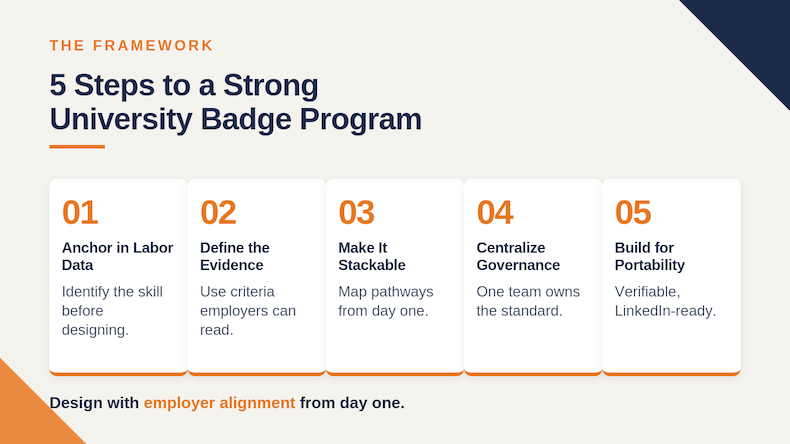
What Are the Five Steps to a Strong University Badge Program?
Here is a practical sequence based on patterns from well-documented programs:
- Anchor every badge in a labor market signal. Start by identifying the skill through labor market data and employer input, then design the assessment around it.
- Define the evidence and assessment up front. A badge with no clear assessment is just a logo. Document the criteria in plain language that a hiring manager can understand.
- Make badges stackable from day one. Map how individual badges roll up into certificates, how certificates may align with degree credit (where appropriate), and define how those elements fit into clear learner pathways.
- Centralize governance. Establish a single team responsible for badge governance and quality assurance. Decentralized badge issuance produces inconsistent quality.
- Build in verification and portability. Use a credentialing platform that supports verifiable metadata and integrates with the tools learners actually use, including LinkedIn and learning management systems.
What Does Stackability Look Like in Practice?
Stackability is the structural decision that lets a learner take a workforce-relevant short course, earn a badge, apply that badge toward a certificate, and eventually count it toward degree credit if they choose. Forward-thinking institutions are creating seamless pathways between credential levels, with badges sitting as a connective layer of that design. Without stackability, a badge is a dead end. With it, a badge becomes an on-ramp.
What Are the Common Pitfalls When Implementing Digital Badges?
Even well-resourced programs run into the same handful of issues. Watch for these:
- Badge inflation. Issuing badges for participation rather than competency dilutes the value of every badge in the system.
- Inconsistent design. If different colleges and departments within the same institution produce badges that look and feel different, it undermines learner trust and employer recognition.
- Weak metadata. A badge without clear, machine-readable metadata cannot be parsed by hiring tools, AI screening systems or LinkedIn search.
- No employer feedback loop. Programs that never check back with employers about whether badges are working drift quickly out of relevance.
The fix for most of these issues is governance. A central badge office that coordinates standards and employer input can prevent almost all of them.
How Are Digital Badges Connected to the Future of Workforce Learning?
Digital badges are part of a longer transition toward skills-based hiring and lifelong learning. More than half of U.S. states have adopted policies encouraging skills-based hiring, which puts pressure on employers and educators alike to communicate skills in verifiable formats. Badges, paired with stackable credentials and digital wallets, are the most practical way to do that.
The institutions that lead this shift treat badges as infrastructure for the learner-to-earner lifecycle that increasingly defines modern careers, not as a side project or marketing layer.
Frequently Asked Questions About Digital Badges in Higher Education
What is the difference between a digital badge and a microcredential? A digital badge is the visual, verifiable representation. A microcredential is the underlying achievement or competency. The terms are often used interchangeably in practice.
Are digital badges in higher education credit-bearing? Some are, many are not. Increasingly, institutions are designing badges so they can be stacked toward credit-bearing certificates or degrees, but a meaningful share of badges represent non-credit, workforce-aligned learning.
How do digital badges support adult and non-traditional learners? Adult learners often need targeted skill development that they can complete around work and family responsibilities. Badges fit that need because they are shorter, more focused and easier to display to current or prospective employers than a partial degree.
Can digital badges replace a college degree? In most fields, no. They complement degrees rather than replace them. The exception is some fast-moving technical fields where a stack of well-designed badges, plus demonstrated experience, can compete with a traditional credential for entry-level roles.
How do employers verify digital badges? Through metadata. A modern digital badge includes verifiable information about the issuer and criteria, as well as the assessment method. Most badges link directly to the issuing institution's verification page. Blockchain-secured credentials add another layer of verification by making forgery technically impractical.
Where Should Your Institution Go from Here?
Digital badges are how millions of learners and tens of thousands of employers communicate skills today. They are increasingly central to how higher education will keep pace with a labor market that refuses to slow down. Institutions that build thoughtful, employer-aligned badge systems today will be the ones that own the next decade of workforce learning.
Modern Campus helps institutions design and deliver digital credentials that learners actually use and employers recognize. Book a demo with our team to see how it works.
Last updated: June 16, 2026