The digital student experience is now the front door to an institution, and it shapes whether learners enroll, stay and return.
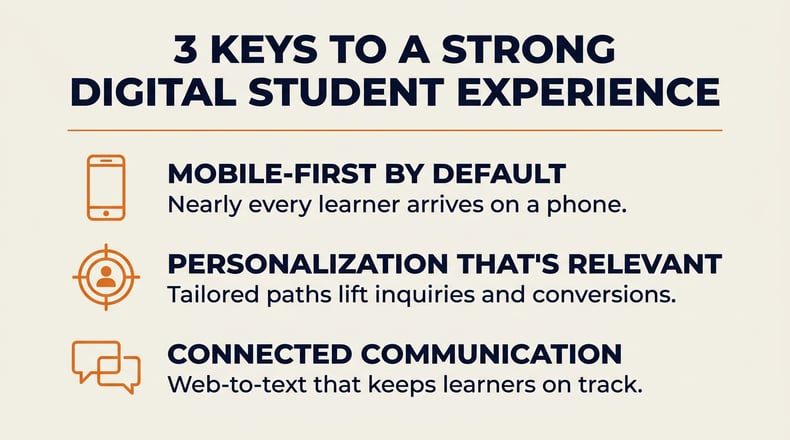
- Nearly all learners arrive on a phone, so mobile-first design is the baseline for a strong digital experience, not an upgrade.
- AI-powered personalization turns generic web pages into relevant, learner-specific paths that lift inquiry conversions.
- Federal rules make WCAG 2.1 Level AA accessibility a hard requirement ahead of the 2027 and 2028 compliance deadlines.
- Connected communication, from web to text, keeps learners on track and supports retention across the full journey.
Treat the experience as continuous infrastructure for the modern learner journey, not a one-time website project.
Every institution now runs two campuses: the physical one and the digital one. For most learners, the digital campus comes first. Before a prospective student ever walks a quad, they judge an institution by how easily they can find the information they need and act on it on a phone. That first impression is the digital student experience, and it increasingly decides who applies, who enrolls and who stays.
Learners bring consumer expectations to that first impression. Today's traditional-age students grew up online, with nearly all teens reporting daily internet use, and adult learners live on their phones just as much. When an institution’s site feels slower or more confusing than the apps they use every day, they return to the search bar. Delivering a modern student experience is no longer a marketing perk. It is the mechanism through which institutions build and sustain learner relationships.
What Is the Digital Student Experience in Higher Education?
The digital student experience is the full set of online interactions a learner has with an institution, from the first search result to the registration confirmation and every portal login in between. It spans the website, catalog, application, payment flow, text messages, and mobile experience. In short, it is everything a student encounters when an institution shows up on a screen rather than in person.
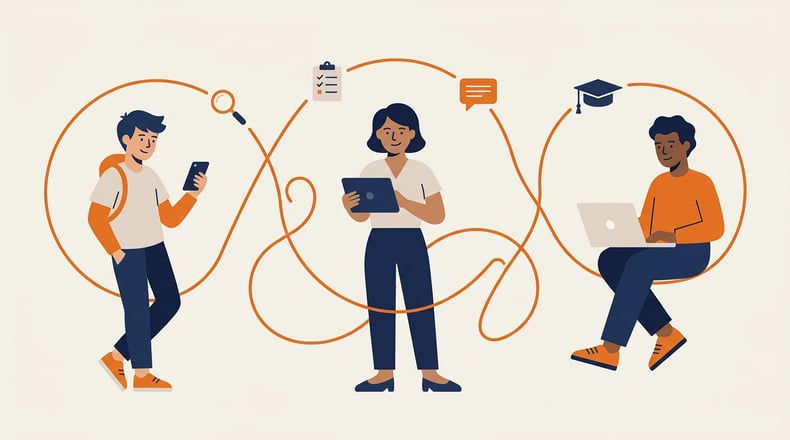
That experience matters more now because the people using it have changed. Modern Learners move in and out of education throughout their life, gaining experience and evolving their path as goals change, rather than following a single linear route from school to career. That means the same person may visit the institution years apart with entirely different questions and needs, whether they’re returning for a certificate, a new credential, or a career change.
This shift breaks the old model. Institutions were built around a one-time student lifecycle: recruit, enroll, graduate, done. The Modern Learner follows a continuous modern learner journey that may have many entry and re-entry points. An experience designed for a single, linear path will frustrate the exact learners institutions most need to reach.
Why Does the Digital Experience Matter More in 2026?
The stakes attached to the digital experience have risen sharply. Enrollment pressures and rising expectations have turned the website from a brochure into the primary point of conversion. When learners can compare institutions across a dozen browser tabs, friction is not an inconvenience. It’s a reason to leave.
How Do Digital Expectations Shape Enrollment?
Prospective learners decide fast, and they decide on their phones. Research on student technology use shows that students expect technology to support learning and grow more satisfied when institutions adopt and integrate it well. A confusing program page or a broken mobile form sends a signal about the whole institution. A clear, mobile-friendly path from interest to application does the opposite, widening the top of the funnel and moving more inquiries toward enrollment.
How Does the Experience Affect Retention and Staff?
The digital experience does not end at enrollment. Nearly one in four students leave before their second year, often because they feel disconnected or cannot get answers when they need them. An experience that keeps learners informed and supported reduces that risk. It also relieves staff: when self-service works, teams spend less time answering routine questions and more time on the work that actually moves retention.
When the digital experience breaks down, the damage compounds:
- Prospects abandon slow or confusing application flows and enroll elsewhere.
- Enrolled students miss deadlines buried in email they never open.
- Staff burn hours patching manual processes instead of supporting learners.
What Do Modern Learners Expect from a Digital Experience?
Learners arrive with expectations shaped by the digital experiences they use every day. Meeting those expectations is less about flashy features and more about removing everyday friction. Five elements now define a strong digital student experience.
- Mobile-first everything. Learners browse on their phones. They also use them to apply and pay. If a task requires a desktop, many learners will not finish it.
- Personalization that feels relevant. Generic pages get ignored. Learners expect content matched to their program interests, as well as their location and stage in the journey.
- Self-service and speed. The Modern Learner wants answers without waiting on a phone queue or an email reply. Fast, self-directed paths win.
- Accessibility by default. An experience that excludes learners with disabilities is both a barrier to enrollment and a legal risk.
- Connected communication. Web, email and text should feel like one conversation rather than a set of disconnected systems.
How Can Institutions Improve the Digital Student Experience?
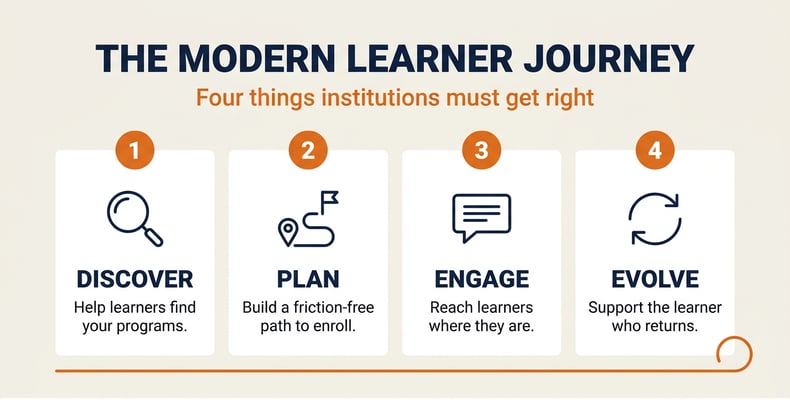
Improving the experience is a matter of design and infrastructure, not slogans. A useful frame is the modern learner journey and what institutions must get right at each stage: Discover, Plan, Engage and Evolve. Each imperative maps to a concrete set of digital priorities.
Discover: Can Learners Find You and Your Programs?
Discovery is where the journey starts, and it is mostly mobile and search-driven. A content platform built for higher ed helps programs surface in search and AI answers, then load fast and read clearly on a phone. Investing in mobile-first design and personalization at the discovery stage means prospects can find the right program and act with confidence.
Plan: Do Your Operations Create a Friction-Free Path?
Behind every smooth experience are academic operations that either help or hinder. Accurate catalogs, clear program sequences and a clean path from interest to application reduce the friction that stalls enrollment. This is also where accessibility lives. Under the Department of Justice's ADA Title II rule, public institutions must bring their sites and apps into WCAG 2.1 Level AA conformance, with new federal accessibility deadlines set for April 2027 and April 2028 based on population served. Designing for accessibility from the start protects both learners and the institution.
Engage: Are You Meeting Learners Where They Are?
Engagement depends on timing and relevance. Personalized digital experiences at scale turn static pages into learner-specific paths, and some institutions have seen personalized homepage blocks lift click-through from under 1% to more than 30%. Communication carries the same weight. Because learners open texts far faster than email, reaching students through text messaging keeps them on track through critical deadlines and reduces the small frictions that cause summer melt.
Evolve: Are You Built for the Learner Who Returns?
The Modern Learner comes back. An experience built only for first-time, degree-seeking students misses the certificates, microcredentials, workforce programs, and professional development courses that bring learners back. Designing for re-engagement, with easy re-enrollment and relevant program suggestions, supports lifelong progression and keeps the relationship alive well beyond graduation.
How Does a Better Digital Experience Drive Engagement and Retention?
The real payoff compounds. Each stage of the journey feeds the next, so work that helps learners discover and engage carries through to persistence and re-enrollment.
That is what separates a website refresh from durable infrastructure. Prospects who find the right program without friction convert at higher rates. Supported students are more likely to persist, and positive experiences bring learners back for the next credential. Texting strategies that support retention show the pattern in practice: institutions protect persistence by reaching at-risk learners in the channels they actually check. That same relationship becomes the groundwork for lifelong engagement. A well-built digital student experience does more than win the first enrollment. It earns the learner who comes back.
Frequently Asked Questions About the Digital Experience
What is the digital student experience in higher education? It covers every online touchpoint between a learner and an institution: the website, catalog, application, payments, portal and text messages. Together they shape how learners move from first discovery to ongoing engagement.
How do you improve the digital experience? Start mobile-first, add personalization driven by learner data, meet WCAG 2.1 Level AA accessibility standards and connect communication across web, email and text so the journey feels seamless.
Why is the digital experience important for retention? Learners who can find answers and receive timely support are more likely to persist. A clear, connected experience reduces the disconnection that drives early departure.
What role does AI play in the digital experience? AI powers personalization and faster support, tailoring content and responses to each learner while freeing staff from routine, repeatable tasks.
Building for the Modern Learner Journey
The institutions winning attention in 2026 treat the digital student experience as living infrastructure for the modern learner journey, not a website project with an end date. Get the mobile, personalization, accessibility and communication layers right, and you support learners at every stage: Discover, Plan, Engage and Evolve.
That is the role of a strategic partner, connecting systems, experiences and data from a learner's first search through lifelong learning. Modern Campus helps institutions support learners across the full journey with solutions built exclusively for higher education. To see how that partnership could work at your institution, request a demo with our team.
Last updated: September 18, 2026