The microcredentials vs certificates conversation is reshaping how institutions design programs, validate skills and serve modern learners.
- Microcredentials are short, skills-based and digitally verifiable, while traditional certificates are longer, broader and often paper-based.
- Stackable credential pathways turn smaller credentials into degrees, opening on-ramps for adult learners and underserved students.
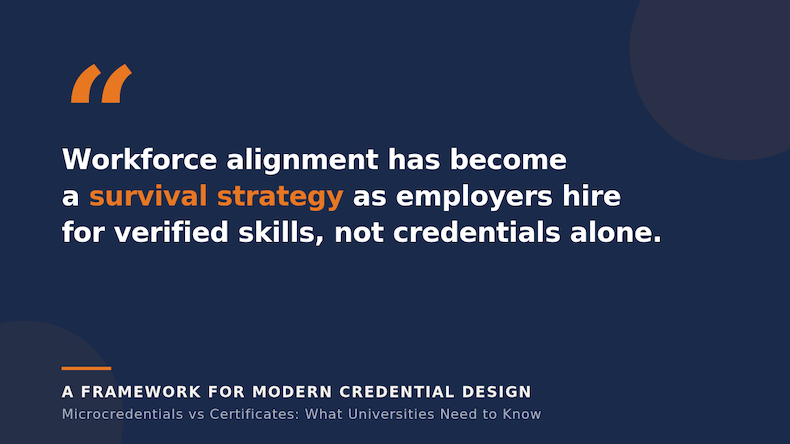
- Workforce alignment has become a survival strategy as employers increasingly hire for verified skills, not credentials alone.
- Institutions that integrate microcredentials into a coherent strategy outperform peers in enrollment competitiveness and learner outcomes.
Universities that treat microcredentials as a strategic layer of their academic portfolio, rather than a side experiment, will be the ones learners and employers choose first.
Higher ed is being asked to do something it has never done at this scale: validate skills as fast as the labor market changes. Learners want shorter, cheaper paths to careers. Employers want proof that a graduate can do the work on day one. And innovative higher ed institutions are answering with a mix of microcredentials, certificates and digital badges that look very different from the four-year transcript most of us grew up with.
The difference between microcredentials and certificates is more than a vocabulary debate. It's a question about how your institution validates learning, how learners present their skills and how programs align with workforce needs. Recent reporting found that 1.8 million credentials are now offered across the country, and digital badges make up more than a million of those offerings. When learners face that many choices, institutional framing has to be crisp. This guide breaks down the differences and overlaps, along with the strategic decisions that provosts, registrars and continuing education leaders need to make.
What Is the Difference Between Microcredentials vs Certificates?
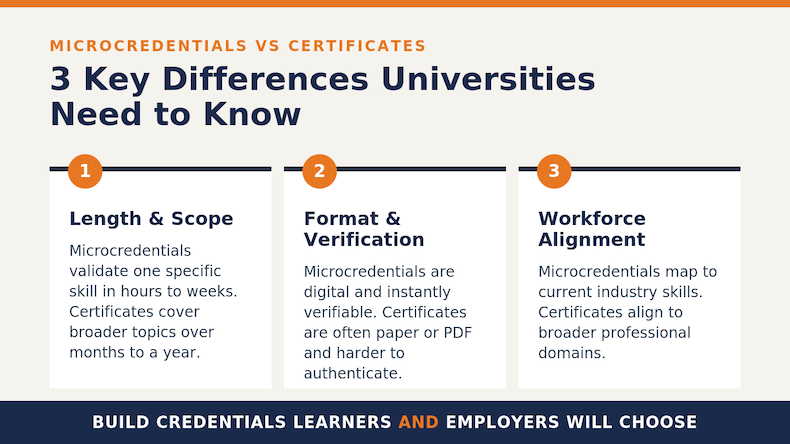
A microcredential validates a specific, narrowly defined skill or competency. It is typically delivered as a short program and issued as a digital, verifiable artifact. A traditional certificate is broader and longer, often spanning several courses across a topic area, and has historically been delivered as a paper award or PDF. Microcredentials are the smallest unit of meaningful learning your institution can certify, while certificates are bundles of related learning that go deeper into a domain. The lines blur because certificates can include microcredentials, and microcredentials can stack into certificates.
How Long Does Each Take to Earn?
Microcredentials typically run from a few hours to a few weeks, focused on one outcome at a time. Certificates usually take several months to a year, depending on credit-bearing status, modality and field. Adult learners and working professionals often can't commit to a year of study without flexible on-ramps. Microcredentials let them get started, prove their progress and continue when life allows.
Are They Credit-Bearing?
Microcredentials can be either. More than half of higher ed leaders already offer microcredentials for academic credit, and 82% plan to do so within the next few years. Traditional certificates are more often credit-bearing, especially when housed inside academic departments, though many continuing education certificates remain non-credit and tied to professional development.
How Are They Delivered and Verified?
Microcredentials are nearly always digital, with rich metadata describing what the learner did, what evidence supports the achievement and who issued it. Certificates have historically been paper or PDF, although that is changing. Many institutions now anchor credential records on a blockchain so that each badge's metadata is hashed and recorded on a distributed ledger. The goal is to make verification fast, secure and portable.
What Do Microcredentials and Certificates Look Like Side-by-Side?
The fastest way to understand microcredentials vs certificates is to put them next to each other. Here is how the two stack up across the dimensions that matter most to institutions and learners.
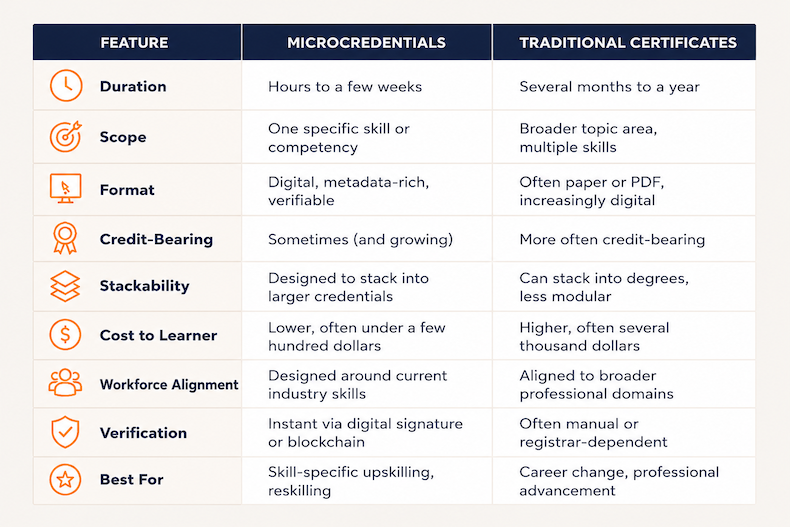
Institutions designing for today's market need to know which tool fits which problem. Both serve real learner needs.
How Do Stackable Credentials Fit Into the Picture?
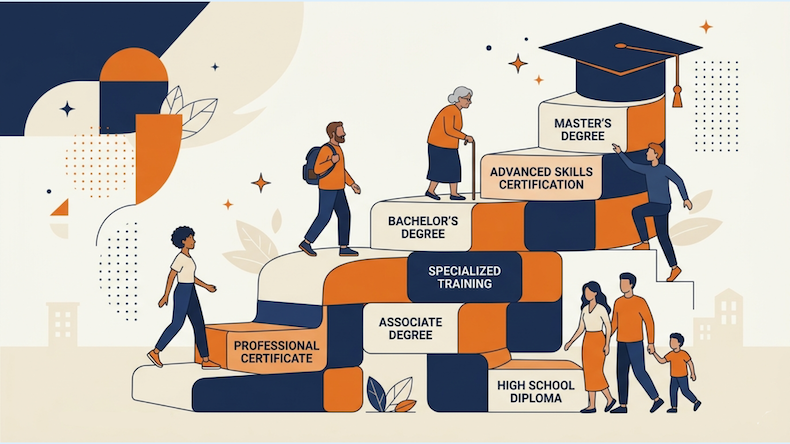
Stackable credentials are the connective tissue between microcredentials, certificates and degrees. A learner earns a small credential, then builds on it with another, until those individual pieces add up to something larger, like a certificate, an associate degree or a bachelor's degree.
Stacking comes in two flavors. Vertical stacking moves a learner from a lower-level credential to a higher-level one. Horizontal stacking adds credentials at the same level, broadening a learner's skill set. Stacking a higher-level credential on a lower-level credential is associated with increased employment rates and earnings, while other types of stacking are not consistently associated with labor market improvements. Building a stackable pathway requires building the right sequence so learners actually move toward better outcomes.
Why Are Stackable Credentials so Attractive to Adult Learners?
Adult learners almost never have the luxury of pausing life to attend full-time school. They need education that fits around work, family, and other life commitments. Stackable credentials create that flexibility by breaking long programs into shorter, achievable milestones. Each milestone produces a credential that the learner can put on a resume immediately, even if they never complete the full degree.
There is also a financial logic at work. Each stackable credential reduces the upfront commitment, which lowers the risk of dropping out with debt and no credential to show for it. For institutions serving non-traditional learners, this is a powerful retention tool because progress becomes visible at every step.
What Does Workforce Alignment Look Like in Practice?
Workforce alignment means designing credentials that map to real jobs and industry needs. The strongest stackable pathways are built in partnership with employers, who help institutions identify which competencies actually move a candidate from interview to offer. Sector-level reporting found that in Ohio, 38% of healthcare certificate programs and 63% of IT certificate programs reported embedding shorter-term credentials into degree programs. The institutions winning here are mapping credentials to specific job roles, validating skills with employer-recognized assessments and using digital badges so learners can present verified competencies directly to hiring managers.
What Are Digital Credentials vs Certificates, and Why Does the Difference Matter?
The digital credentials vs certificates conversation comes down to verification and portability, as well as how much information each can convey. Digital credentials are issued in a verifiable, machine-readable format. They carry rich metadata about what the learner did, who validated it and what evidence backs the claim. Traditional certificates communicate completion but rarely carry the same depth or ease of verification.
The labor market is increasingly valuing demonstrated skills alongside traditional academic achievement. Employers want to see exactly what a candidate can do, beyond where they studied. A verifiable credential contains a signature from the issuer that makes any alteration easily detectable, while a PDF is essentially a picture of a credential that can be easily copied. This security gap is why digital credentials are becoming the default for any institution serious about workforce readiness.

How Do Open Standards Shape Digital Credentials?
Open standards make digital credentials portable. 1EdTech released the Open Badges 3.0 standard in May 2024, improving security and learner ownership. When your institution issues credentials on open standards, learners can carry them across platforms, share them with employers and combine them with credentials from other issuers without losing fidelity. A comprehensive learner record (CLR) takes this further by bundling credentials, courses and competencies into one verifiable document that travels with the learner.
Why Are Employers Paying Attention to Microcredentials?
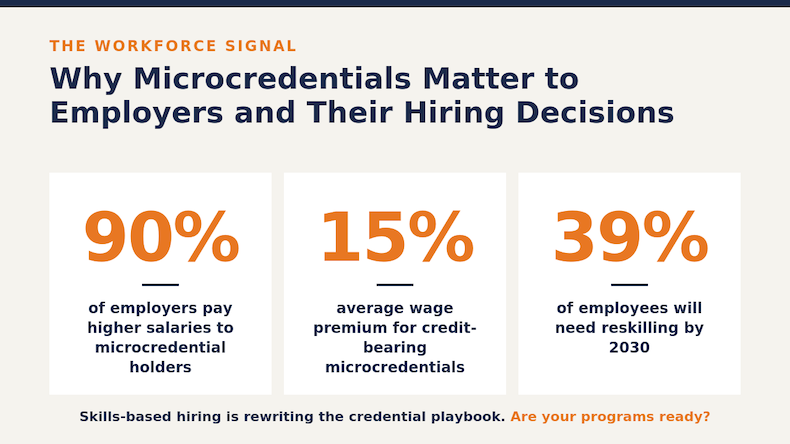
Employers are paying attention because the skills they need now don't always match what traditional degrees produce. A recent analysis projected that 39% of all employees will need reskilling by 2030 due to the rapid integration of AI and automation into the workforce. Employers know they can't wait for four-year programs to catch up. Microcredentials and stackable certificates give employers a faster signal of skill validity, plus a way to directly invest in upskilling their existing employees.
Are Employers Willing to Pay More for Microcredential Holders?
Yes, and the data has become hard to ignore. According to recent research, 90% of employers are willing to offer higher starting salaries to candidates with microcredentials, with most offering up to 15% more for credit-bearing versus non-credit credentials. For institutions, that data point is a clear signal to design credentials with credit-bearing pathways and industry partnerships baked in, so graduates can capture the wage premium that employers are already willing to pay.
How Should Universities Build a Credential Strategy?
Building a coherent credential strategy is a leadership challenge as much as a curriculum exercise. The institutions leading the way are aligning microcredentials, certificates and degrees under a single framework so learners can move between them without friction. Without that alignment, institutions risk creating a sprawl of disconnected programs that confuse learners and dilute the brand.
Start with three questions:
- What workforce outcomes do you want each credential to produce?
- What is the relationship between your microcredentials, certificates and degrees?
- How will learners know what to take next?
Answering these questions forces clarity that downstream operations depend on, from catalog management to enrollment to student success.
Which Infrastructure Decisions Matter Most?
A few infrastructure decisions make or break credential strategies. They are often invisible from the marketing brochure, but learners feel them every day.
- Catalog and curriculum systems that can manage credit-bearing and non-credit programs side by side. Without this, microcredentials end up living in a parallel universe disconnected from academic offerings.
- Student information systems built for the messy reality of non-traditional learners. Adult students often enroll in multiple programs at once, attend part-time or move between credit and non-credit programs.
- Digital credentialing tools aligned to open standards. Issuing badges on closed platforms locks learners into your ecosystem and limits the value of the credential.
How Do Continuing Education Divisions Fit in?
Continuing education divisions have been doing this work for decades. They built the muscle for short-form, workforce-aligned programming long before microcredentials were trendy. The institutions making the most of microcredentials are treating their continuing education divisions as strategic partners, not standalone units.
5 Practical Steps to Launch Stackable Microcredentials
If your institution is ready to move beyond pilots, here is a practical sequence that consistently shows up in successful credential strategies.
- Audit existing programs for microcredential potential. Many institutions already have content that could be unbundled into stackable units. Start there before building from scratch.
- Partner with employers from day one. Build credentials in conversation with hiring managers, not in isolation. This step is what turns a credential into a job signal.
- Choose a digital credentialing platform aligned to open standards. Open Badges 3.0 and Comprehensive Learner Record compatibility should be non-negotiable.
- Build clear, stackable pathways. Show learners how each microcredential connects to certificates and degrees. If they can't see the path, they won't take it.
- Measure outcomes that matter. Track enrollment, completion, employer adoption and wage outcomes. Use that data to refine pathways and prove value.
Without a strategic frame, a microcredential program becomes a pile of disconnected courses that confuse learners, frustrate faculty and produce no measurable workforce impact. The second risk is misalignment with workforce needs. A microcredential that doesn't map to real jobs won't earn the wage premium employers are willing to pay. The third risk is poor verification. If your credentials can't be quickly authenticated, they won't travel well, and learners will look elsewhere.
Frequently Asked Questions
What is the difference between a certificate vs credential? A credential is the umbrella term for any formal recognition of learning, including degrees, certificates, microcredentials and badges. A certificate is one specific type of credential, typically broader than a microcredential and often delivered through a multi-course program. Understanding the certificate vs credential distinction is fundamental to designing programs that learners and employers can navigate.
Are microcredentials respected by employers? Yes, and adoption is climbing. Employers value microcredentials most when they are issued by a recognized institution, aligned to specific workforce skills and presented in a verifiable digital format that hiring managers can quickly authenticate.
Can microcredentials count toward a degree? In many cases, yes. Credit-bearing microcredentials can stack toward certificates, associate degrees and bachelor's degrees, depending on how the institution has designed the pathway. Non-credit microcredentials typically do not, though some institutions offer prior learning assessments that allow learners to convert non-credit work into credit.
What makes a microcredential digital? A digital microcredential is issued in a verifiable, machine-readable format with embedded metadata describing the learner, the issuer, the criteria met and supporting evidence. Standards like Open Badges 3.0 ensure these credentials are portable across platforms and resistant to tampering.
How do stackable credentials support adult learners? Stackable credentials let adult learners earn meaningful awards in shorter intervals, fitting around work and family commitments. Each credential creates an exit point with real value, so learners can take a job, return to study later and keep building toward larger credentials at their own pace.
Offer Your Students a Career Pathway
The microcredentials vs certificates conversation is about designing a coherent portfolio that serves modern learners while aligning with employer demand, giving institutions a competitive edge. Universities that build clear pathways across microcredentials, certificates and degrees will be the ones learners trust and employers seek out.
Modern Campus helps institutions bring those credential strategies to life through purpose-built solutions for catalog management, curriculum workflows and non-traditional student management. To see how Modern Campus Lifelong Learning, Connected Curriculum and CMS can power your credential strategy, book a demo with our team today.
Last updated: July 6, 2026
.png)