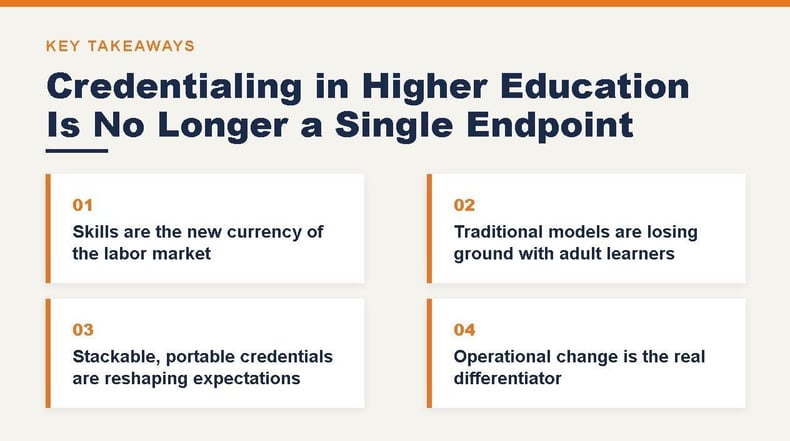
Credentialing in higher education is no longer a single endpoint. It's an ongoing relationship between institutions and learners across their working lives.
- Demonstrated skills are playing a larger role in hiring decisions. 39% of workers' core skills will change by 2030, and 70% of employers now use skills-based hiring for entry-level roles.
- Traditional models are losing ground with the learners institutions need most. Roughly 38 million working-age Americans hold some college credit but no credential, and the majority of adults considering enrollment prefer non-degree options.
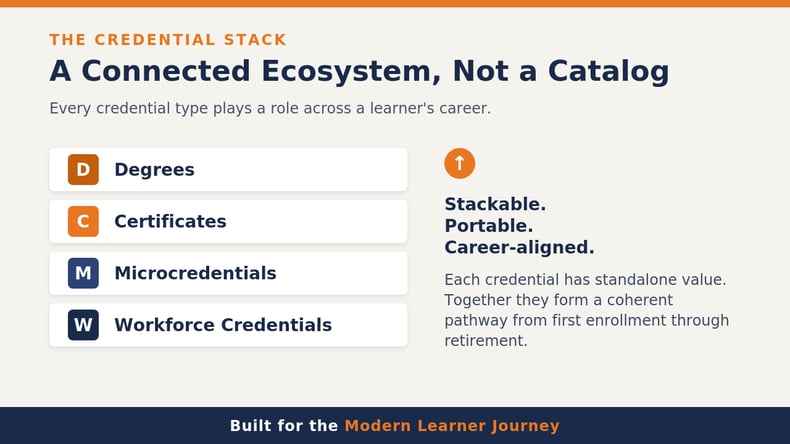
- Stackable, portable credentials are reshaping student expectations. Learners want degrees, certificates, microcredentials and workforce credentials to connect, not compete.
- Operational change is the differentiator. Institutions that integrate credential management into their core systems while supporting personalized pathways are best positioned to lead.
The institutions that treat credentialing as a connected ecosystem, rather than a checklist of disconnected programs, will define the next era of higher ed.
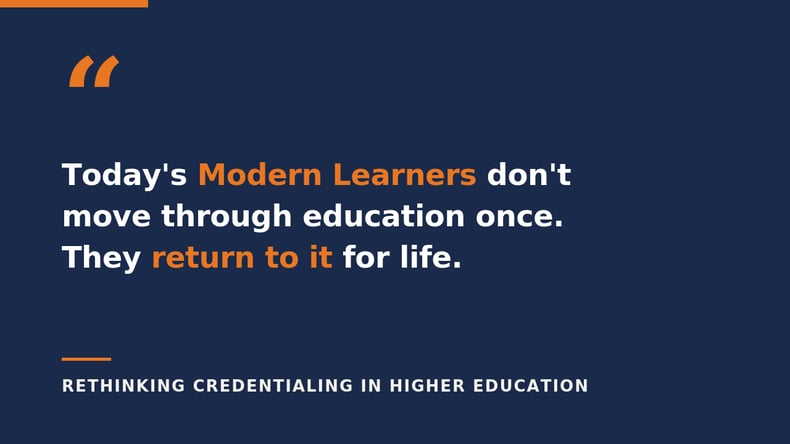
Today's learners no longer move through education in a straight line. The Modern Learner starts, stops, returns, switches careers and adds new skills throughout their working life, moving in and out of education as goals evolve. Yet most colleges and universities still treat credentialing in higher education as a one-time outcome.
That gap between learner reality and institutional design is where opportunity lives. Modern Learners see themselves as the architects of their own educational experience. They want flexibility and portability, along with proof that what they learn will translate into career outcomes. The institutions choosing to redesign the modern student experience are already pulling ahead of those still anchored to the traditional model.
Employers expect 39% of workers' core skills to be transformed or outdated between now and 2030. If the global workforce were represented as 100 people, 59 of them would need training before the decade ends. That kind of disruption can't be addressed by four-year degrees alone.
What Does Credentialing in Higher Education Mean Today?
The word "credential" used to be shorthand for a degree. That's no longer the case.
Credentialing in higher education now spans an entire family of recognitions: associate, bachelor's and master's degrees, professional certificates, industry certifications, microcredentials, digital badges and workforce credentials tied to specific occupations. Each carries different time commitments and costs. They also communicate something different to the labor market. Together, they shape a learner's long-term trajectory.
Accreditors are reinforcing this shift. In October 2025, the Higher Learning Commission and the New England Commission of Higher Education each launched new endorsement processes for short-term and noncredit credential providers. The formal infrastructure for non-degree credential strategy is being built in real time.
What Is the Difference Between Traditional and Skills-Based Credentials?
Traditional credentials, such as degrees, signal that a learner has completed a comprehensive course of study tied to a discipline. They remain essential, especially in fields that require deep theoretical grounding.
Skills-based credentials, by contrast, certify that a learner has demonstrated specific competencies. They are typically faster and tied more directly to a job task or industry need. Both have a place. The institutions that thrive will offer both and connect them coherently.
Why Are Traditional Credential Models No Longer Enough?
Three forces are pushing the traditional model past its limits.
The learner population has changed. Adult learners are no longer a niche population. Nearly 38 million Americans of working age hold some college credit but no credential, and the population continues to grow. These learners are often balancing work and family commitments, and return to school after years away. They are the mainstream of the modern enrollment pipeline rather than an edge case institutions can afford to overlook.
The labor market is moving faster than degree cycles. Skills change faster than institutions can revise four-year programs. According to NACE's Job Outlook 2026 survey, 70% of employers now use skills-based hiring for entry-level roles, up from 65% the year before. Seven out of 10 say they use the approach at least half the time.
Public expectations have shifted. Learners increasingly view credentials through a return-on-investment lens. They want to see how a program connects to wages, as well as career mobility and growth. Enrollment in shorter, career-focused credentials continues to outpace bachelor’s degree enrollment, creating new competitive pressure for institutions that only offer traditional degree pathways.
The traditional model isn't broken. It's incomplete.
How Does Credentialing Support Lifelong Learning?
A modern credentialing strategy treats education as a continuous learner journey rather than a four-year transaction. This is the foundation of the 60-year curriculum model, where learners will return to institutions repeatedly for new skills and opportunities throughout their careers.
Lifelong learning programs depend on a few interlocking ideas. The institutions running the most effective lifelong learning programs treat them as a connected system rather than a collection of one-off offerings.
How Do Stackable Credentials Build Career Pathways?
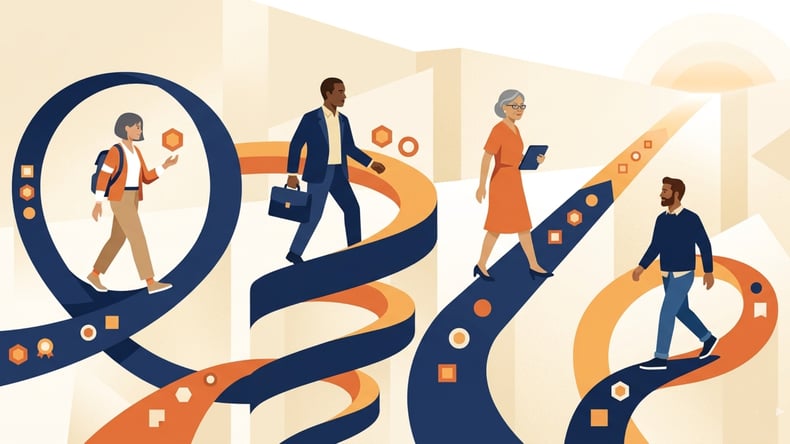
Stackable credentials allow learners to combine smaller credentials into larger ones over time. For example, a learner can earn a microcredential in data analytics, stack it with a workforce credential in project management, then apply both toward a bachelor's degree in business. Each step has standalone value. Together, they form a coherent career path.
State systems are already organizing around this idea. The Lumina Foundation highlights credential stackability as a central priority for states designing short-term workforce credential programs, with the goal of connecting credentials so learners build genuine career pathways rather than collecting disconnected certificates.
Why Do Digital Credentials Make Achievement Portable?
Digital credentials carry rich metadata about what a learner can actually do. Open Badges 3.0 and Comprehensive Learner Records package skills, context and verification into a format both humans and machines can read. That portability matters because the average career spans multiple employers and industries. Static paper transcripts can't keep up.
How Do Workforce Credentials Tie Learning to Outcomes?
Workforce credentials connect institutional offerings directly to industry demand. They answer the question learners are asking with increasing urgency: Will this credential help me get a better job?
The federal landscape is reinforcing this shift. As of July 1, 2026, the new Workforce Pell Grant program is extending Pell eligibility to high-quality short-term programs as brief as eight weeks. For institutions, this program is reshaping how short-term credentials are positioned and supported.
What Operational Changes Do Institutions Need to Make?
Strategic intent only matters if the operational backbone can support it. A credentialing strategy that adds programs without rethinking the systems behind them tends to stall. Here are the operational shifts that separate institutions making real progress from those still planning.

How Should Institutions Modernize Credential Management?
When curriculum and catalog processes operate in silos, stackability becomes nearly impossible. Modern credential management requires a centralized way to define, approve, publish and track every credential offered, whether it’s a degree, certificate, microcredential or workforce credential.
Institutions that have streamlined catalog and curriculum management have seen production time drop, freeing staff to focus on program innovation instead of paperwork. The faster a credential can move from concept to launch, the faster it can respond to industry demand.
How Can Institutions Build Stackable Pathways Across Programs?
Stackability is an operational problem as much as an academic one. To make it real, institutions need:
- A clear mapping of how credit-bearing and non-credit credentials relate to one another, so learners know exactly what stacks into what.
- Articulation policies that allow microcredentials and certificates to count toward larger qualifications.
- A single system of record that can track a learner's credentials across credential types.
When these pieces are in place, learners can see the full ladder of credentials available to them and choose the rung that fits their current life and career stage.
What Role Does Digital Infrastructure Play in Credentialing?
Digital infrastructure is where credential strategy meets technology strategy. A credential is only as valuable as the systems that issue, verify and connect it to the next step in a learner's journey. Institutions need infrastructure that supports:
- Digital credential issuance with verifiable metadata
- Integration between continuing education systems and the institution’s core platforms
- Personalized learner experiences that surface relevant programs based on past activity and career goals
These capabilities are how institutions deliver the flexible, learner-centered experience that students expect.
Five Operational Priorities for Credentialing in Higher Education
For institutions ready to move from intention to action, here are five priorities worth focusing on in the next planning cycle.
- Start with the current credential portfolio. Map every degree, certificate, microcredential and workforce credential the institution offers. Identify opportunities to improve stackability.
- Centralize credential management. Bring academic data into a single system so that the entire content lifecycle happens in one place.
- Define explicit stackable pathways. Document how credentials connect, then make those pathways visible to learners on the website and inside enrollment systems.
- Invest in digital credential infrastructure. Move beyond paper transcripts toward verifiable and portable records aligned with current open standards.
- Align programs with workforce demand. Build employer partnerships and use labor market data to shape new credentials, particularly short-term programs that may qualify for Workforce Pell funding.
These priorities are parallel investments that compound when executed together.
How Does Skills-Based Education Change the Institution's Role?
Skills-based education does not replace traditional higher education. It expands what institutions are responsible for. Colleges and universities are no longer just degree-granting bodies. They are partners in a learner's full career arc, from first-time enrollment through retirement.
This expanded role means institutions must:
- Communicate the value of every credential they offer in clear, career-focused language.
- Provide on-ramps and off-ramps that let learners enter and exit programs without losing progress.
- Build credentials that send strong signals to both learners and employers about specific skills and competencies.
Coordinating these efforts requires alignment across academic units, registrar functions, marketing, continuing education and technology teams. The institutions that orchestrate this coordination well are building credentialing strategies that will last.
Frequently Asked Questions
What are the most common types of credentials in higher education today? Common credentials include traditional degrees (associate, bachelor's, master's, doctoral), certificates, professional certifications, microcredentials, digital badges and workforce credentials tied to specific industry occupations. The boundaries between them are increasingly fluid, with many institutions building stackable pathways that connect them.
How does skills-based education differ from traditional degree programs? Skills-based education focuses on demonstrating specific competencies tied to job tasks, while traditional degree programs emphasize broader disciplinary mastery. Skills-based credentials tend to be shorter and more directly tied to immediate labor market needs. Both serve important functions in a complete credentialing strategy.
Why are stackable credentials becoming so important? Stackable credentials let learners accumulate value over time, combining smaller credentials into larger ones at their own pace. This model fits the reality that most adults cannot pause their lives to complete a four-year program but can complete shorter credentials that build toward a degree.
What is driving the shift toward digital credentials? Digital credentials are portable and verifiable. They are also rich with metadata about what a learner has demonstrated. As skills-based hiring expands and learners move between employers more frequently, digital credentials give both students and employers a faster, more reliable way to validate skills.
Where Credentialing Goes from Here
Credentialing in higher education is in the middle of its biggest strategic reset in decades. Degrees still matter. Certificates still matter. Microcredentials, digital credentials and workforce credentials matter alongside them, not instead of them. The institutions that recognize credentialing as one continuous ecosystem rather than a disconnected catalog of programs will be the ones Modern Learners trust across their working lives. This is where the modern learner journey becomes a lifelong relationship between learners and institutions, built on ongoing learning and re-engagement.
Supporting that journey depends on the right operational foundation and the right strategic partner. Modern Campus helps institutions connect the infrastructure that supports learners from discovery through lifelong learning, so every credential a learner earns builds toward what comes next. To see how a unified credentialing strategy can take shape at your institution, book a personalized demo today.
Last updated: July 16, 2026