Digital credentials in higher education are reshaping how institutions issue, share and verify proof of learning across a learner's lifetime.
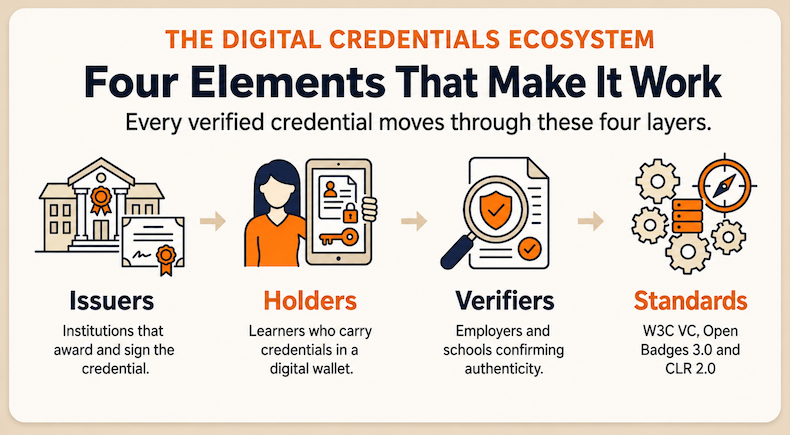
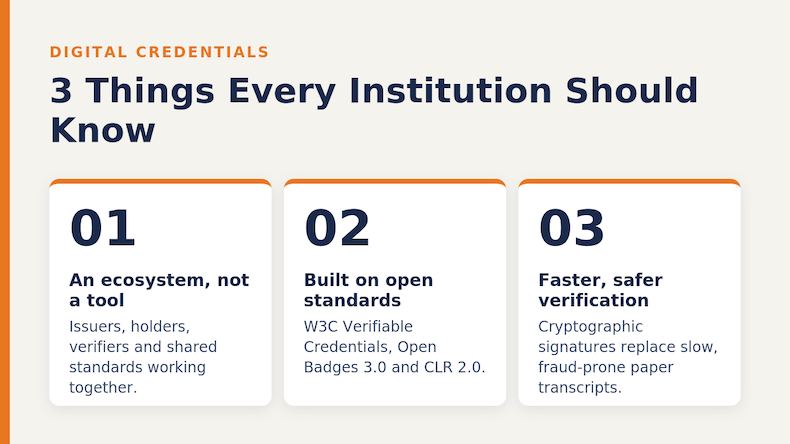
- The ecosystem includes issuers (institutions), holders (learners), verifiers (employers and other schools) and the technology standards that connect them.
- The benefits are concrete: faster verification, fraud prevention, lifelong portability and stronger workforce alignment for lifelong learners.
- Verification methods now rely on cryptographically signed Verifiable Credentials, Open Badges 3.0 and the Comprehensive Learner Record Standard 2.0.
- Institutions that adopt early position themselves as workforce-relevant partners in an era of skills-based hiring.
Institutions that still treat credentialing as a transcript-issuing function rather than a learner experience are missing where higher ed is heading.
The way you prove what you know is changing, and so is the way institutions issue that proof. Traditional paper certificates, while still valuable, face growing challenges: risk of fraud, difficulty in verification across borders and limitations in capturing the wide range of skills learners now acquire. Digital credentials in higher education are making validation easier for students and employers. They're becoming central to how many colleges and universities are rethinking how they recognize learning at every stage.
A digital credential is a secure, machine-readable record of an academic or skill-based achievement. It can represent a range of credentials, including a full degree, a certificate, a badge for a single competency or a record of cumulative learning over years. Credentials are increasingly issued in digital formats, as opposed to paper versions.
This shift has implications for what gets recognized, who recognizes it and how quickly that recognition can travel from a classroom to an employer.
What Is the Ecosystem of Digital Credentials in Higher Education?
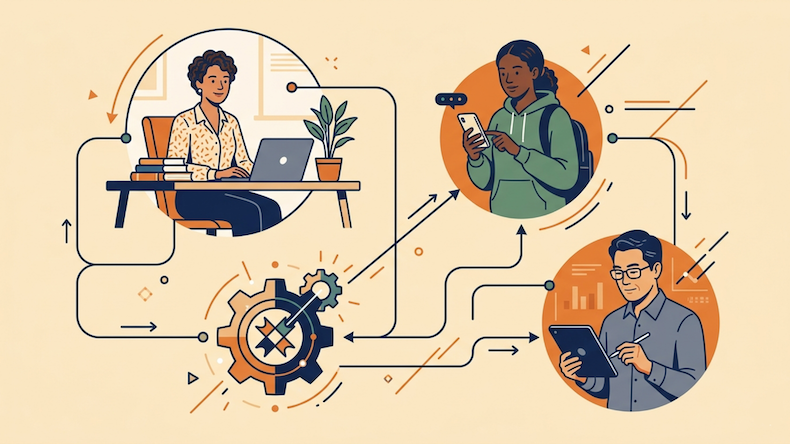
The digital credentials ecosystem is the network of people, institutions and technologies that support the creation and verification of learning records online. Four elements make the ecosystem function: issuers, holders, verifiers, and technology standards.
Who Are the Issuers?
Issuers are the institutions, departments or organizations awarding the credential. In higher ed, that typically means a college, university, continuing education division or workforce development program. Each issuer is responsible for the assessment behind the credential and for cryptographically signing the record so that it can be trusted later. The issuer's signature is what tells a future verifier that the credential is real.
Who Holds the Credential?
Holders are the learners themselves. With a digital credentials platform, the learner controls their own records through a digital wallet, much like storing a boarding pass or driver's license on a phone. They decide who sees what, when and for how long. Blockchain has the potential to reshape the higher ed ecosystem by giving learners greater control over their credentials, providing employers with instant and tamper-proof verification and assisting universities in safeguarding academic trust.
Who Verifies the Credential?
Verifiers are anyone the learner shares the credential with. It could include an employer reviewing a job application, a graduate program evaluating an applicant or another institution considering a transfer. Because the credential carries the issuer's digital signature, verifiers can confirm authenticity instantly without picking up a phone or emailing a registrar's office.
What Technology Standards Connect Them?
The ecosystem only works if everyone agrees on shared formats. Three standards do most of the work today: W3C Verifiable Credentials, Open Badges 3.0 and the Comprehensive Learner Record Standard 2.0. The Comprehensive Learner Record Standard has been designed to create, transmit and render an individual's set of achievements, as issued by multiple learning providers, in a machine-readable format that can be curated into verifiable digital records of achievement. These standards let credentials issued by one institution travel cleanly into a wallet, a Learning Management System, (LMS) or an employer's hiring platform.
What Are the Benefits of Digital Credentials for Institutions and Learners?
Institutions that adopt digital credentials see measurable returns in efficiency and security, as well as learner satisfaction. Here are the benefits driving adoption.
How Do Digital Credentials Improve Verification Speed and Reduce Fraud?
Manual transcript verification has always been slow, expensive and easy to game. Blockchain can reduce credential verification times from weeks to seconds, while cutting costs by nearly 90% and drastically reducing fraudulent claims. When a credential is cryptographically signed, an employer or graduate program doesn't need to call the registrar or wait days for a paper transcript. They scan, verify and move on.
As fake degrees become easier to manufacture and résumé inflation proliferates, verifiable credentials provide a tamper-proof alternative that can't be edited after being issued.
How Do They Support Adult and Lifelong Learners?
Modern learners don't move in straight lines. They might stack a certificate on top of a degree, return for a workforce program five years later and add a microcredential the year after that. Microcredentials open up possibilities for just-in-time, highly personalized learning, which is exactly what both students and employers need to meet fast-evolving workforce demands.
Digital credentials make these journeys legible. Each completion produces a discrete, portable record that can be combined with others over time. For institutions trying to engage lifelong learners returning for short programs, this type of credential infrastructure is foundational, treating verifiable credentials as the building blocks of a lifelong learning record.
How Do They Drive Enrollment and Workforce Relevance?
Credentials matter because employers value them, and employers are explicit about what they want. According to the World Economic Forum’s Future of Jobs Report, almost six in ten members of the global workforce will require training before 2030. Institutions that issue verifiable, skills-aligned credentials are positioned to fill that gap. According to a report from the Lumina Foundation, 96% of employers say microcredentials strengthen a candidate's application, 85% are more likely to hire candidates who hold them, and nine in ten are willing to offer higher starting salaries for relevant microcredentials.
A few additional benefits worth flagging:
- Lower administrative cost. Automated issuance and verification reduce registrar workload and the cost of producing paper transcripts.
- Stronger learner ownership. Learners carry their records for life, no matter where they study or work next.
- Better data on outcomes. Institutions can see which credentials translate into employment and use that to refine programs.
How Are Digital Credentials Verified in Higher Ed?
Verification is the function that makes the entire system trustworthy. Without it, a digital credential is just a PDF with extra steps. Three verification methods dominate higher ed today, and most institutions use a combination of them.
What Are Verifiable Credentials, and How Do They Work?
A Verifiable Credential, or VC, is a digital record built on a W3C standard that is cryptographically signed by the issuer. A VC is secure (tamper-resistant) and immediately machine-verifiable. When a verifier receives one, software checks the signature against the issuer's public key. If anything has been altered, the signature breaks and the verification fails.
This process is the foundation of validating most modern academic credentials online. It's also why VCs are spreading beyond education into healthcare, identity and travel documents.
How Do Open Badges and Comprehensive Learner Records Fit In?
Open Badges 3.0 and the Comprehensive Learner Record (CLR) Standard 2.0 build on the W3C VC standard. They define how educational achievements should be packaged, including the metadata about the issuer, the learner, the assessment criteria and the evidence behind the achievement. AACRAO has played a central role in advancing the CLR standard.
The practical effect is interoperability. A badge issued by your continuing education division can be read by another institution's LMS, an employer's HR system or a learner's wallet without translation.
How Does Blockchain Verification Work in Practice?
Some institutions take verification a step further by anchoring credentials to a blockchain. The credential itself is not stored on the chain. Instead, only a cryptographic hash is recorded there, creating a permanent reference point that proves the credential existed at a specific moment. If anyone later changes the credential, the hashes won't match and the tampering is exposed.
Not every institution needs blockchain to issue digital credentials. The W3C VC standard does not require it. But for institutions issuing high-value credentials that need to be verified decades later, blockchain anchoring adds a layer of permanence.
What Should Institutions Consider Before Launching a Digital Credentials Program?
A credentialing program touches the registrar's office, continuing education, IT, marketing, faculty governance and student services. Here are five practical considerations to work through before issuing a single badge.
- Map credentials to existing programs. Start with what you already award, and identify which records are best suited for digital issuance, including degrees, certificates and microcredentials.
- Choose a standards-aligned digital credentials platform. Adopt technology that supports W3C Verifiable Credentials, Open Badges 3.0 and the CLR Standard 2.0 to ensure portability of academic credentials online from day one.
- Define quality and assessment criteria. Each credential should represent a clear, measurable achievement with documented evidence behind it.
- Plan for learner ownership. Provide a wallet experience or partner with a trusted wallet provider so learners can carry their credentials forward.
- Engage employers early. Co-design credentials with the workforce partners who will hire your graduates so that the records signal what employers actually need.

Institutions that skip these steps end up with badges no one trusts and a registrar's office that quietly resists the rollout. Credentialing is a strategic part of the learner-to-earner lifecycle rather than a side project.
Frequently Asked Questions About Digital Credentials in Higher Education
Are digital credentials the same as microcredentials? No. Microcredentials are a type of learning achievement, typically representing a specific skill or short program. Digital credentials are the format used to issue and verify any kind of achievement, including degrees, certificates and microcredentials. A microcredential is the type of achievement being earned. A digital credential is how it is recorded and shared.
How do learners share digital credentials with employers? Learners typically share credentials through a digital wallet, a verification link or a downloadable file containing the cryptographic signature. The employer then runs the credential through a verifier tool, which checks the issuer's signature in seconds.
Do digital credentials replace traditional transcripts? Not yet, but they increasingly complement them. Many institutions still issue official transcripts while adding digital credentials for individual achievements, microcredentials and competencies. Over time, comprehensive learner records may absorb much of what transcripts do today.
What standards should institutions look for in a digital credentials platform? Look for support of W3C Verifiable Credentials, Open Badges 3.0 and the Comprehensive Learner Record Standard 2.0. Platforms aligned to these open standards ensure your credentials remain portable and verifiable as the ecosystem evolves.
How secure are digital credentials compared to paper records? When implemented correctly, they are significantly more secure. Many universities use a hybrid blockchain setup. This combines public blockchains like Ethereum (for transparency) and private ones like Hyperledger (for privacy). Combined with cryptographic signatures, tampering is far more difficult than altering a paper diploma.
Building a Future-Ready Credentialing Strategy
Digital credentials in higher education are no longer a fringe topic for the registrar's office. They are central to how institutions will attract adult learners, validate skills, partner with employers and remain relevant in a workforce hungry for verifiable proof of learning. The institutions investing in digital credentials today are laying the foundation for how learning will be recognized and verified in the years ahead.
Modern Campus helps colleges and universities deliver the modern student experience that lifelong learners expect, from continuing education and curriculum management to credential-aligned program design. To see how the platform supports your credentialing strategy, book a personalized demo today.
Last updated: June 8, 2026
.png)