.png)
Some institutions still treat continuing education as a series of one-off enrollments, but the operating model that worked a decade ago is increasingly misaligned with the needs of modern adult learners.
- Continuing education (CE) management software is the operational backbone for non-credit, non-degree and workforce programs, handling everything from registration and payments to credentialing and learner records.
- Adult learners expect a lifecycle relationship, not a transaction. They return for reskilling across decades, and legacy systems weren't built for that pattern.
- Operational friction can limit enrollment. Manual workflows, fragmented data and siloed catalogs cost staff hundreds of hours and undermine program growth.
- The institutions winning right now treat continuing education software as infrastructure for continuous learning, rather than a glorified shopping cart bolted onto a traditional SIS.
If your platform was designed around the old enrollment funnel, you're running a lifecycle business on transactional plumbing. That gap creates an opportunity for a rethink.
Continuing education management software has become one of the most important pieces of operational infrastructure at colleges and universities, and institutions are realizing their current setup wasn't built for what's being asked of it. Adult learners are arriving in higher numbers and returning more often. They expect the kind of digital experience they get from any other service in their lives. Meanwhile, continuing education and workforce divisions are absorbing pressure that traditional academic systems were never designed to handle.
Global labor data shows that 39% of workers' core skill sets are expected to be transformed or become outdated by 2030. The modern learner moves in and out of education throughout their life, returning whenever a new role or industry shift demands it. Continuing education is no longer a niche operation. It's the infrastructure that supports a continuous learner journey.
What Is Continuing Education Management Software?
Continuing education management software is the purpose-built system institutions use to manage workforce development and other non-degree learning programs. It handles the operational reality of adult learners, including flexible registration cycles, varied pricing, employer billing, credit tracking, certificate issuance and the messy data that comes from learners who don't follow a standard four-year path.
The category goes by a few different names. Some call it a CE software for universities. Others use the term continuing education platform, adult learning platforms or workforce training software. These systems exist because the traditional student information system (SIS) can't do this job.
Why a Traditional SIS Is Not Enough
A traditional SIS is engineered around academic terms, credit hours and a linear degree progression. That's a fine model for an 18-year-old freshman declaring a major. It’s less effective for a 42-year-old project manager registering for a four-week certificate, who is paying with a corporate card and expecting an automated CE credit report when they finish.
When institutions try to bend a traditional SIS into a continuing education tool, three things tend to break:.
- Course catalogs become impossible to update at the pace adult learners expect.
- Payment workflows can't handle the variety of pricing, discounts and employer arrangements required.
- Reporting collapses because the system can't distinguish a non-credit certificate completion from a credit-bearing course outcome.
What a Continuing Education Platform Manages
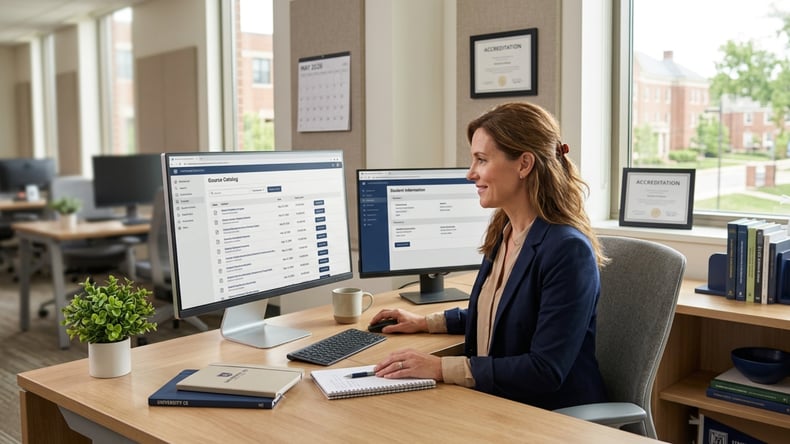
A CE platform sits at the intersection of marketing, operations and student data to support learners at every stage of their journey. That means helping prospective learners discover the right programs through clear, searchable catalogs and digital experiences. It means letting a team plan and launch new offerings without the operational drag that comes from disconnected systems. It means giving institutions the tools to engage learners with timely, personalized communication from first touch through completion. And it means supporting them as they evolve and return for new credentials, new skills and new chapters of their careers.
The features that matter most include:
- Flexible course and program management for everything from one-day workshops to multi-term certificates
- Automated registration and payment processing across individual learners and corporate accounts
- Integration with existing SIS, ERP and CRM platforms
- Reporting that lets leadership see what's working
Without those pieces, CE units are running on spreadsheets and willpower.
Why Are Institutions Rethinking Continuing Education Software?
Continuing education used to be a nice supplement. It is now a strategic priority, and the operational gaps that were tolerable five years ago are now blocking growth.
Demand Has Exploded
Final fall 2025 enrollment data show that undergraduate certificate programs continue to grow faster than bachelor's programs (1.9% versus 0.9%), with certificate enrollment at community colleges now 28.3% higher than it was in fall 2021. An increasing number of learners favor shorter, career-aligned, stackable credentials over another four-year commitment.
The labor market is amplifying the pressure. If the world's workforce were made up of 100 people, 59 would need training by 2030 to keep pace with shifting skill demands. Every one of those people is a potential learner for an institution that can deliver timely, relevant programming.
Supply Is Stretched Thin
Inside continuing education divisions, leaders are doing more with less. Recent industry research on professional and continuing education units found that only 37% said they had the appropriate amount of staff to execute their goals. This capacity gap is where good software earns its keep.
When a team is short-staffed, every hour spent on manual data entry, reconciling registration spreadsheets or building one-off reports is an hour not spent on program design or learner support. Multiply that across a year, and it’s easy to see why operational friction shows up as flat enrollment growth.
Workforce Pell Is Putting a Clock on the Decision
There is also a regulatory deadline accelerating the conversation. Workforce Pell extends grant eligibility to short-term training programs of 150 to 599 clock hours that take 8 to 15 weeks to complete, with the grant program set to begin in July 2026. Institutions that can quickly stand up eligible short-term programs, credibly track outcomes and meet the compliance requirements will capture the new funding stream. Those that try to make this work in legacy systems will spend the first year just figuring out the workflow.
What Does Operational Friction Look Like in Practice?
Operational friction is one of those terms that gets used a lot and explained almost never. In a continuing education context, it has very specific symptoms that appear in three places.
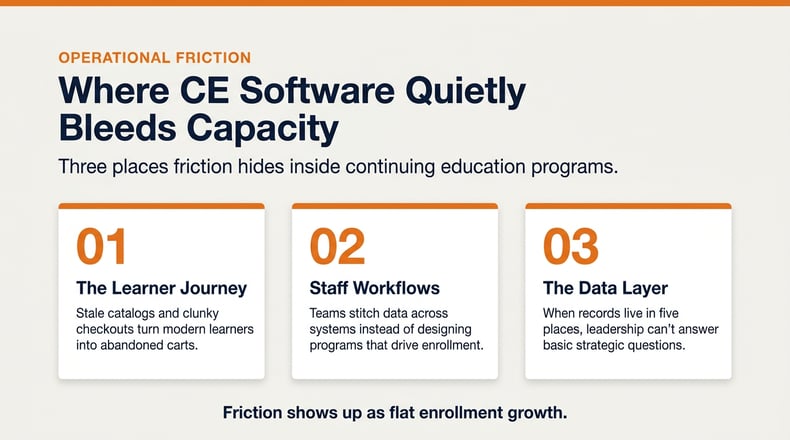
Where Friction Hides in the Learner Journey
The first place is the front door. A prospective learner finds a continuing education page through a search engine, then hits a wall. Here are some barriers they might find:
- A course catalog hasn't been updated this term,
- A registration form asks for information no adult learner should have to provide,
- A checkout doesn't accept the payment method their employer uses,
- A confirmation email arrives 36 hours later.
Every one of those is a leaky moment, and they compound.
Where Friction Hides in Staff Workflows
The second place is the back office. Often, course schedules are built in one system, marketed on another, and registration is managed through a third. Reconciling those takes a person or several people, and they spend their week stitching together data instead of designing programs. Every refund, transfer and exception becomes a small project. By the time a report makes it to a dean, the data is two weeks old and not entirely trustworthy.
Where Friction Hides in the Data
The third place is the least visible and the most damaging. When data lives in five places and matches in none of them, leaders can't answer basic questions. Which programs are growing? Which are losing money? Where do learners stop coming back? Only 39% of professional and continuing education units agree that it is easy to access real-time enrollment data. The right software is designed to solve this problem.
How Has the Definition of "Enrollment" Changed?
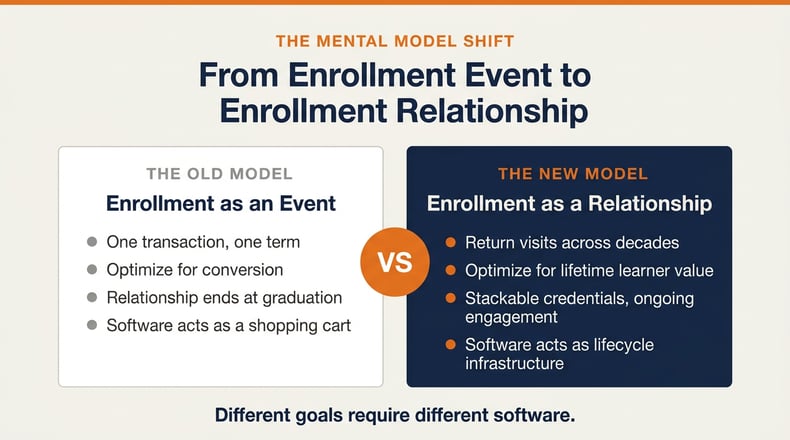
For a long time, enrollment was treated as an event. A learner signed up and paid. Once the term ended, the relationship ended. Continuing education software built in that era reflected that mental model. It was a registration tool with a few extras bolted on.
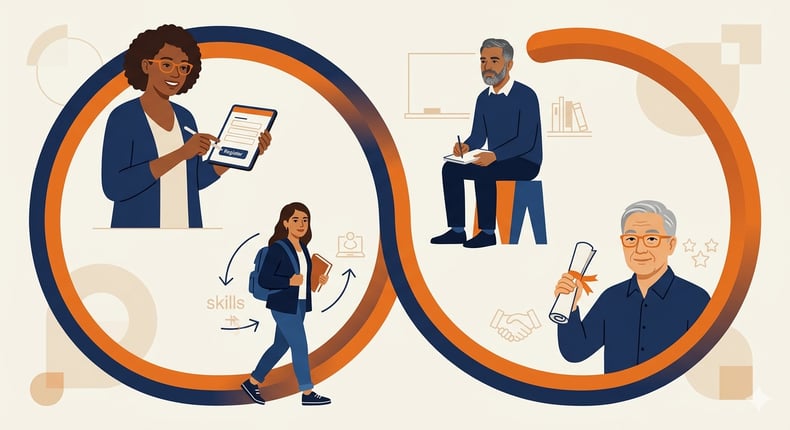
The new mental model is a continuous journey. Modern learners move in and out of education throughout their lives.They might come in for one program, leave for two years, return for a stackable credential, leave again and come back for a workforce certificate when their employer pays for it. Learning does not start when a student arrives at an institution and does not end when they graduate. Instead, it’s a continuous relationship between learner and institution that spans careers, industries and decades. Software has to support that pattern, or it gets in the way of it.
Enrollment as an Event vs. Enrollment as a Relationship
Treating enrollment as an event means optimizing for a single transaction. Treating it as a relationship means creating value over decades. Those two goals require different software systems and ways of measuring success.
Institutions that have made this shift talk about lifetime learner value the same way other industries talk about customer lifetime value. They invest in keeping a record of every interaction, every credential earned and every program of interest, so they can re-engage modern learners as their goals evolve. The next outreach campaign and personalized recommendation run on that data. If you can't easily access it, you can't run a lifecycle strategy.
Why "Lifecycle" Beats "Funnel" as a Mental Model
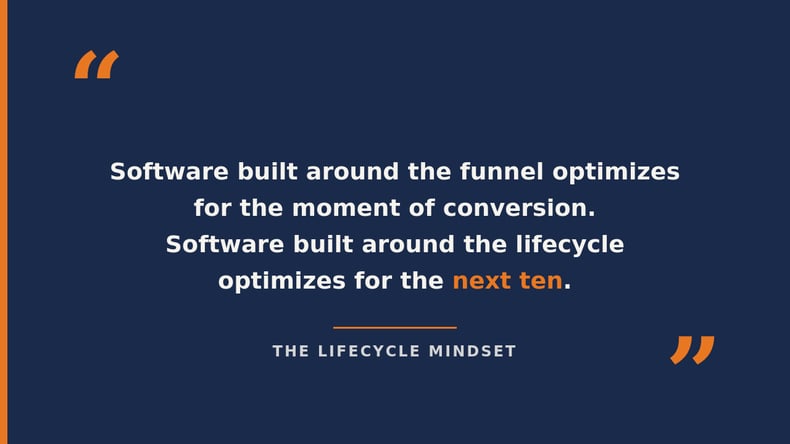
The funnel metaphor has a few problems when applied to modern learners. It implies a single direction, with a single conversion event and a clean exit. This is a mismatch for how today's learners actually behave, moving in and out of education as their goals and careers evolve. A learner-to-earner lifecycle approach treats the relationship as ongoing and the institution as a long-term partner across that journey.
Software built around the funnel optimizes for the moment of conversion. Software built around the lifecycle optimizes for the next ten conversions. That is the philosophical shift driving the rethink.
What Should Continuing Education Management Software Actually Do?
Here is a useful checklist for evaluating platforms. Strong CE software should hit every item on this list.
- Flexible program management. It should handle one-day workshops, weeks-long bootcamps, multi-term certificates and degree completion paths in one system, without forcing every program into the same structure.
- Frictionless learner experience. From course discovery to checkout, the experience should be closer to a modern e-commerce site than a legacy student portal. Mobile-first, fast and intuitive.
- Automated administrative workflows. Registration, payment processing, refunds, transfers and credit reporting should run on automated workflows, not staff hours.
- Integration with the rest of your stack. Data should flow cleanly into and out of your SIS, ERP, CRM and finance systems. Manual reconciliation is a tax on your team.
- Real reporting. Leadership should be able to see enrollment, revenue, completion and re-engagement metrics without filing a ticket.
- Support for non-traditional payment models. Corporate billing, payment plans, vouchers and employer reimbursement should be standard rather than a custom build.
- Compliance and security baked in. PCI, accessibility and jurisdictional privacy requirements should be built in, not an upgrade.
- Lifecycle-aware data architecture. The system should remember a learner across programs and over time.
If a platform misses more than two or three of these, the operational friction will likely show up in enrollment numbers and staff burnout rates.
Who Should Be Using a Continuing Education Platform?
Here’s the short answer: any institution running programs that fall outside the traditional credit-bearing degree structure can benefit. The slightly longer answer depends on what you're trying to accomplish.
Continuing Education Divisions
A dedicated continuing education or extended education division almost always benefits from purpose-built CE software for universities because the operational complexity of running dozens or hundreds of non-credit programs can't be reasonably managed inside a traditional SIS.
Workforce Development Programs
Workforce training software needs are similar but not identical. Workforce programs tend to involve more employer partnerships, as well as more compliance reporting and outcomes tracking. The platform needs to handle cohort-based delivery and the reporting required to prove ROI to a corporate partner, while also managing B2B billing.
Professional and Executive Education
Programs aimed at working professionals and executives often sit somewhere between continuing education and workforce development. They benefit from the same lifecycle infrastructure, with extra emphasis on the experience layer. Adult learning platforms designed for this audience need to handle cohort management and deliver a digital experience that matches learner expectations.
Community and Personal Enrichment Programs
Even programs that look small from the outside, like community classes or personal enrichment offerings, generate operational complexity at scale. A continuing education platform makes the difference between running them as a labor of love and running them as a sustainable line of business.
Frequently Asked Questions
What is the difference between continuing education management software and a learning management system? A learning management system (LMS) is where the actual learning happens. It hosts course content, assignments and assessments. Continuing education management software is the operational layer around that. It handles registration, payments, catalog management, credentialing, reporting and student records. The two systems often integrate, but they do different jobs.
How long does it take to implement a continuing education platform? Timelines vary based on the size of the institution, as well as the complexity of existing systems and the number of programs being migrated. A focused implementation for a single division often runs three to six months. A larger consolidation across multiple departments takes longer. The biggest variable is data migration, not the software itself.
Can a continuing education platform replace our SIS? For continuing education and workforce programs, yes. Many institutions run their non-credit operations entirely on a purpose-built continuing education platform while keeping their traditional SIS for credit-bearing programs. The two systems integrate so learner records stay connected. The reverse, trying to run continuing education through a traditional SIS, is what tends to create most of the friction.
What does it cost to switch continuing education software? The cost of switching is usually less than the cost of staying. Legacy systems generate ongoing operational costs in the form of staff time and lost enrollments. A switch involves real implementation cost, but the payback typically shows up in efficiency gains and revenue growth within the first year or two.
How does continuing education software help with Workforce Pell readiness? Workforce Pell requires programs to demonstrate alignment with high-demand industries, and lead to recognized stackable credentials while tracking student outcomes. A modern continuing education platform makes those requirements operational rather than aspirational. It captures the data you'll need for compliance and reporting and lets you stand up eligible short-term programs faster than a legacy system allows.
Rethinking Continuing Education Software
The institutions that are growing their continuing education programs share a common trait: they stopped treating their software as a registration tool and started treating it as the infrastructure for a long-term relationship with adult learners. That shift changes the questions institutions ask. It also evolves the metrics they track and the way teams spend their time.
If your current platform was built for an enrollment-first world, the gap between what it does and what modern learners expect is widening every year. Better infrastructure exists, and the institutions that move first will be the ones that capture the next wave of continuing education and workforce growth.
Modern Campus partners with institutions to support learners across the full journey, connecting the systems, experiences and data that power continuous lifelong learning from discovery through re-engagement. Book a personalized demo with our team to see what that partnership looks like in practice.
Last updated: June 25, 2026