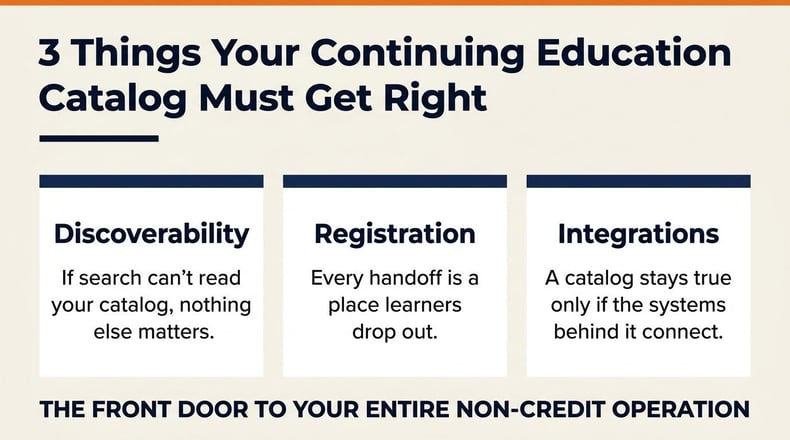
A continuing education course catalog isn't a reference document anymore. It's the front door to an institution’s entire non-credit operation, and it either turns interest into enrollment or loses it.
- Discoverability decides everything downstream. If a working adult can't find a program through a search engine or an AI assistant, nothing else about the catalog matters.
- Registration belongs inside the catalog, not three clicks away. Every handoff to a separate system is a place where learners drop out.
- Filters have to match how adults actually shop. Schedule, format, cost, credential type and start date matter more than academic department structure.
- Integrations determine whether the catalog stays true. A catalog that drifts out of sync with the registration system becomes a liability instead of an asset.
Walk the catalog the way a 42-year-old shift worker would at 9 p.m. on a phone. Whatever breaks in that five-minute test becomes the roadmap.
The continuing education course catalog has become one of the most impactful tools in higher ed. It's where a prospective learner forms a first impression, evaluates whether a credential is worth their time and decides whether to hand over a credit card. Yet plenty of institutions still run non-credit programming through a catalog that was designed for degree-seeking students, published on an annual cycle and organized by academic department.
That mismatch is getting expensive. Final fall 2025 enrollment data shows undergraduate certificate programs growing at more than double the rate of bachelor's programs, with certificate enrollment at community colleges up 28.3% since fall 2021. Demand for short, career-connected learning is arriving through the catalog. Institutions investing in continuing education catalog software are responding to a specific behavioral shift, and it helps to name that shift clearly before talking about features.
Who Is the Modern Learner, and What Do They Expect From a Continuing Education Course Catalog?
The people browsing non-credit offerings don't behave like traditional applicants. They're evaluating, comparing and often buying in a single session. Understanding who they are changes what a catalog needs to do.
What Defines the Modern Learner?
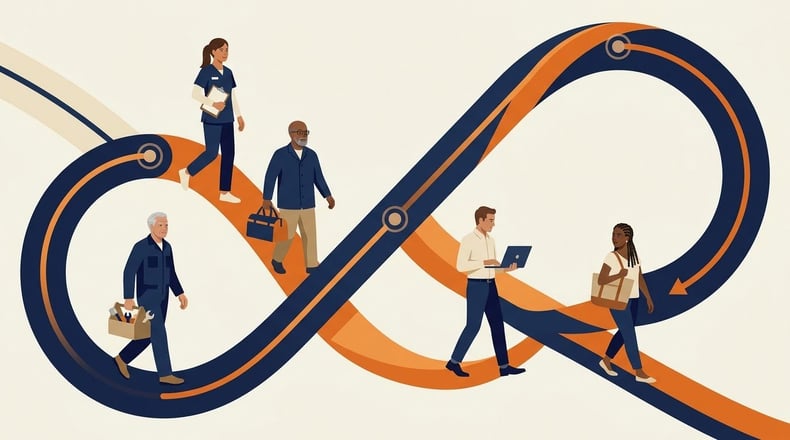
The Modern Learner is an individual who moves in and out of education throughout their life, gaining experience and building skills as their goals evolve, rather than following a single linear journey from school to career. They aren't moving through education once. They're returning to it repeatedly, often across decades, whenever career advancement or new industry requirements make new skills necessary.
That pattern breaks the assumptions baked into most catalogs. A traditional catalog assumes a student arrives once and follows a set path through to completion. A Modern Learner might take a four-week certificate this fall, leave for three years and come back for a stackable credential their employer is paying for. The catalog has to be legible to someone outside the institution who has no idea what department names mean.
Why Has the Linear Student Lifecycle Stopped Working?
Institutions have historically organized around a one-time student lifecycle: recruit, enroll, graduate and hand off to alumni relations. That model still describes some traditional undergraduates. It describes almost none of the audience for professional and workforce programming.
Supporting the modern learner journey means treating the relationship as continuous instead of transactional. Four institutional imperatives sit across that journey: Discover, helping learners find the right programs; Plan, giving them a realistic path from interest to action; Engage, keeping them connected through completion; and Evolve, supporting re-engagement as their goals and careers change. A continuing education course catalog is the primary interface for the first two and a meaningful contributor to the other two.
Why Does Discoverability Come First in Continuing Education Catalog Management?
Discoverability is the part that institutions most often underestimate. A beautifully organized catalog that search engines can't read is invisible to the majority of prospective learners because most of them start on Google or an AI assistant rather than the institution’s homepage.
Is the Catalog Actually Indexable?
Many non-credit catalogs are trapped in ways that block discovery entirely. PDFs, JavaScript-rendered course lists that never produce a crawlable URL and course detail pages that live behind a session-based portal all produce the same outcome: the program doesn't exist as far as search is concerned. Every course and program needs its own persistent page, built with a descriptive URL and structured data so search engines can index it.
Learners ask complete questions instead of typing keyword fragments. Someone searching "phlebotomy certificate evening classes near me" wants a specific answer, and the page that answers it directly is the one that gets surfaced. Course descriptions written in academic shorthand rarely match how people ask.
Does the Catalog Meet Accessibility Requirements?
Accessibility has moved from good practice to a legal obligation for public institutions. The Department of Justice's digital accessibility compliance deadline requires public entities serving populations of 50,000 or more to bring websites, mobile applications and digital content into conformance with WCAG 2.1 Level AA by April 26, 2027, with smaller jurisdictions following in April 2028. Because population is calculated at the state level, this captures nearly every public college and university.
Catalogs are frequently the weakest link, carrying heavy tables, downloadable PDFs, inconsistent heading structures and images of text that all fail accessibility review. Fixing this issue improves the experience for every learner using assistive technology or navigating on a small screen, and it improves how machines read content too.
What Should Filtering and Navigation Look Like in a Non-Credit Course Catalog?
Filtering is where the difference between a credit catalog and a non-credit course catalog becomes obvious. Degree-seeking students browse by discipline because their program dictates their path. Adult learners browse by constraint, and their first constraint is almost always time.
Which Filters Actually Matter to Adult Learners?
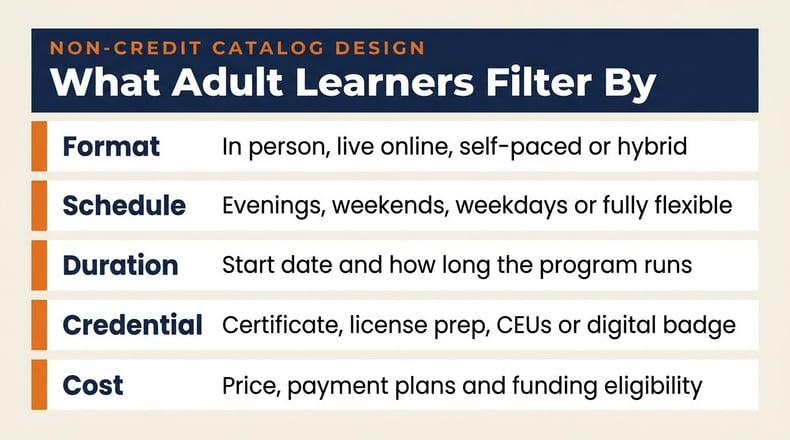
The filters that drive non-credit conversion map to real-life limitations rather than institutional structure. Learners want to narrow by delivery format, schedule, duration, price and what they'll walk away with. Department and course prefix are near the bottom of that list.
A practical filter set for a professional education catalog looks like this:
- Format: in person, live online, self-paced or hybrid
- Schedule: evenings, weekends, weekday daytime or fully flexible
- Duration and start date: what's starting in the next 30 days and how long it runs
- Credential earned: certificate, license preparation, CEUs, microcredential or digital badge
- Cost and funding eligibility: total price, along with available payment plans and financial support
How Should Programs Be Grouped?
Grouping should follow learner intent, not the org chart. A person who wants to work in healthcare doesn't know whether a phlebotomy course lives under Allied Health, Workforce Development or Community Education, and they shouldn't have to guess. Career-oriented topic clusters outperform administrative categories every time.
Stackability deserves visible treatment as well. When a learner can see that three individual courses ladder into a certificate and that the certificate connects to a credit pathway, the value of the first course changes. This concept is one of the clearest opportunities in academic catalog management today, and most catalogs leave it largely untapped.
How Should Registration Work Inside a Continuing Education Course Catalog?
Registration is where good catalogs lose people. A learner reads a compelling course page, clicks register and hits a login wall or paper form, sometimes with nothing more than a phone number to call during business hours. That handoff is the most common leak in non-credit enrollment.
Why Does Registration Belong in the Same Journey?
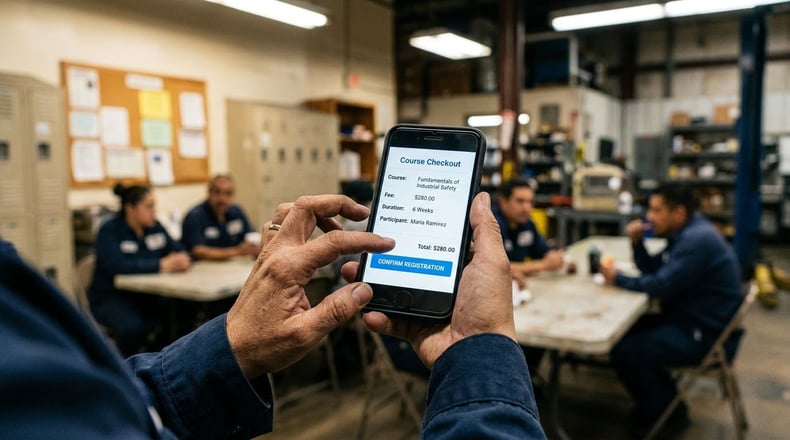
The learner should be able to find a course, confirm eligibility, check seat availability, register and pay without leaving the experience. Each additional system introduces a new interface and a new reason to abandon the process. Adults registering at 9 p.m. after work will rarely call an office in the morning to finish what a website couldn't complete.
Streamlining continuing education registration is inseparable from catalog design. Guest checkout for low-cost offerings, saved profiles for returning learners, real-time seat counts and immediate confirmation are baseline expectations set by every other transaction in a person's life.
What Payment Realities Does Non-Credit Enrollment Involve?
Non-credit payment is messier than tuition billing, and the catalog has to accommodate that. Employer sponsorship, purchase orders, corporate invoicing, third-party vouchers, installment plans and workforce agency funding all show up regularly, sometimes in the same cohort.
Workforce Pell adds a new layer. The Department of Education's final rule opened federal grant eligibility to short-term workforce training programs running 150 to 599 clock hours across 8 to 15 weeks, with early implementation beginning July 2026. Institutions with eligible programs need catalog pages that clearly show eligibility and clock hours, with required completion and placement outcomes published alongside them.
Which Integrations Does a Professional Education Catalog Need?
Integration is the least visible catalog requirement and the one that determines whether everything above stays true six months from now. A catalog is only as trustworthy as the systems feeding it.
What Breaks When Systems Don't Talk?
When course data lives in one system, schedules in another and registration in a third, the catalog becomes a manual reconciliation project. Someone retypes information, something gets missed, and a learner registers for a section that was canceled two weeks ago. Staff capacity absorbs the difference, and there isn't much slack left.
The pressure is measurable. Recent sector research found that fewer than four in ten professional and continuing education units agree it's easy to access real-time enrollment data, and just 37% said they had adequate staff to execute their goals. Manual catalog maintenance is a direct tax on both numbers.
Which Connections Deliver the Most Value?
Prioritize the integrations that eliminate double entry and keep learner records intact over time. The connections that consistently earn their keep include the student information system, the website content management platform, the CRM, the payment processor and the credentialing or badging tool.
Analytics belongs on that list too. Visibility into how learners use the catalog and which programs generate repeat enrollment helps institutions make portfolio decisions with evidence instead of instinct. Those same signals reveal which offerings deserve promotion and which are consuming staff time for no return.
What Are the Signs a Continuing Education Course Catalog Is Working?
Most teams sense that their catalog underperforms without being able to name the specific failure. These indicators separate a catalog that drives enrollment from one that merely documents it.
- Individual course pages rank in organic search. Learners arrive on a course page directly from a query rather than navigating through the broader site.
- A learner can register in under three minutes on a phone. Mobile completion is the honest test of a registration flow.
- Filters reflect life constraints. Format, schedule, duration, cost and credential are all filterable in a single view.
- Pathways are visible. Learners can see how a course stacks toward a certificate and where that certificate leads professionally.
- Information is never stale. Course availability and pricing update automatically because systems are connected.
- Outcomes are published. Completion and credential outcomes appear alongside career alignment on the page instead of in a brochure.
- Returning learners are recognized. A person who took a course in 2023 doesn't start from zero when they come back in 2026.
- The catalog passes an accessibility audit. Every course detail page, not only the homepage.
Institutions hitting most of these items report fewer support calls and more completed registrations, with better data to guide planning for the next term. The essential catalog software features that support these outcomes are increasingly standard rather than premium.
How Does the Catalog Support Learners Beyond the First Enrollment?
A catalog optimized purely for first-time registration captures a fraction of its potential value. Modern Learners return, and the catalog is often what brings them back.
What Does Re-Engagement Look Like in Practice?
Someone who completed a project management certificate two years ago may be ready to build on it with advanced coursework or a leadership credential. Reaching that learner requires knowing what they took, what they completed and what logically comes next. That intelligence lives in the connection between the catalog and learner records.
Thriving institutions treat every completion as the start of the next conversation instead of the end of a transaction. They personalize the catalog around relevant next steps and track lifetime learner value the way other industries track customer relationships. This point is where continuing education management software and catalog strategy converge.
How Do Employers Fit Into the Picture?
Employers are a second audience for the same catalog, and they evaluate it differently. A training manager wants to see whether offerings address specific skill gaps and scheduling needs, with documented outcomes for reporting.
Global workforce research reinforces the urgency. Global skills disruption data indicate that 39% of workers' core skill sets are expected to be transformed or become outdated by 2030. Employers are actively shopping for partners who can move quickly, and a catalog that reads as a browsable, credible menu of workforce solutions is a competitive advantage in those conversations. Institutions have responded by expanding short-form offerings, and microcredential adoption reached record levels across professional and continuing education units.
Frequently Asked Questions
What is a continuing education course catalog? It's the searchable, public listing of an institution's non-credit, professional and workforce offerings, including course descriptions, schedules, pricing, credential outcomes and registration. Unlike an academic catalog, which functions largely as a governance and compliance document, a non-credit course catalog operates as a commerce and discovery experience for adult learners.
How is a non-credit course catalog different from an academic catalog? An academic catalog documents requirements and policies for enrolled students on an annual publication cycle. A non-credit course catalog is transactional and continuously updated, built for people who are comparing options, checking schedules and registering in a single visit without ever applying for admission.
How often should a continuing education catalog be updated? Continuously. Pricing, seat availability, start dates and cancellations change weekly, and a catalog that reflects last term's data actively damages trust. Automated synchronization with the registration system removes the burden of manual updates entirely.
What makes a professional education catalog rank well in search? Individual indexable pages for each course and program, descriptive titles matching how learners actually phrase questions, structured data markup, clear outcome information and accessible page structure. Catalogs published as PDFs or rendered inside a session-based portal rarely rank at all.
Building a Catalog for the Journey Ahead
Institutions still running a static, department-organized listing are optimizing for a linear student lifecycle that fewer learners follow. The ones treating the catalog as a living discovery and commerce experience are building for a continuous modern learner journey and capturing the workforce demand that comes with it. Understanding what learners expect from catalogs is the starting point, and the operational infrastructure behind it determines whether you can deliver.
Modern Campus partners with institutions to support learners across the full journey, connecting the systems, experiences and data that carry someone from first search through every return to learning. Book a personalized demo to see what that partnership looks like at your institution.
Last updated: August 24, 2026
.png)