Continuing education administration gets complicated because of program variety, not program volume, which means another hire won't solve a structural problem.
- The top barriers to expanding credentials are now administrative burden and the pressure to respond quickly to market demand, overtaking the faculty resistance that dominated this conversation for years.
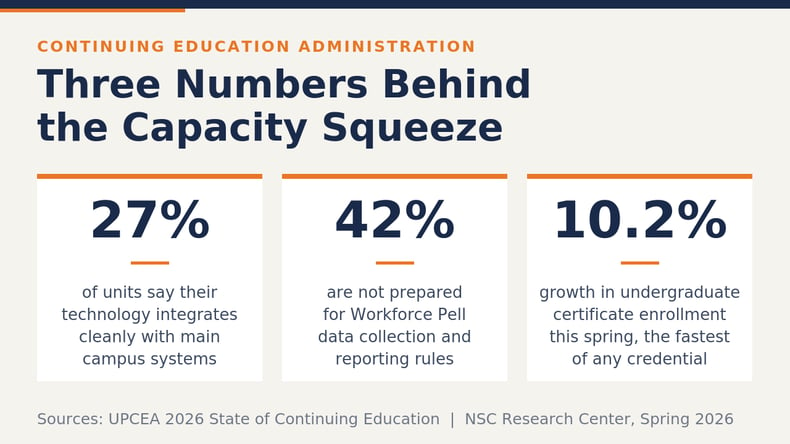
- Only 27% of continuing education units say their technology integrates cleanly with main campus systems, which turns staff into the integration layer between disconnected tools.
- Workforce Pell took effect July 1, 2026, and 42% of institutions say they aren't prepared for the data collection and reporting it requires.
- Registration, approvals, catalog updates and outcome reporting consume the capacity that should go toward program design and employer relationships.
Before writing another job description, audit where the team's hours actually go. The answer usually points to process, not people.
Continuing education administration has a scale problem that hiring can't solve. Units are launching more programs, serving more audiences and reporting on more outcomes than they did three years ago, and the staffing line hasn't moved. Undergraduate certificate programs posted a 10.2% enrollment increase this spring, the fastest growth of any credential type in the country. That demand lands on the same teams that were already stretched thin.
The instinct is to ask for more people. The better question is why the work multiplies faster than enrollment does. Most units are overloaded because every program carries its own registration path, approval chain, catalog entry and reporting requirement, and none of those things talk to each other. Institutions that support learners across their journey treat that fragmentation as the actual problem.
What Makes Continuing Education Administration So Complex?
Complexity in continuing education comes from variety, not headcount. A registrar's office processes thousands of transactions that follow one set of rules. A continuing education unit processes a fraction of that volume across dozens of rule sets: open enrollment courses, cohort certificates, contract training, CEU-bearing workshops, badge programs and short-term workforce offerings tied to federal aid.
Leaders know where the pressure sits. When institutions were asked to name the key enablers for scalable growth, they pointed to more efficient registration and program management, along with better access to learner data. Those are operational answers, not staffing answers.
Why Does Program Variety Multiply Administrative Work?
Every program type introduces its own exceptions:
- A corporate contract needs invoicing.
- A licensure course needs credit-hour tracking that a badge doesn't.
- A cohort program needs waitlist logic that an on-demand course ignores.
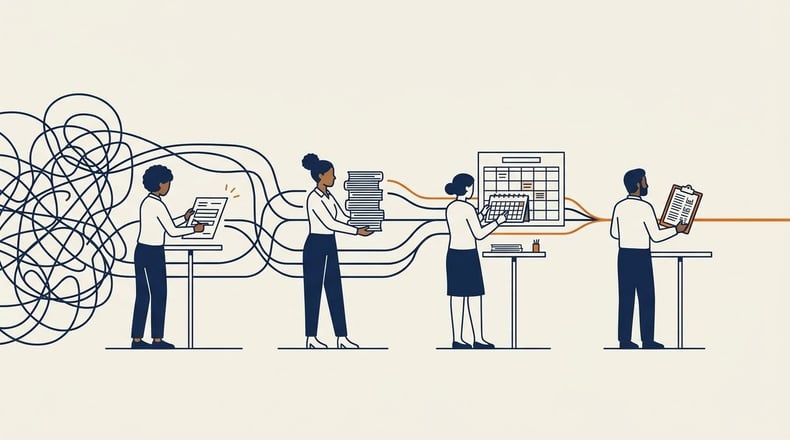
When those exceptions live in staff members' heads instead of in systems, each one becomes a manual step somebody has to remember. Multiply that across a catalog of 200 offerings, and you get a unit where the most experienced people spend their days doing the least strategic work.
What Changed About Who Institutions Are Serving?
The Modern Learner moves in and out of education throughout their life, gaining experience and building skills as their goals and path evolve, rather than following a single linear route from school to career. That's not a demographic footnote. It's an operating condition. A learner who takes a certificate in March, returns for a workshop in October and comes back two years later for a degree pathway expects institutional systems to recognize them each time, and most systems don't.
Institutions built their infrastructure around a one-time student lifecycle: apply, enroll, graduate, leave. The modern learner journey is continuous, and continuing education administration feels that mismatch first because they serve the returning learner more often than anyone else on campus. Teams end up manually reconciling the gap between how people actually learn and how the technology assumes they learn.
Where Does the Time Actually Go in Continuing Education Operations?
Before any team can reduce administrative complexity, it needs an honest inventory of where hours disappear. Most continuing education operations leaders can name their bottlenecks in general terms. Far fewer can quantify them. When teams run a two-week time audit, the same five categories surface almost every time.
- Registration and payment handling. Staff manually process registrations that arrive by email, phone or paper, then chase down payments while applying discounts and issuing refunds outside the system of record.
- Approval routing. New course and program proposals move through the committee by email attachment, with no visibility into who has it, what version is current or how long it's been sitting.
- Catalog and course data maintenance. The same course description gets typed into the catalog, the website, the registration system and a marketing email, then updated in three of those four places when something changes.
- Reporting and compliance. Enrollment counts, completion rates, CEU records and outcome data get assembled by hand from multiple exports every time somebody asks for a number.
- Learner inquiries. Staff answer the same questions about start dates, refund policies, prerequisites and certificates because the catalog doesn’t surface that information clearly.
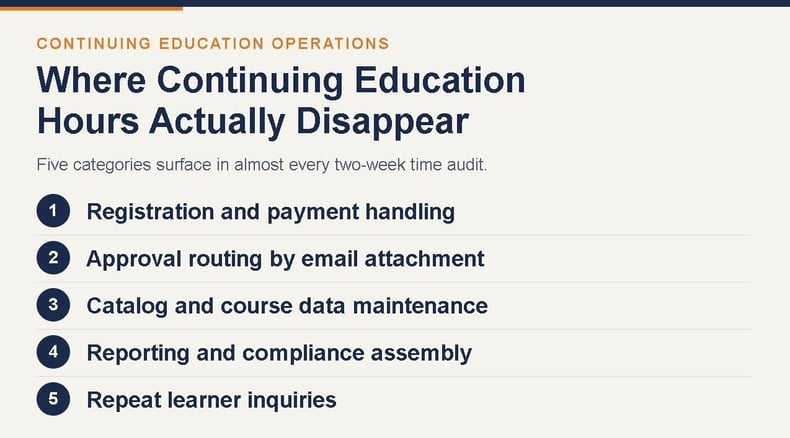
Together, these categories routinely account for the majority of a small team's week, and every one of them is a candidate for elimination rather than acceleration. Doing a broken process faster still leaves you with a broken process.
How Can Institutions Reduce Registration Friction Without Adding Headcount?
Registration is where administrative complexity is most visible and most fixable. Every manual touch in the enrollment path is a place where staff time gets spent and where learners drop out. The flaws in the registration process that frustrate adult learners are the same ones generating internal work.
The fix is self-service that actually serves. Learners should be able to browse offerings, check prerequisites, register, pay, set up a payment plan, drop within policy, retrieve a receipt and download a certificate without contacting anyone. When a unit evaluates continuing education registration software, the question is which platform removes the most manual steps from the team's week.
Watch for the exceptions too. Contract training, employer-sponsored cohorts and third-party billing are where most self-service systems break down and staff revert to spreadsheets. A registration process that handles 80% of transactions cleanly and dumps the rest on a coordinator has relocated complexity rather than reducing it.
What's the Fix for Slow Approvals and Stale Catalog Data?
Approval workflows and catalog maintenance are the two places where continuing education program management most often collides with the rest of campus. New non-credit offerings need to move quickly to meet employer demand, and the governance processes they pass through were built for degree programs on an annual cycle. That mismatch produces months of delay on programs designed to be responsive.
How Do Teams Speed Up Approvals Without Weakening Governance?
Faster approval isn't about skipping steps. It's about making the steps visible and parallel instead of sequential and invisible. Digital routing shows every stakeholder a proposal’s current status and what’s changed since the last review, which eliminates the follow-up emails that consume coordinator time. Institutions focused on streamlining curriculum management find that most delay comes from proposals waiting in inboxes, not from committees deliberating.
Build a separate track for non-credit and short-form offerings. Applying full degree-program governance to an eight-week workforce certificate is a policy choice, and it's often the wrong one. Define what level of review each program type genuinely requires, then encode that in the workflow so nobody has to negotiate it case by case.
Why Does Catalog Accuracy Reduce Downstream Work?
Every place a course description lives independently is a place it will eventually be wrong. Learners register for the wrong section and advisors give outdated guidance, leaving staff to field the resulting inquiries. A digital catalog management solution that publishes from a single source across digital channels and printed materials removes an entire category of correction work.
Accuracy also compounds over time. When catalog data is trustworthy, it supports marketing and reporting, while giving advisors information they can rely on. When it isn't, every downstream team builds its own workaround, and reconciliation becomes part of the workload.
How Should Continuing Education Program Management Handle Reporting Now?
Reporting demands on continuing education units grew in 2026, and the timing is difficult. Workforce Pell took effect July 1, and the U.S. Department of Education's final rule on short-term Pell established a new category of eligible workforce programs running 150 to 599 clock hours over 8 to fewer than 15 weeks. Eligibility depends on completion rates and job placement rates, which means outcome tracking is now a condition of funding.
Sector research shows the gap. Sixty-seven percent of institutions say they're at least somewhat likely to expand short-term workforce-aligned programs in response to the new aid, while 42% say they aren't prepared to meet the data collection and reporting requirements that come with it. The appetite is there. The infrastructure isn't.
If reporting depends on someone exporting four spreadsheets and reconciling them by hand, that approach won't survive an audit cycle. The practical move is to define the required reporting outputs first, then work backward to determine which data has to be captured at the point of transaction. Data captured at registration costs nothing to report. Data reconstructed afterward costs weeks.
What Does Workforce Program Management Require That Traditional Operations Don't?
Workforce program management adds a stakeholder that consumer-facing continuing education doesn't have: the employer. Employers bring cohorts, contracts, custom scheduling, invoicing terms and outcome expectations, and each of those introduces administrative paths that standard registration flows were never designed to handle.
The units that manage this well treat employer relationships as a distinct operational model rather than an exception to the consumer one. The solution is support for group registration and employer billing, backed by reporting that shows employers how their people performed. It also means connecting non-credit records to credit systems so that a learner who completes workforce training can apply it toward a credential later without staff having to rebuild their history by hand.
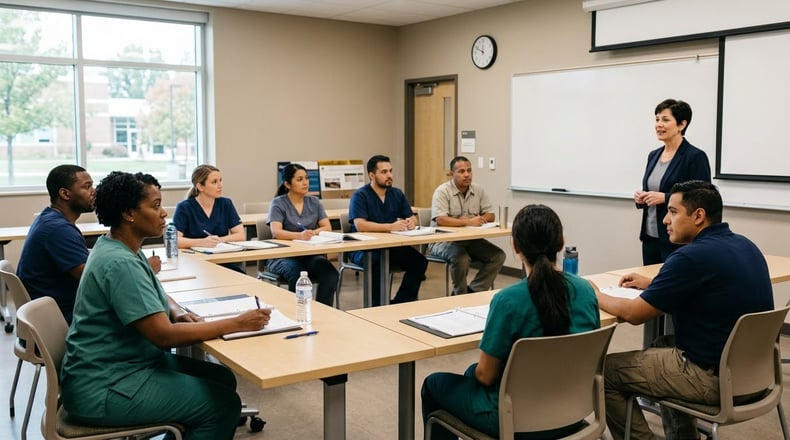
This area is also where the four institutional imperatives of the modern learner journey become concrete. Discover means employers and learners can find the right program without needing to contact staff. Plan means the academic operations behind that program create a friction-free path from interest to enrollment. Engage means timely communication keeps cohorts on track without manual outreach. Evolve means a learner's completed training stays connected to whatever they come back for next. Each imperative is an operational requirement, not just a communications framework.
What's the Right Role for Technology in Continuing Education Administration?
Technology is an enabler here, not the strategy. The units that reduce complexity most successfully do process work first: they map what actually happens, cut steps that exist only because a previous system required them and standardize the exceptions that can be standardized. Then they automate what remains. Reversing that order produces expensive software wrapped around inefficient processes.
Integration deserves particular attention. Only 27% of continuing education units report that their technology integrates cleanly with main campus systems, and 30% say they lack marketing support, while 22% lack instructional designers. That same research found the top barriers to expanding credentials are now administrative burden and responding to market demand, overtaking the faculty resistance narrative that dominated this conversation for years. When systems don't connect, staff become the connective tissue, rekeying data between platforms and reconciling numbers that should match automatically. That's invisible labor, and it's the first thing to disappear when integration works. Looking at academic operations across an institution as one connected system rather than a set of departmental tools makes the difference.
There's a retention argument here as well. Roughly one in four higher ed employees say they're likely to look for another job in the coming year, and workload sits near the center of that pressure. Reducing administrative complexity keeps the experienced people who already understand your programs, which is worth more than a new hire who needs two years to learn the same institutional knowledge.
Frequently Asked Questions
How do institutions reduce continuing education administration workload without cutting programs? Start with a time audit rather than a program review. Identify the manual steps that repeat across every program, then eliminate or automate those steps. Most units find that a small number of process fixes, particularly in registration and reporting, free up more capacity than cutting offerings would.
What should continuing education operations automate first? Automate the work that repeats identically every time: registration confirmations, payment processing, waitlist management and certificate issuance. These follow clear rules and occur at high volume, which makes them the safest and fastest wins.
Does new technology require more staff to manage it? Implementation requires a short-term investment of time from the team. After that, well-integrated systems reduce ongoing administrative load rather than adding to it. The risk comes from adding tools that don't connect to existing systems, which creates new manual reconciliation work.
How can institutions prepare continuing education program management for Workforce Pell reporting? Start by identifying programs that fall within the 150 to 599 clock-hour range. From there, confirm the state's approval process and ensure completion and job placement data can be captured as part of normal operations. Reporting generated on demand is sustainable. Reporting assembled manually each cycle is not.
Where Should You Start?
Reducing administrative complexity is a sequencing problem more than a spending problem. Audit where the hours go, eliminate the steps that exist for historical reasons, standardize what you can and connect the systems that are forcing your staff to move data by hand.
If workforce program management is where you're growing fastest, start there because that's where manual processes break first. Do that work in order, and the same team can handle substantially more program volume without the burnout that drives good people out.
The pressure on continuing education units isn't going to ease. Demand for short-term credentials is climbing and federal reporting expectations are tightening, while employer partnerships are becoming central to institutional relevance. Modern Campus partners with institutions to support learners across the full modern learner journey, connecting the systems, experiences and data that keep continuing education teams focused on programs instead of paperwork. If your team is carrying more than its processes were built for, request a demo and let's talk about what to fix first.
Last updated: August 31, 2026