Workforce Pell programs open a new federal aid pathway for short-term, career-focused training, but launching one takes more than a new course catalog page.
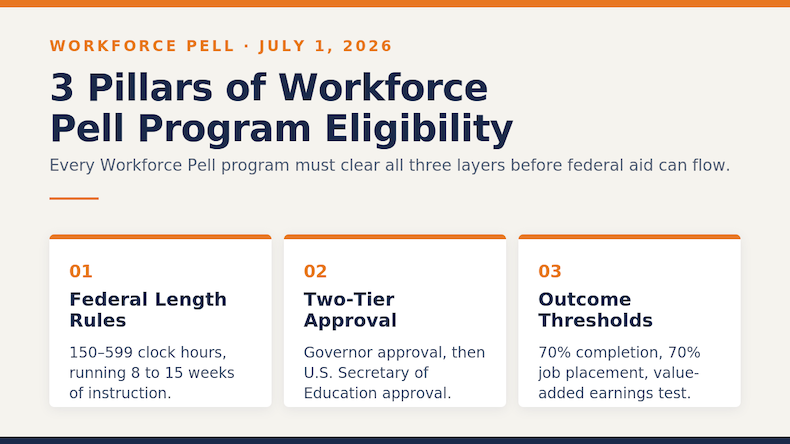
- Programs must run 150 to 599 clock hours over 8 to 15 weeks and have been offered by an institution for at least one year before becoming eligible.
- Two-tier approval is required: governor approval (after consultation with the state workforce board) and a separate determination by the U.S. Secretary of Education.
- Outcome thresholds include a 70% completion rate, a 70% job placement rate within 180 days and a value-added earnings test comparing tuition to median graduate earnings.
- Federal eligibility begins July 1, 2026, and program-level approvals depend on state processes that vary from one governor's office to the next.
Institutions that treat Workforce Pell as an operational redesign, not a marketing checkbox, will be the ones ready to disburse short-term Pell funding in the 2026 to 2027 award year.
If your institution is staring down the July 1, 2026 launch date for Workforce Pell programs, you already know the policy expands federal Pell Grant eligibility to short-term, workforce-aligned offerings for the first time. What you may still be sorting out is the sequence of moves: which programs to put forward, who signs off on what, what data to start collecting, and how to keep the rollout from collapsing into a compliance scramble before the deadline.
This guide is built for the people doing that work. It covers program design, eligibility, compliance and operational steps to launch a Workforce Pell offering. Institutions acting early will be in position to support more learners with career-focused continuing education programs when the policy takes effect.
What Are Workforce Pell Programs?
Workforce Pell, sometimes called “short-term Pell,” is a new category of Pell Grant eligibility created under the One Big Beautiful Bill Act passed in July 2025. Before this law, Pell Grants could only fund programs of at least 600 clock hours over a minimum of 15 weeks, ruling out most short-term workforce training, even when it led to high-demand jobs.
The new category covers programs between 150 and 599 clock hours running 8 to 15 weeks. The Congressional Budget Office has estimated federal investment at roughly $1.5 billion over the next decade, with average awards around $2,200 per recipient. Aligning marketing strategy with these programs can help institutions engage the adult learners who benefit most.
Who Benefits from Workforce Pell Eligibility?
The policy reaches learners who have historically fallen through the cracks of federal aid, including:
- Career changers
- Working adults pursuing reskilling
- Students who want to enter a career field quickly without a multi-year degree commitment.
Among other learners. Notably, students who already hold a bachelor's degree may qualify, even though they would not qualify for a traditional Pell Grant in most cases. They cannot, however, hold or be enrolled in a graduate credential.
For practitioners in continuing education, workforce development or non-credit programming serving adult learners, this funding pathway can unlock enrollment for students who previously paid out of pocket. Workforce Pell eligibility opens the door for learners who could never afford short-term Pell programs without federal support. The eligibility bar is high, though, and the design choices institutions make now will determine whether programs clear it. Our companion piece on how institutions are preparing for Workforce Pell covers the strategic mindset shift that runs alongside this execution guide.
How Do Institutions Determine Which Programs Are Eligible?
Eligibility is a layered test. A program has to clear federal length and content rules, win governor approval, satisfy outcome thresholds and pass a value-added earnings calculation. Each layer can disqualify a program independently, so institutions should audit portfolios against every requirement before nominating anything.
What Are the Federal Program Requirements?
The federal floor for an eligible workforce program includes:
- A length of 150 to 599 clock hours, or 4 to 15 semester or trimester hours (or 6 to 23 quarter hours), running 8 to 15 weeks
- Operation by an accredited institution that is eligible for Title IV federal student aid
- A track record: the program must have been offered for at least one year before it is eligible
- A recognized postsecondary credential that is stackable and portable across multiple employers or that prepares students for an occupation with a single recognized credential
- Academic credit acceptable toward a future certificate or degree program
- No correspondence courses, study abroad or remedial coursework
Distance education is permitted, but the U.S. Department of Education has flagged extra scrutiny for online programs, and states may need bilateral agreements to authorize them across state lines.
What About State Workforce Alignment?
Beyond the federal rules, each program has to demonstrate alignment with high-skill, high-wage or in-demand industry sectors or occupations as defined by the state workforce board. According to the National Governors Association, states must publish their list of qualifying occupations and review it at least every two years, in line with their Workforce Innovation and Opportunity Act state plans. A program eligible in one state may not qualify in another, so internal labor market analysis must map onto the state's published priority occupations.
What Are the Compliance and Outcome Requirements?
Workforce Pell is more outcome-driven than any other category of Pell aid. Three benchmarks define ongoing eligibility, and missing any one can trigger a loss of approval.
What Are the Completion and Job Placement Thresholds?
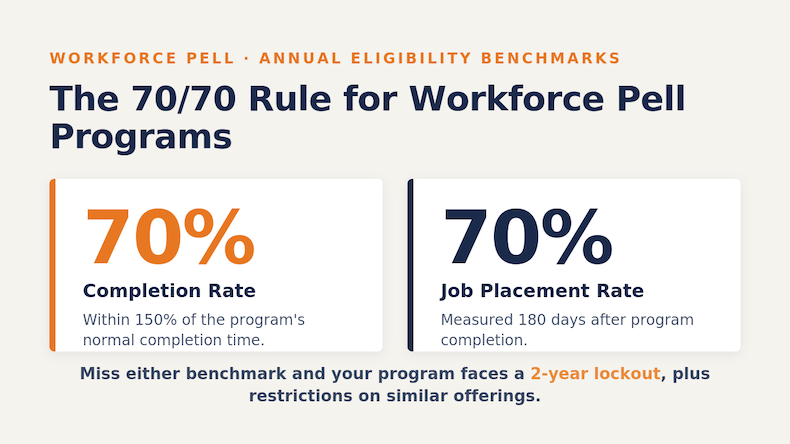
Eligible programs must maintain a completion rate of at least 70%, measured within 150% of the program's normal completion time, and a job placement rate of at least 70%, measured 180 days after completion. For the 2026 to 2027, 2027 to 2028 and 2028 to 2029 award years, governors will calculate completion rates under transitional rules. After that, the formula in 34 CFR 668.8(f) applies. Job placement rates are calculated using state administrative data, including unemployment insurance wage records.
If a program loses eligibility for failing completion or placement tests, it is locked out for two years, and the lockout extends to "substantially similar" programs that share the same Classification of Instructional Program code and Standard Occupational Classification code. That's why a program eligibility review needs to be honest, not aspirational.
How Does the Value-Added Earnings Test Work?
The earnings test compares published tuition and fees to a calculated value-added earnings figure. Value-added earnings are calculated by taking the median earnings of program completers who received federal aid (measured three years after completion), adjusting for regional price parities published by the Bureau of Economic Analysis and subtracting 150% of the federal poverty guidelines for a single-person household. If the result exceeds a program’s published tuition and fees, the program passes. If not, it risks losing eligibility until tuition is reduced or earnings improve.
Pricing is now an outcomes question. Tuition that looks reasonable next to comparable programs can still fail the federal test if graduate earnings don't clear the regionally-adjusted floor.
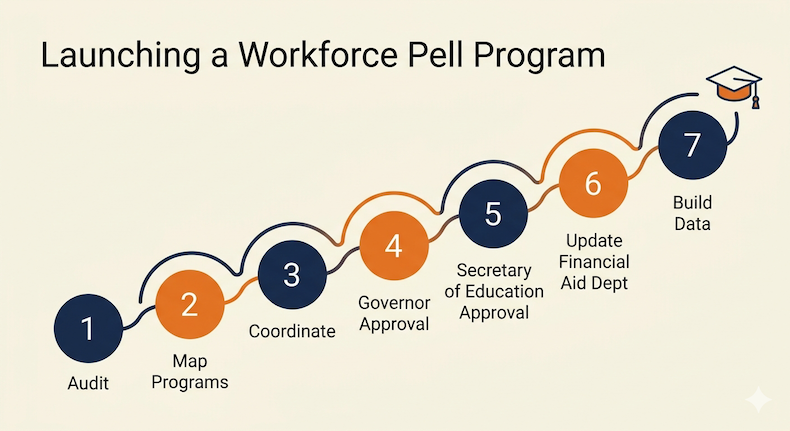
How Do You Actually Launch a Workforce Pell Program?
After understanding the requirements, the launch becomes a project plan. Here is the path most institutions are following, drawn from the Department of Education's proposed rules and guidance from Jobs for the Future.
- Audit existing programs. Document clock hours, weeks of instruction, completion rate, job placement rate, tuition and fees and credential awarded for each short-term offering. Flag any program offered for less than a year or where outcome data is unreliable.
- Map programs to state priority occupations. Once the state publishes its list of high-skill, high-wage and in-demand occupations, institutions should match each candidate program to a specific occupation and document the connection in writing. Weak occupational alignment is a common reason for rejection.
- Coordinate across departments. Stand up a cross-functional task force with academic affairs, workforce, registrar and financial aid. The launch touches every system handling student data and funding.
- Submit for governor approval. File your nominated programs through your state's designated authorizing entity. States have delegated this authority to higher ed boards, workforce departments and other agencies, so confirm where it sits.
- Secure Secretary of Education approval. After governor approval, the Secretary verifies one year of operation, completion and placement rates of 70% and (eventually) the earnings test.
- Update financial aid operations. Train staff to navigate both traditional Pell and Workforce Pell requirements. Students cannot receive Workforce Pell and traditional Pell in the same enrollment period. Workforce Pell awards count toward lifetime Pell eligibility, and they're prorated based on program length.
- Build the data pipeline for annual reporting. Each year, institutions will report completion, placement and earnings data to state oversight bodies, which use it to recertify each program.
What Operational Realities Should Institutions Plan For?
Even institutions with strong continuing education divisions are running into a few predictable challenges.
How Should You Handle Non-Credit Programs?
Many existing workforce-aligned programs are non-credit, which complicates federal aid eligibility because non-credit offerings typically aren't integrated into financial aid systems. Workforce Pell rules don't explicitly exclude workforce training programs that are non-credit, but the program must lead to a credential-carrying academic credit acceptable toward a future certificate or degree. That means redesigning non-credit programs as credit-bearing or building credit-recognition pathways, with registrar and academic affairs partnership. Our overview of continuing education student management walks through how purpose-built systems support the flexible enrollment and outcome tracking required.
How Should You Track Long-Term Student Success?
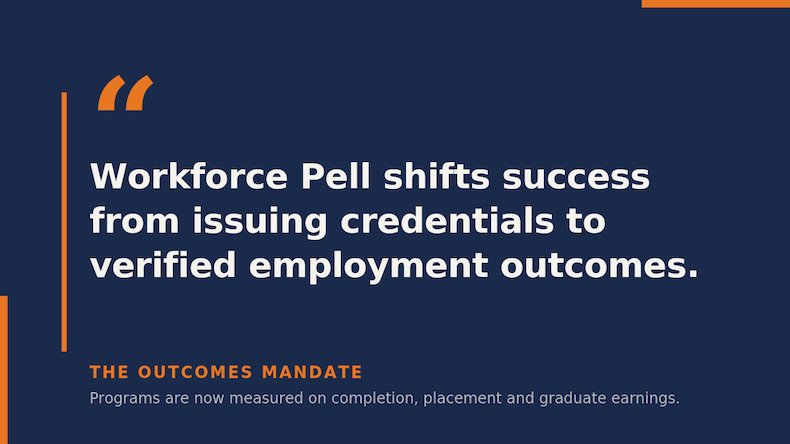
Workforce Pell shifts the success metric from credential issuance to verified employment and earnings. As Kristi Flack of Northeast Iowa Community College put it in our community conversation on Workforce Pell, institutions must now track students into the workforce with the same rigor used for graduation rates. That requires data partnerships across the institution and, often, with the state agency holding wage records. Continuing education programs have rarely been held to this level of post-completion accountability.
Frequently Asked Questions About Workforce Pell Programs
When does Workforce Pell go into effect? The program officially begins July 1, 2026, for the 2026 to 2027 award year. The Department of Education released proposed rules on March 6, 2026, with final rules expected before launch.
Can a brand-new program qualify for Workforce Pell? Generally, no. Short-term Pell programs must be offered by the institution for at least one year before becoming eligible. New programs need to complete a year of operation, generate baseline outcome data and then go through approval.
How much can students actually receive in Workforce Pell awards? Awards are prorated based on program length and student need. The 2026 to 2027 maximum Pell amount is $7,395, but Workforce Pell awards will typically be smaller because they're calculated against shorter programs. Average awards are estimated at around $2,200 per recipient.
Can students use Workforce Pell and traditional Pell at the same time? No. Students cannot receive both during the same enrollment period, and Workforce Pell awards count toward the lifetime Pell eligibility limit of 12 semesters or its equivalent.
What happens if a program loses eligibility? If a program loses approval because of completion or job placement rates, it is locked out for two years, and substantially similar programs are also locked out. Failing the value-added earnings test can be fixed by reducing tuition. Loss of governor approval is reversed once the governor recertifies and the Secretary verifies the criteria.
Launching Workforce Pell-Eligible Programs
Workforce Pell programs are a real federal investment in short-term training, and institutions that move now will be best positioned to support adult learners and career changers starting in fall 2026. The launch sequence can be a heavy lift: audit your portfolio against length, outcome and credential rules, win two-tier approval through your governor's office and the Department of Education, and stand up reporting infrastructure linking continuing education, financial aid and institutional research. Done well, the result is a federal aid pathway that genuinely expands access to workforce training programs at your institution.
The Modern Campus Lifelong Learning platform is built for the kind of non-traditional student management this policy requires, including flexible enrollment cycles, outcomes tracking and the integrations between registrar, financial aid and continuing education systems that compliance demands.
To see how Modern Campus can help you launch and sustain Workforce Pell-eligible programs, book a quick demo today.
Last updated: June 8, 2026
.png)