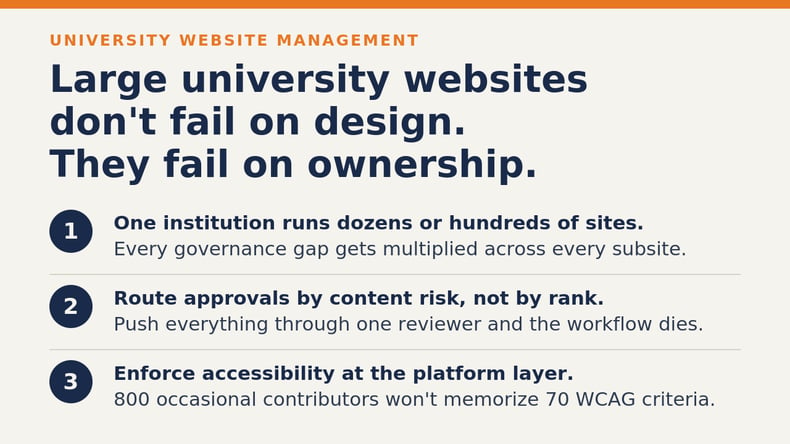
Large university websites rarely fail because of bad design. They fail because nobody wrote down who owns what.
- A single institution often runs dozens or hundreds of departmental sites, which means every governance gap gets multiplied across every subsite.
- Route approvals by content risk instead of pushing everything through one reviewer, or the workflow gets abandoned within a semester.
- Accessibility has to be enforced at the platform layer because hundreds of occasional contributors will never internalize 70 WCAG success criteria.
- Public institutions have until April 26, 2027 to conform to WCAG 2.1 Level AA, and the most decentralized institutions face the steepest climb.
Start with an inventory. Institutions can't govern properties they don't know exist, and most are governing about 60% of their footprint.
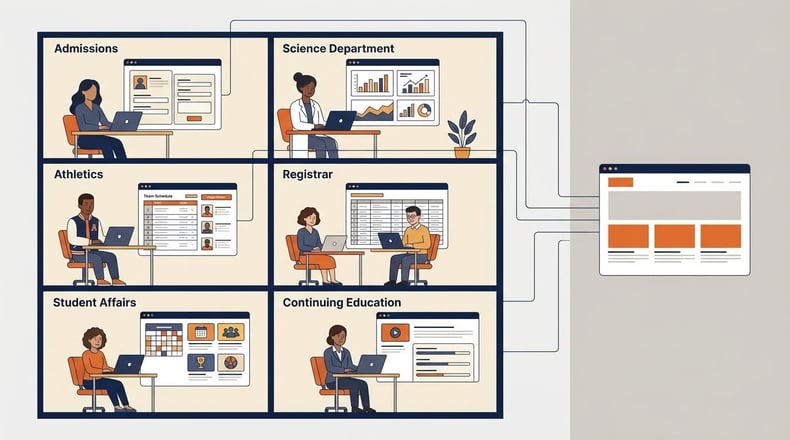
Ask a web director how many pages their institution publishes, and watch the pause. Most large universities honestly don't know. That's the real starting condition for university website management at scale: a sprawling digital footprint built by hundreds of people across academic departments, research centers, athletics, admissions, student affairs and continuing education, each working at a different pace with a different idea of what "done" looks like.
The pressure on that footprint keeps rising. Websites are getting more complex, and complexity has a cost. A 2026 web accessibility benchmark study of one million home pages found an average of 56.1 detectable errors per page, up more than 10% in a single year, alongside a 22.5% jump in page complexity. Higher ed feels that math more than most industries because the content volume is enormous and the people producing it are almost never full-time web professionals. Institutions that get this right treat the website as shared infrastructure rather than a marketing asset, and they lean on purpose-built higher education technology to enforce the rules their teams can't be expected to memorize.
Why Is University Website Management So Hard at Scale?
Every institution starts with a reasonable idea: let the people closest to the content write the content. The chemistry department knows its labs better than the marketing office does. That instinct is correct. What breaks is everything around it because distributed authorship without structure produces a website that reads as if it belongs to 12 different organizations.
How Many Sites Does a Large University Actually Run?
A midsize public university typically maintains a flagship site plus separate presences for each college, dozens of academic departments, research centers, campus services, athletics and a rotating cast of campaign microsites. Add legacy sites nobody has touched since the staff member who built them left, and the count climbs fast. Each property brings its own maintenance burden, from templates and contributors to the risk that content breaks or falls out of date.
Who Is the Website Actually Serving?
The audience shifted before most site architectures did. The Modern Learner returns to education whenever life or work demands something new, building on existing experience instead of following a single linear route from school to career. That person visits a site as a prospective undergraduate at 18, comes back at 27 to compare certificate programs and returns at 40 looking for a workforce credential their employer will pay for. Each visit lands them on a different corner of the site, maintained by a different team, so the experience never recognizes them as the same person.
Institutions used to manage a one-time student lifecycle with a clear beginning and end. Now they support a continuous journey with four ongoing imperatives: Discover, helping learners find their way to the institution; Plan, running the academic operations that turn interest into action; Engage, keeping communication timely and personal; and Evolve, supporting re-engagement and skill-building over decades. The website is where Discover happens, and a fragmented site fails at it every day. For a closer look at how institutions can personalize the discovery experience in Modern Campus CMS, explore this guide.
What Does Weak Governance Actually Cost Institutions?
The costs are rarely dramatic, which is exactly why they compound. Three different offices publish three versions of the financial aid deadline, and two of them are wrong. Program pages describe curricula that changed two catalog cycles ago. Department sites drift visually until the brand guidelines read like a suggestion. Meanwhile, prospective students draw conclusions about institutional competence from what they can see, and what they see is inconsistency.
What Governance Model Works Best for Higher Ed Website Governance?
Higher education website governance comes down to three models, and institutions have run the experiment on all of them for two decades. The question is which one survives contact with faculty autonomy, staff turnover and a central web team of four people supporting 3,000 contributors. The short answer is hybrid governance. The longer answer is that hybrid governance only works when roles and responsibilities are enforced by the platform rather than remembered by staff.
|
Model |
Who publishes |
Strength |
Failure mode |
|
Centralized |
One central team controls all content |
Brand and quality stay tight |
Central team becomes a bottleneck and departments route around it |
|
Decentralized |
Every department owns and publishes its own pages |
Fast updates, local expertise |
Standards erode, duplication spreads, accessibility drifts |
|
Hybrid |
Central team sets standards, departments publish within them |
Speed with guardrails |
Requires real permissions and workflows to hold |
Why Does Hybrid Governance Win in Higher Ed?
Hybrid works because it splits ownership along the line where expertise actually sits. The central team owns the design system, templates, information architecture, accessibility standards, security and search performance. Departments own the substance: program descriptions, faculty profiles, event details and news. Nobody negotiates for permission to fix a typo, and nobody wonders whether a department page will break the brand because the template won't let it.
The catch is that hybrid governance only functions when the platform enforces the split. A policy document describing who may do what is a wish. Role-based permissions inside the content management system are a fact. If you're building this framework from scratch, our deeper guide to website governance best practices covers role design and the training and documentation needed to support it in detail. The rest of this article focuses on what changes when that framework has to stretch across dozens of departments at once.
How Should Permissions Work in Distributed Content Management?
Permissions are the most underused tool in higher ed web operations. Most institutions run two tiers, admin and everyone else, then wonder why quality varies. Effective distributed content management needs four or five tiers that map to how people actually work on campus: contributors who draft but can't publish, section editors who publish within their own department, site owners who manage templates and access for a college or division, and central administrators who control the platform itself.
What changes at scale is scoping. A permission tier that works for one department breaks when it’s replicated 40 times without a clear map of which section each role applies to. Before configuring anything, build the ownership map: every subsite, every section, every named owner. Institutions that skip this step end up with editors who accumulated access during a reorganization three years ago and nobody remembers why.
What Should the Central Team Never Give Away?
Some controls belong at the center permanently. Template code, global navigation, brand assets, redirect management, integrations and user provisioning should stay with the central team, no matter how much autonomy departments have. These are the elements where a well-meaning local change causes institution-wide damage, and they're the elements that make choosing a university CMS a governance decision more than a feature decision. Content stays local. Infrastructure stays central.
What Should Approval Workflows Look Like in Practice?
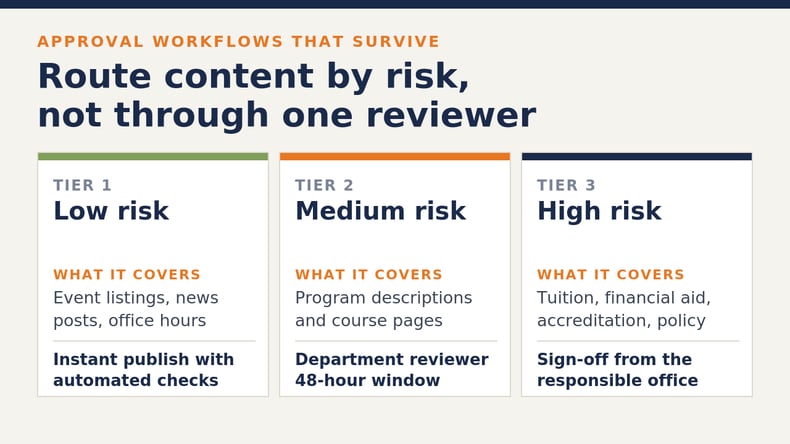
Approval workflows fail for one reason: institutions apply the same level of scrutiny to a faculty bio and a tuition page. Then everything queues behind the same overloaded reviewer until exceptions become the norm and the workflow falls apart. The fix is to route content by risk instead of routing everything through one person.
Three tiers cover most situations. Low-risk updates like event listings, news posts, contact information and office hours publish immediately with automated checks only. Medium-risk content, such as program descriptions and course pages, routes to a department reviewer. High-risk content covering tuition, financial aid, admissions requirements, accreditation and policy language requires sign-off from the responsible office before it goes live.
How Do Institutions Keep Approvals From Becoming a Bottleneck?
Set service expectations and publish them. A 48-hour review window for medium-risk content, with automatic escalation to a backup reviewer, keeps trust intact. Build in scheduled publishing so departments can queue updates ahead of registration periods rather than racing the clock. Audit the queue quarterly. If one reviewer is holding 60% of the volume, the tiering is wrong, not the reviewer.
How Do Institutions Manage Accessibility Across Hundreds of Contributors?
Accessibility is where decentralized publishing gets expensive. Every contributor who introduces an accessibility issue creates a defect that's cheap to prevent and costly to fix later. Multiply that by 800 occasional editors, and the backlog becomes a budget line.
The regulatory clock makes this concrete. The Department of Justice extended the Title II compliance deadline by one year, giving public institutions in jurisdictions of 50,000 or more until April 26, 2027 to conform to WCAG 2.1 Level AA, with smaller jurisdictions and special district governments due by April 26, 2028. Because population is calculated at the state level, that first date covers nearly every public university. Our breakdown of web accessibility requirements for universities covers the exceptions and scope in detail.

What Belongs in the Platform Instead of the Policy?
Anything a machine can catch. Require alt text at upload. Block publishing when contrast fails. Flag heading structures that skip levels. Scan the full site on a schedule and route findings to the owner of each page rather than dumping a 4,000-row report on the central team. Policy handles judgment calls like whether a video needs audio description. The platform handles everything else because contributors who publish twice a semester will never internalize WCAG success criteria and shouldn't have to.
How Do Institutions Build Collaboration Into University Website Management?
Governance documents don't create collaboration. People do, and higher ed has a retention problem that makes this harder. The 2026 EDUCAUSE Workforce Report found that among institutions taking no action on workload challenges, 41% reported turnover that reduced capacity to meet strategic priorities. When a long-tenured web contributor leaves, the undocumented process leaves with them.
A few practices consistently hold distributed teams together:
- Run a standing web contributors group. A monthly 30-minute call where the central team shares changes and departments raise problems does more for consistency than any style guide.
- Document inside the tool, not beside it. Help text and templates that live in the CMS get used. A governance PDF on a shared drive does not.
- Onboard by role, not by rank. A new contributor needs 20 minutes covering their four main tasks, not a two-hour platform tour.
- Publish a public owner map. Every section should list a named owner and a review date so accountability survives staff changes.
7 Practices That Keep Large University Websites Under Control
Institutions that run university website management well tend to share the same habits.
- Inventory everything once a year. Institutions can't govern sites if they don't know they exist. Crawl the domain and all subdomains, then assign an owner to every property.
- Set expiration dates on content. Give every page a review date. Pages that pass that date without review get flagged, then unpublished.
- Make templates the default path. When the easiest way to build a page is the compliant way, compliance stops being a negotiation.
- Retire aggressively. Orphaned pages and dead microsites dilute search performance and create accessibility liability.
- Measure at the department level. Give each unit a dashboard showing accessibility and content quality issues. Visibility drives behavior.
- Connect the site to the academic source of truth. Program and course information should flow from the catalog system rather than being retyped into 40 department pages.
- Review governance annually. Reorganizations, new colleges and platform changes all shift ownership. A model nobody revisits becomes fiction within two years.
University Website Management FAQs
How many people should have CMS access at a large university? More than most central teams are comfortable with. Restricting access pushes departments toward shadow sites built outside the platform, creating governance and quality problems that are hard to manage. Broad access with tight, role-appropriate permissions is the safer trade.
Should each department have its own website or live on the main site? Live on the main site whenever possible, using shared templates and a common navigation structure. Separate domains create ongoing search and accessibility challenges while making consistent university website management substantially harder.
What do you do about departments that refuse to use the central platform? Find out why before escalating. Most shadow sites exist because the official process was too slow or the template didn't support something the department genuinely needed. Fix the underlying gap, then migrate the site. Enforcement without a fix just pushes the next department to a different workaround.
How often should a university audit its website? Run automated accessibility and link scans continuously, then schedule regular reviews of high-traffic pages and the broader content inventory. Institutions planning a website redesign should treat the audit as the first project phase rather than a post-launch cleanup task.
Building a Site That Keeps Pace With Modern Learners
Managing a large university website across departments isn't a technology problem with a governance side effect. It's a governance problem that technology can either solve or amplify. Institutions doing this well have made peace with decentralized authorship, then built governance into the platform so the right thing becomes the easy thing. That combination separates strong higher ed website practices from a site that grows faster than anyone can maintain it.
When your site is accurate, accessible and coherent, learners moving in and out of education can find the right program the first time they look, whether that's their first term or their fourth return. Modern Campus partners with institutions to support that continuous learner journey, connecting the systems, content and standards that keep a sprawling digital presence working as one. To build a foundation that scales with your departments instead of fighting them, schedule a conversation with our team.
Last updated: September 3, 2026.