Workforce development programs and continuing education overlap so often that institutions blur them, but the distinction shapes how they are funded, designed and measured.
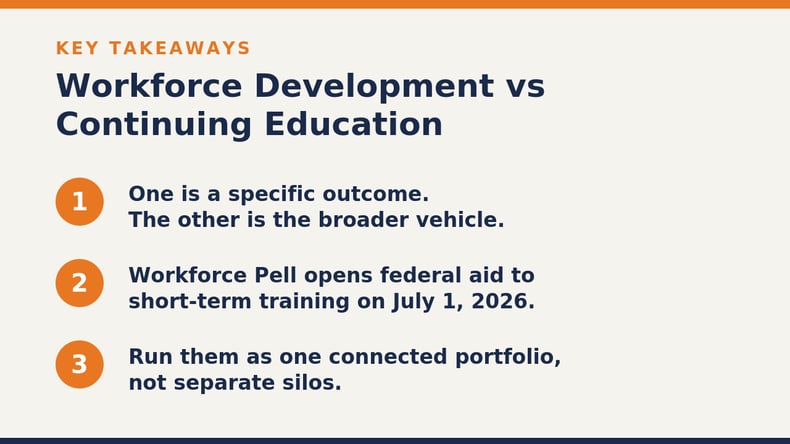
- Workforce development programs are short, skills-based and built for job placement, while continuing education programs cover a wider mix of career advancement and lifelong learning.
- Most workforce training is employer-aligned and frequently funded through corporate contracts, where continuing education learners more often pay their own way.
- A federal shift has taken effect: As of July 1, 2026, Workforce Pell is extending Pell Grant eligibility to short-term workforce training for the first time.
- Institutions that treat these programs as a connected portfolio, not separate silos, are best positioned to serve adult learners and capture new funding.
If your continuing education and workforce teams still operate on different systems and definitions, now is the moment to align them.
Walk into any continuing education division, and you'll hear "workforce development" and "continuing education" used almost interchangeably. The confusion is understandable because the two share many of the same audiences and objectives. But understanding the distinction matters more in 2026 than it ever has. Employers expect 39% of core job skills to change by 2030, which is pushing colleges to rethink how they design workforce development programs and the broader portfolio around them. For institutions supporting learners across their careers, the clarity pays off in stronger programs and better results.
This guide breaks down what workforce development means, how it differs from continuing education and how universities are stepping up to support workforce initiatives right now.
What Are Workforce Development Programs?
Workforce development is the practice of building specific, job-ready skills that connect people to employment and connect employers to talent. It focuses on the needs of both sides: the learner who wants a faster path to a good job and the employer who can't hire fast enough. Workforce development programs are the structured offerings that deliver on that goal. They're usually short-term and tied to measurable employment outcomes.
What Do Workforce Development Programs Typically Include?
These programs tend to be skills-first and credential-bearing rather than degree-seeking. They are designed to move a learner into a role quickly, which is why they lean toward compact formats and industry validation. Common formats include:
- Short-term certificate and credential programs in fields like healthcare, IT, skilled trades and transportation
- Corporate training delivered under contract with a local or regional employer
- Apprenticeships and related technical instruction tied to a registered trade
- Bootcamp-style intensives that compress a skill set into weeks rather than years
The thread running through all of these formats is alignment. Workforce training works when the curriculum maps to a real job that an employer is actively trying to fill, not to a course a department happens to offer.
Who Are Workforce Training Programs Designed For?
The audience is rarely the traditional 18-year-old arriving straight from high school. More often, it's the career switcher, the working parent, or the adult who needs to reskill without pausing a paycheck. That’s the Modern Learner: an individual who moves in and out of education throughout their life, building skills and evolving their path as goals change.
That framing reshapes who institutions are building for. Modern Learners don't move through education once and graduate for good. They return to it repeatedly, which means workforce education has to meet them where they are in life. Designing for that reality is the difference between a program that fills and one that stalls.
How Does Workforce Development Differ From Continuing Education?
Workforce development is a specific outcome, and continuing education is the broader vehicle that often delivers it. Workforce training almost always lives inside a continuing education or non-credit division, but not everything that division offers is workforce development. The distinction comes down to intent.
How Do Continuing Education Programs Work?
Continuing education programs serve a wider set of motivations than workforce training alone. Some learners enroll to satisfy a licensure renewal requirement, while others pursue learning to advance in a current field or simply for personal enrichment. These programs tend to run longer than workforce intensives, often spanning multiple courses that stack into a certificate or progress toward a degree. Because the goals vary so much, continuing education divisions have spent decades building the flexibility to serve both learners who return to the workforce and those pursuing growth for its own sake.
Where Do Professional Education Programs Fit?
Professional education programs sit close to workforce development but carry a distinct flavor. They target people already established in a career who want to sharpen their expertise or advance professionally. Where workforce training often aims to get someone hired, professional education programs usually aim to help someone already employed advance or pivot. Examples include executive certificates, project management credentials or other specialized continuing professional education that keeps practitioners current. Many institutions deliver these options through the same non-credit infrastructure that powers their workforce offerings, which is exactly why the categories get tangled.
What Are the Key Differences Between Workforce Development Programs and Continuing Education?
When teams confuse these two, they make planning mistakes: pricing a workforce program like an enrichment course or measuring a continuing education offering by job placement alone. A side-by-side view keeps the strategy honest. Here are the differences that matter most:
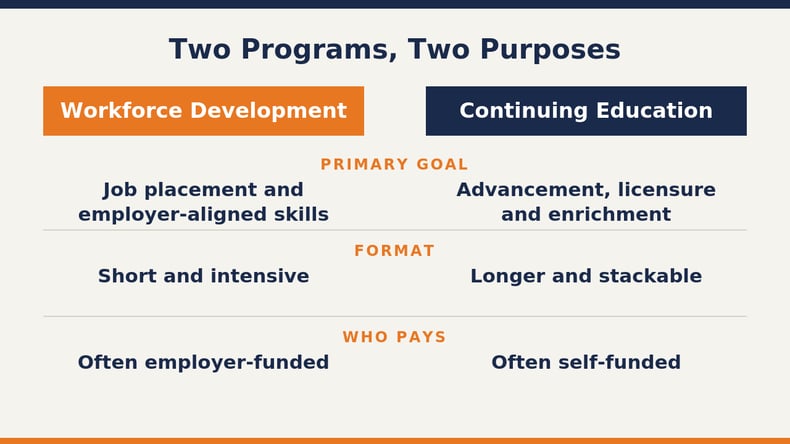
- Primary goal: Workforce development programs aim at job placement and employer-aligned skills. Continuing education programs extend beyond workforce training to support career growth and personal enrichment.
- Length and format: Workforce training tends to be short and intensive. Continuing education programs often run longer and stack into certificates or degrees.
- Credential type: Workforce programs lead to industry-recognized, often stackable credentials. Continuing education can award CEUs, certificates, academic credit or digital badges.
- Who funds it: Employers often pay for workforce training through corporate contracts. Continuing education learners more often self-fund.
- Funding eligibility: Short-term workforce programs are gaining federal aid access for the first time, a change that continuing enrichment courses won't see.
How Are Universities Supporting Workforce Initiatives?
Universities are supporting workforce initiatives by:
- Aligning programs to real labor market data
- Deepening employer partnerships
- Establishing short-term credentials that connect directly to in-demand jobs
The most effective institutions treat workforce development programs as a strategic priority rather than a side hustle for the continuing education office. They invest in the systems and relationships that let them respond quickly as industry needs change.
Why Does Workforce Pell Change the Workforce Training Equation?
The biggest near-term shift is federal. As of July 1, 2026, a new federal rule has opened Pell Grant funding to high-quality short-term programs that prepare students for high-skill, high-wage and in-demand jobs. For the first time, federal aid can flow to workforce training that runs 8 to 15 weeks, a category historically locked out of Pell because it fell under the old 600-hour minimum. Institutions that prepare eligible programs can now extend access to learners who previously paid out of pocket. Launching Workforce Pell programs requires significant implementation work, including auditing the institutional portfolio against length and outcome requirements and securing governor approval.
How Do These Programs Connect to the Modern Learner Journey?
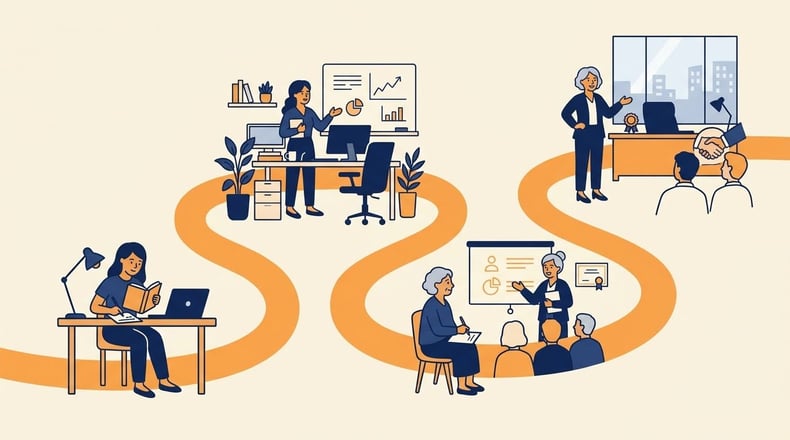
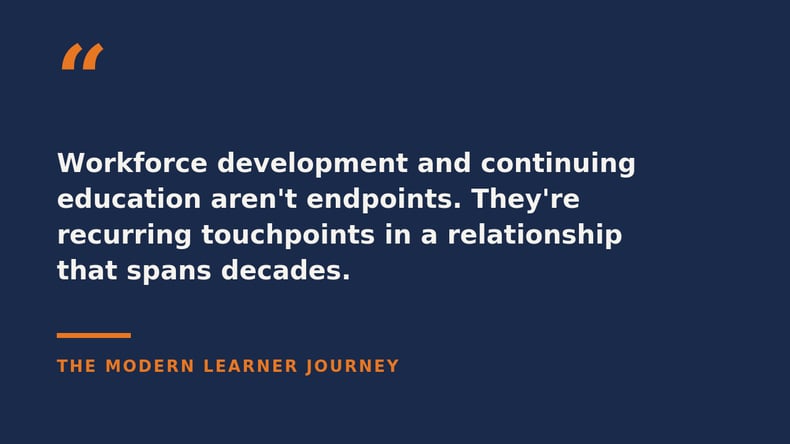
Supporting workforce initiatives well means thinking past a single enrollment and across the full modern learner journey. That journey gives institutions four imperatives to get right: discover, plan, engage and evolve. Discover is about helping learners find their way to the institution, so prospective students can see relevant workforce programs and understand their options. Plan is about better operations driving better outcomes and building a friction-free path from interest to enrollment. Engage is about keeping learners connected with timely, personalized communication that holds them through completion. Evolve is about building for lifelong progression, supporting re-engagement and the next credential after the first one lands. Workforce development and continuing education are not endpoints in this view. They are recurring touchpoints in a relationship that can span decades.
What Systems Do Institutions Need to Manage Both?
Running workforce training and continuing education programs side by side exposes a hard truth: most legacy systems weren't built for this modern audience. Adult learners move fluidly across programs and learning models, and they expect a consumer-grade experience. Institutions need infrastructure that can manage non-traditional student programs, supporting flexible enrollment and the reporting requirements that come with them. The institutions making real progress are treating continuing education as a strategic engine rather than a standalone unit and giving it the tools to scale its programs without drowning staff in manual work.
Frequently Asked Questions
Is workforce development the same as continuing education? No. Workforce development is a specific, employment-focused outcome, while continuing education is the broader category that often houses it. Workforce training is one type of program a continuing education division offers, alongside a broader range of professional and personal learning opportunities. The overlap is real, but the goals differ.
Are workforce development programs credit or non-credit? Historically, most have been non-credit, which is part of why they were excluded from federal aid for so long. That is changing as institutions redesign offerings to be credit-bearing or to stack into recognized credentials, partly to meet Workforce Pell eligibility and partly because learners increasingly want credentials that count toward something larger.
How long do workforce training programs usually take? Many run for a matter of weeks rather than semesters. The new Workforce Pell category specifically covers programs of 8 to 15 weeks, reflecting how much of today's high-demand training is built for speed. Continuing education programs as a whole span a much wider range of timelines.
Why does this distinction matter for enrollment strategy? Because each type attracts a different learner with different needs and expectations. Treating workforce education and enrichment courses identically leads to mispriced programs and missed audiences. With 59 of every 100 workers projected to need reskilling or upskilling by 2030, the institutions that segment clearly will capture demand others miss.
Where Does Your Institution Go From Here?
The line between workforce development and continuing education will keep blurring as learners demand faster, more flexible paths and as new funding reshapes what's possible. The institutions that win will connect discovery, enrollment, engagement and re-engagement into one continuous experience, treating credentials like microcredentials and certificates as steps in a longer relationship rather than one-off transactions. That strategy requires a partner that understands the full journey, not a single product working in isolation.
Modern Campus helps institutions support learners across that entire journey, connecting systems, experiences and data from first discovery through lifelong learning. To see how that partnership can strengthen your workforce and continuing education programs, request a demo with Modern Campus.
Last updated: August 6, 2026
.png)