AI-powered text messaging is transforming how institutions connect with students across the entire learner lifecycle.
-
Two-way texting enables genuine conversations that build relationships, with students who engage in conversational messaging demonstrating higher action rates than those who receive static messages.
-
SMS compliance with TCPA and FERPA regulations is essential for institutions; violations can result in fines of $500 to $1,500 per message.
-
AI automation blended with human interaction allows institutions to scale personalized support without overwhelming staff, reducing summer melt and improving retention rates.
Institutions that adopt higher education text messaging platforms position themselves to meet modern learners where they already spend their time: on their phones.
For a first-generation college student who has a question about FAFSA at 10 PM, waiting until office hours isn't an option. When an accepted student feels overwhelmed by housing forms during summer break, that uncertainty can derail their entire enrollment. If a struggling sophomore needs academic support, an email buried in their inbox won't reach them in time.
These moments define whether students persist or disappear. Institutions that support the modern learner lifecycle are discovering that text messaging is becoming the primary way to reach students when it matters most. With 98% of Americans now owning a cellphone, the path to connecting with learners through higher ed text messaging platforms is clear.
AI-powered conversational messaging is a powerful evolution in higher ed. With enrollment challenges affecting institutions nationwide and student expectations continuing to rise, the ability to connect through mobile devices has moved from convenient to critical.
Why Are Traditional Communication Channels Failing Students?
Email served higher education well for decades, but the reality has shifted. While 98% of text messages are read, email open rates hover around 20%. SMS messages also generate response rates of 45%, compared to email's 6%.
For institutions, this engagement metric is a retention crisis hiding in plain sight.
What Happens When Students Miss Critical Messages?
When institutions rely solely on email, students are more likely to miss important deadlines, support resources or engagement opportunities. In cluttered inboxes, messages from financial aid get buried under campus announcements, club invitations and course reminders. By the time students notice a critical FAFSA deadline notification, the opportunity may have already passed.
The asynchronous nature of email compounds this problem. When a student has an urgent question about registration or financial aid, waiting 24 to 48 hours for an email response feels like an eternity. The moment for action passes, and institutions lose the chance to intervene.
Phone calls fare no better. Students routinely screen calls from unknown numbers, treating voicemails as an afterthought rather than a priority.
How Are Student Communication Expectations Changing?
Generation Z is the first truly mobile-native generation. They've never known a world without smartphones and instant connectivity. Research shows that Gen Z spends an average of 6 hours and 27 minutes on their phones daily. This constant connectivity has shaped their expectations for all communications, including those from their educational institutions.
When students can get instant answers from their bank, their favorite retailer and their food delivery service, they expect similar responsiveness from their college or university. According to Salesforce research, 82% of students say they need more proactive and personalized support from their institution than they did 5 years ago. The disconnect between institutional communication strategies and student expectations creates friction at every stage of the learner journey.
What Makes a Higher Education Text Messaging Platform Different?
The distinction between general business texting tools and specialized higher education text messaging platforms lies in their purpose-built features and compliance capabilities. Generic SMS platforms aren't designed to address the unique challenges academic institutions face.
Why Can't Institutions Use Consumer Texting Apps?
Student privacy regulations require strict controls that consumer applications don't provide. FERPA compliance demands specific safeguards for student data that general business texting tools weren't built to handle. Education-specific platforms include built-in protections to secure sensitive information while enabling effective communication.
Campus populations also require sophisticated segmentation that doesn't exist in standard business contexts. Students need to be grouped by academic status, major, graduation year, housing situation, financial aid status and dozens of other variables specific to higher ed.
How Does AI Transform the Messaging Experience?
The most practical evolution in campus communication comes from AI-powered personalization at scale. Advanced higher education text messaging platforms leverage artificial intelligence to understand, interpret and respond to student inquiries in real time.
The result is personalized, context-aware conversations rather than generic automated responses. When a nursing student texts about registration, the platform can provide information specific to their program. When a business major asks about career services, they receive relevant guidance for their field.
AI texting uses natural language processing to power conversations that feel genuinely helpful rather than robotic. Students can ask questions about deadlines or request help with registration, and get support navigating campus resources through familiar text messaging interfaces.
Automation allows institutions to scale personal communication without overwhelming staff resources. When a student exhibits warning signs like missed classes or declining grades, automated systems can trigger supportive messages while routing complex issues to human advisors who can provide personalized attention.
How Does Two-Way Texting for Student Success Drive Results?
Traditional SMS broadcasting treats students as passive recipients of information. Two-way texting for student success creates dynamic relationships that adapt to individual student needs.

What Does Conversational Messaging Look Like in Practice?
Imagine a student named Marcus receives a text about an upcoming financial aid deadline. Instead of a generic blast, the message acknowledges that he's a second-year engineering student and includes a direct link to the scholarship application relevant to his major.
Marcus replies with a question about required documents. Within moments, he receives a helpful response guiding him through the process. If his question is complex, the conversation seamlessly transitions to a financial aid counselor who can provide personalized assistance.
This back-and-forth dialogue transforms texting from a notification tool into a support system. Students can reply at their own pace with questions and concerns. By asking the right questions, institutions can uncover roadblocks that may, if left unaddressed, prevent a student from persisting.
What Impact Does Conversational Texting Have on Retention?
The evidence for two-way texting for student success continues to mount. Students engaged in genuine two-way text conversations demonstrate higher action rates compared to those receiving one-way broadcast messages.
Austin Community College District achieved a 15% increase in persistence among part-time students by implementing targeted text messaging campaigns focused on financial aid deadlines and money management tips. For a community college serving thousands of students, this achievement translates to hundreds of additional graduates and millions in retained tuition revenue.
Institutions exploring texting strategies for student retention find that even modest investments yield substantial returns. Recent research and institutional case studies show that text messaging enables scalable outreach, helping institutions identify at-risk students and deliver timely support. Both texting and higher-touch approaches can improve college entry and completion among traditionally underrepresented populations.
How Can Institutions Prevent Summer Melt Through Strategic Texting?
The period between high school graduation and college enrollment creates numerous opportunities for students to fall through administrative cracks. Institutions are finding that strategic texting campaigns specifically designed to prevent summer melt can dramatically improve yield rates.
Why Do Accepted Students Fail to Enroll?
Summer melt is the phenomenon where college-intending students who have applied to, been accepted by and made a deposit to a college fail to matriculate in the fall. Estimates suggest that 10% to 40% of college-intending students experience summer melt each year, with rates higher among low-income students and first-generation learners.
The majority of students who fail to matriculate do so not because they had a change of heart but because they encounter logistical or emotional barriers and lack the knowledge or support systems needed to overcome them. Without high school counselors available during the summer months, students may not have mentors to turn to for guidance.
Financial complexity often triggers melt. Even if students understand tuition costs before applying, they may feel blindsided by additional expenses like housing, books and student activity fees. Their plans to pay may fall through when a summer job doesn't materialize or financial aid packages fall short of expectations.
How Does Texting Address Summer Melt?
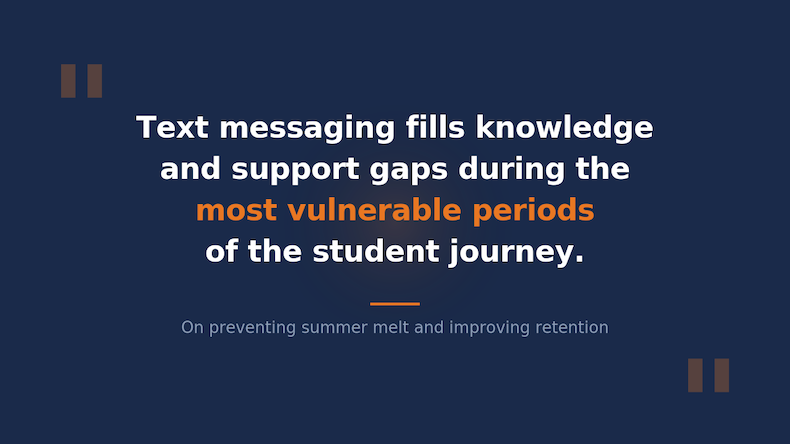
Strategic text messaging fills knowledge and support gaps during this vulnerable period. By reaching students through their preferred channel, institutions can guide thousands of incoming students to the right support services.
Automated texts supplemented with personalized messaging show students they have accessible support. Texts can help students solve immediate challenges and reassure them that help will be available throughout their college experience.
Successful summer melt campaigns include reminders about FAFSA completion deadlines, guidance on housing applications and course registration and connections to orientation requirements that otherwise derail enrollment plans. A simple message like, "Your housing application deadline is in 5 days. Need help? Reply and we'll walk you through it" can make the difference between a student who enrolls, and one who never completes the process.

What SMS Compliance Requirements Must Institutions Follow?
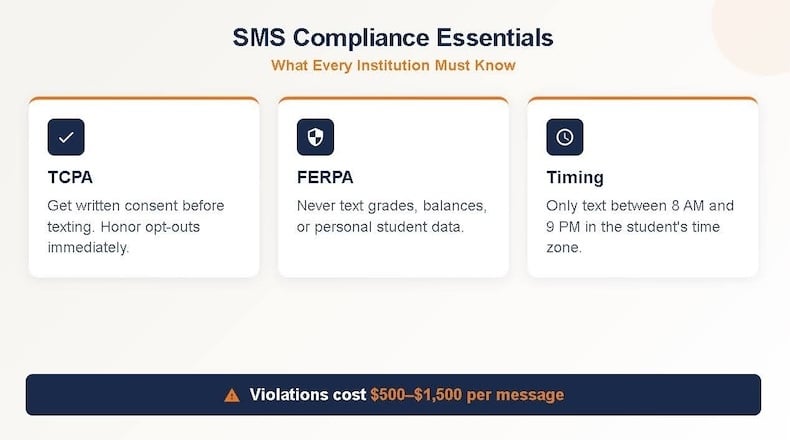
Effective higher ed text messaging requires careful attention to regulatory compliance. TCPA violations can result in fines ranging from $500 to $1,500 per message, and non-compliant institutions face potential class-action lawsuits.
How Does TCPA Affect Campus Texting Programs?
The Telephone Consumer Protection Act requires institutions to obtain express written consent before sending promotional or automated messages. For campus communication, students must take a clear affirmative action to opt in, and consent cannot be implied based on application submission or enrollment.
Compliance requires transparent disclosure about message content and frequency before obtaining consent. Students must understand they're agreeing to receive texts, as well as what type of information they'll receive and how often they should expect messages.
The TCPA also mandates clear opt-out mechanisms. When a student texts STOP, institutions must immediately cease sending messages and send confirmation that the request was processed. Recent rule changes require institutions to process opt-out requests within 24 hours and recognize various forms of unsubscribe requests, not just the word "STOP."
Texting hours matter as well. The TCPA prohibits sending messages outside of 8 AM to 9 PM in the recipient's time zone, requiring platforms that can accommodate students across different geographic areas.
How Does FERPA Protect Student Information in Text Messages?
The Family Educational Rights and Privacy Act (FERPA) adds another layer of SMS compliance. FERPA regulations protect personally identifiable information and apply to all institutions that receive federal funding.
Text messaging is not a secure platform for sharing private student data. Sending personally identifiable information through SMS can violate FERPA and expose students to security risks. Sharing that a deadline for tuition payment is approaching doesn't violate FERPA, but texting the specific amount a student owes, their grades or their enrollment status without proper safeguards does.
This distinction requires institutions to choose higher education text messaging platforms specifically designed with FERPA compliance in mind. Purpose-built solutions include encrypted data transmission, secure integrations with Student Information Systems and proper consent management workflows.
What Industry Standards Apply Beyond Federal Regulations?
Beyond TCPA and FERPA, institutions should be aware of guidelines from the Cellular Telecommunications Industry Association (CTIA) and the Mobile Marketing Association (MMA). These organizations provide best practices for commercial messaging programs that carriers monitor and enforce.
CTIA guidelines require clear identification of the sending institution in initial messages. The MMA discourages promotional programs like contests or sweepstakes via SMS texting.
The best strategy for maintaining compliance involves selecting platforms specifically designed for higher ed that automate many compliance requirements, provide audit trails and include staff training resources.
How Should Institutions Implement AI-Powered Messaging Programs?
Success with higher education text messaging platforms requires thoughtful planning, cross-campus collaboration and phased implementation that builds on early wins.
What Should Institutions Consider Before Launch?
Before implementing an SMS program, institutions should evaluate their communication gaps and identify where text messaging can have the greatest impact. High-impact use cases typically include:
-
Enrollment yield campaigns
-
Financial aid deadline reminders
-
Registration support
-
Early alert interventions for at-risk students
Prioritize higher ed-specific features, including FERPA compliance, Student Information System integration, two-way conversational capabilities and sophisticated audience segmentation. The ability to blend AI automation with human handoff ensures students receive immediate responses to simple questions while getting personalized attention for complex issues.
Cross-campus buy-in proves essential for success. When multiple departments send messages without coordination, students receive conflicting information and develop message fatigue. Successful implementations involve admissions, financial aid, student success and academic advising in developing coordinated communication strategies.
What Best Practices Lead to Strong Engagement?
Messages should be concise, ideally under 160 characters. Every text should include a clear purpose and a single call to action rather than overwhelming students with multiple requests.
Personalization drives engagement. Students are more likely to engage when communication acknowledges their individual circumstances. Following established best practices for texting in higher education helps institutions maximize these engagement opportunities. This includes using their name, referencing their major or year and sharing information specific to their situation.
Tone matters. Messages should feel conversational and supportive rather than formal or demanding. Emojis, used sparingly, can add warmth without appearing unprofessional.
Timing requires careful consideration. Messages should arrive when students can act on them, avoiding early morning hours or late nights. Deadlines should be communicated with enough lead time for students to complete required tasks without feeling rushed.
Frequently Asked Questions
What is the difference between one-way and two-way texting in higher education? One-way texting broadcasts announcements to students without enabling responses. Two-way texting creates conversational exchanges where students can ask questions, receive personalized guidance and build relationships with institutional staff through their preferred communication channel.
How can institutions ensure SMS compliance with FERPA regulations? Institutions should use higher education text messaging platforms specifically designed with FERPA compliance features, including encrypted data transmission, secure system integrations and proper consent management. Avoid sending personally identifiable information through text messages and ensure all messaging platforms undergo appropriate security audits.
What types of messages work best for student engagement? The most effective messages are personalized, timely and action-oriented. Successful campaigns include deadline reminders specific to the student's situation, progress check-ins that acknowledge individual circumstances and supportive outreach during critical transition periods like enrollment and the first semester.
How do institutions measure the success of texting programs? Key metrics include open rates, response rates, task completion rates for specific campaigns, retention and persistence data and student satisfaction surveys. Institutions should establish baseline measurements before launch and track improvements over time.
Start Communicating on Your Students' Preferred Channel
The communication gap between institutions and students is one of higher ed's most pressing challenges. Students who feel disconnected, unsupported or uninformed are more likely to struggle academically and less likely to persist to graduation.
AI-powered text messaging offers a path forward that honors both institutional capacity and student preferences. By meeting learners on the devices they already use, institutions can build the responsive, personalized support systems that students expect and deserve.
Request a demo with Modern Campus to explore how conversational text messaging can strengthen student success across your campus.
Last updated: April 30, 2026
.png)