Campus scheduling dysfunction signals deeper operational crises that directly undermine student retention and institutional competitiveness.
-
Administrative inefficiency: Manual scheduling processes consume valuable staff time that should be focused on strategic student support initiatives.
-
Student barriers: Course availability issues prevent timely degree completion, extending time to graduation and increasing financial burden.
-
Resource waste: Poor visibility into space utilization leads to misallocated facilities, while optimal scheduling opportunities remain hidden.
-
Faculty dissatisfaction: Scheduling systems that ignore preferences and expertise reduce job satisfaction among valuable academic talent.
Institutions that continue operating with antiquated scheduling systems will fall behind competitors who embrace integrated technology solutions that automate conflicts, optimize resources and create clear pathways to student success.
Campus scheduling shouldn't feel like orchestrating chaos. Yet across higher education, administrators spend countless hours battling spreadsheets, resolving conflicts and fielding frustrated calls from students who can't get into required courses. The root problem is relying on outdated tools when a modern student scheduling system could transform these daily headaches into streamlined operations.
With national retention rates reaching 68.2% in 2022, institutions can't afford scheduling barriers that push students toward the exit. Antiquated scheduling approaches are costing more than time as they undermine student success and institutional efficiency.
What Warning Signs Indicate Scheduling System Problems?
Smart administrators recognize that scheduling challenges rarely exist in isolation. When your campus shows multiple symptoms of scheduling dysfunction, it's time to acknowledge that band-aid solutions won't address the underlying issues. These eight warning signs reveal when your institution needs to embrace a modern student scheduling system.
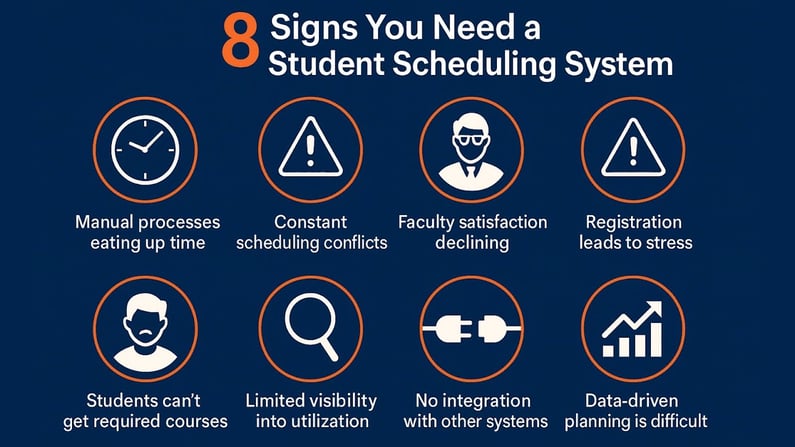
1. Manual Processes Are Eating Up Administrative Time
Your registrar's office resembles a war room during scheduling season, with staff manually cross-referencing spreadsheets and sticky notes covering every available surface. Traditional approaches demand considerable time and effort from administrators and faculty, often resulting in schedules that fail to optimally allocate resources or meet stakeholder needs. When your team spends weeks building schedules that should take days, manual inefficiency has become the enemy of strategic planning.
The ripple effects extend beyond overtime hours. Staff who should focus on student support and curriculum development instead become data entry specialists. This misallocation of human resources represents a hidden cost that compounds semester after semester, ultimately impacting your institution's ability to deliver exceptional student experiences.
Administrative burnout becomes inevitable when skilled professionals repeatedly tackle problems that academic scheduling software could solve automatically. Higher education scheduling software transforms these tedious manual processes into streamlined workflows that free staff to focus on strategic initiatives.

2. Constant Scheduling Conflicts Require Daily Resolution
Double-booked classrooms have become routine rather than exceptional. Faculty members discover conflicting assignments after schedules are published, creating last-minute scrambles to find alternative solutions. These snafus signal fundamental system failures that compromise educational delivery.
Effective scheduling systems can reduce conflicts, demonstrating the stark difference between manual and automated approaches. When conflicts become daily occurrences, your institution wastes resources and damages credibility with students, faculty and staff.
The hidden costs multiply quickly. Resolving each conflict requires administrative intervention, often involving multiple departments. Faculty preparation time gets disrupted, students miss valuable learning opportunities, and institutional reputation suffers when scheduling appears chaotic rather than professional.
3. Students Can't Get Required Courses When Needed
When students discover required courses aren't available when needed for timely graduation, it can be frustrating. Approximately 60% of students encounter course availability issues that directly hinder their academic progress. This scheduling barrier extends the time to degree completion and increases the student's financial burden.
These student scheduling challenges particularly impact non-traditional learners who need flexible options to balance academic commitments with work and family responsibilities. When institutions fail to offer courses at accessible times, they inadvertently exclude student populations from academic success.

The retention implications are serious. Students who can't progress toward graduation on schedule become more likely to transfer, stop out or abandon their educational goals entirely. This effect leads to lost tuition revenue and undermines institutional mission fulfillment.
4. Limited Visibility into Room and Resource Utilization
Your institution lacks clear insight into how campus spaces and resources are actually being used throughout each term. Classrooms remain empty during prime hours while other spaces experience overcrowding. Specialized equipment sits unused while faculty struggle to access technology for their courses. This resource misallocation indicates that scheduling decisions rely on incomplete information rather than data-driven optimization.
Without comprehensive visibility, administrators can't identify opportunities to improve space utilization or justify facility investments. Budget planning becomes guesswork when data remains fragmented across different departments and systems.
Effective higher ed scheduling software provides detailed analytics on room utilization, enabling institutions to optimize facility allocation and make informed decisions about campus expansion or consolidation needs.
5. Faculty Satisfaction Is Declining Due to Scheduling Issues
Faculty members express increasing frustration with scheduling processes that ignore their preferences, expertise areas and availability constraints. When professors receive teaching assignments that conflict with their research commitments or place them in inappropriate classroom environments, job satisfaction declines. Poor scheduling practices that overlook faculty preferences and expertise reduce satisfaction, potentially impacting retention of valuable academic talent.
Poor scheduling practices force faculty to accept suboptimal working conditions that reduce their effectiveness and enthusiasm. Ripple effects spread throughout academic departments, influencing collaboration, research productivity and ultimately student learning outcomes.
Smart scheduling systems incorporate faculty preferences and qualifications into optimization algorithms, creating assignments that balance institutional needs with faculty satisfaction. This approach recognizes that engaged, satisfied faculty deliver better educational experiences for students.
6. Registration Periods Become Campus-Wide Stress Events
Registration resembles a campus emergency instead of a routine academic process. Students camp out online or in offices, desperately trying to secure spots in required courses. Staff members field hundreds of calls from frustrated students seeking alternatives for closed sections. The entire campus community braces for registration chaos rather than viewing it as a smooth administrative function.
These stressful experiences damage student satisfaction and create negative associations with institutional competence. When students associate their university with frustration and barriers rather than support and opportunity, retention rates suffer.
Modern student scheduling systems enable institutions to predict demand, optimize course offerings and create registration processes that feel seamless. Students can focus on academic planning instead of fighting system limitations.
7. No Integration Between Scheduling and Other Campus Systems
Your scheduling tools operate in isolation, creating data silos that prevent comprehensive planning. Course information doesn't sync with learning management systems, student information systems or communication platforms. Faculty and students receive conflicting information from different sources, undermining confidence in institutional technology.
This fragmentation forces staff to duplicate data entry across multiple systems, increasing errors and consuming valuable time. Students can't access comprehensive academic planning tools because scheduling information remains disconnected from degree audit systems and graduation planning resources.
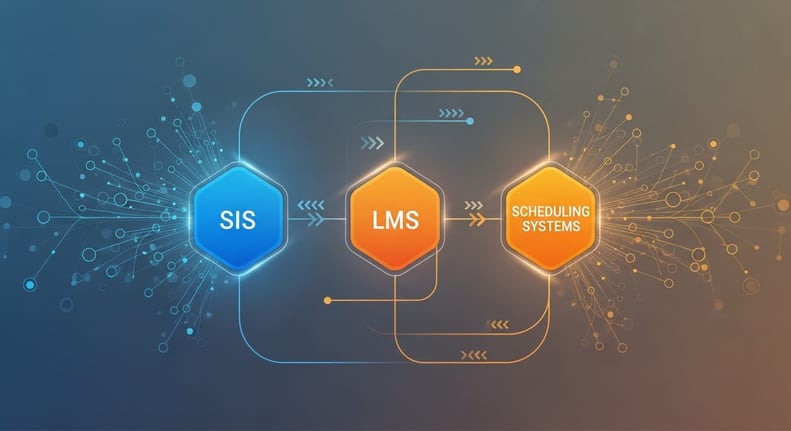
Class schedule management solutions that integrate with existing campus technology create unified experiences for students and staff while eliminating data inconsistencies.
8. Data-Driven Planning Is Impossible with Current Tools
Your institution lacks the analytical capabilities needed for strategic academic planning. Historical enrollment patterns, space utilization trends and student success correlations remain buried in disparate systems rather than informing future decisions. Without access to comprehensive scheduling analytics, academic leaders make decisions based on intuition instead of evidence.
This data deficit prevents institutions from identifying optimization opportunities, predicting resource needs or measuring the impact of scheduling decisions on student outcomes. In an era where data-driven decision-making defines institutional competitiveness, scheduling systems that can't generate actionable insights become strategic liabilities.
Course scheduling systems that provide predictive analytics and comprehensive reporting enable informed decisions about academic programming, resource allocation and student support services.
How Do Modern Student Scheduling Systems Address These Challenges?
Academic scheduling software transforms persistent student scheduling challenges into competitive advantages through intelligent automation and integration. These solutions eliminate manual conflicts, optimize resource utilization and provide comprehensive analytics that inform strategic planning. Leaders can focus on student success rather than administrative crisis management.
Automated conflict detection prevents scheduling problems before they impact students and faculty. Real-time optimization algorithms balance multiple variables, including room capacity, equipment requirements, faculty preferences and student needs. Integration ensures that scheduling decisions propagate accurately across all campus systems.
Modern systems enable data-driven planning that aligns course offerings with actual student demand and institutional goals. This strategic approach to campus scheduling tools supports both operational efficiency and student success outcomes.
What Should You Look for in Academic Scheduling Software?
When evaluating higher ed scheduling software options, prioritize these essential capabilities that directly address common challenges:
-
Intelligent conflict detection and resolution that identifies problems before they disrupt campus operations
-
Seamless integration with student information systems, learning management platforms and other campus technology
-
Predictive analytics and reporting that enable data-driven academic planning and resource optimization
-
Faculty preference management that balances institutional needs with instructor satisfaction and expertise
-
Student-centered scheduling that prioritizes course accessibility and graduation pathway support
The most effective solutions combine robust functionality with intuitive interfaces that encourage adoption across campus departments. Look for platforms that can scale with institutional growth while adapting to changing academic program needs and delivery modalities.
FAQ
How quickly can institutions expect to see results after implementing new scheduling software? Most institutions observe immediate improvements in conflict reduction and administrative efficiency, with comprehensive benefits typically realized within one to two academic terms. Early wins include decreased manual scheduling time and fewer double-booking incidents.
What integration challenges should campuses anticipate when adopting new scheduling systems? The most common challenges involve data formatting inconsistencies between systems and ensuring real-time synchronization. Working with vendors early to map integration requirements and planning thorough testing periods before go-live helps minimize disruption.
How do modern scheduling systems handle complex academic calendars and non-traditional program formats? Advanced platforms accommodate multiple calendar systems, compressed terms, online learning formats and competency-based programs through flexible configuration options. These systems recognize that higher ed delivery methods continue to diversify.
Can scheduling software help improve student retention and graduation rates? Yes, by ensuring students can access required courses when needed and providing clear academic pathways. When scheduling barriers are removed, students progress toward graduation more efficiently, improving both retention and completion metrics.
Transform Your Campus Scheduling from Chaos to Strategic Advantage
These eight warning signs signal fundamental barriers to student success and institutional effectiveness. When scheduling systems fail, the ripple effects impact:
-
Retention rates
-
Faculty satisfaction
-
Resource utilization
-
Strategic planning
However, institutions that embrace modern student scheduling systems transform these challenges into advantages.
Scheduling excellence requires more than avoiding conflicts. It demands integrated systems that optimize resources, support faculty success and create clear pathways for student achievement. Institutions with effective scheduling systems outperform their peers in retention, satisfaction and efficiency.
Modern Campus offers comprehensive scheduling solutions designed specifically for higher ed's unique challenges and opportunities. Request a demo and discover how the right technology can eliminate scheduling barriers while supporting institutional success.
Last updated: December 30, 2025