Student engagement platforms promise transformational results, but implementation often stumbles before institutions see real impact. Understanding the most common challenges in student engagement platforms can help your institution avoid costly missteps and accelerate time to value.
-
Integration failures with legacy systems cause delays in platform deployment and create frustration across departments.
-
Faculty and staff resistance remains the top adoption hurdle, with many educators lacking adequate training or incentive to embrace new tools.
-
Measuring ROI proves elusive when engagement metrics don't clearly connect to retention and graduation outcomes.
-
Students experience platform fatigue, leading to low adoption rates despite institutional investment.
Start with stakeholder buy-in and phased implementation to transform these challenges into opportunities for meaningful student connection.
When nearly one in four students leaves their institution before completing a degree, the pressure to improve student engagement is intense. Student persistence rates reached 76.5% in 2024, the highest in over a decade, meaning more students are continuing their education even if they transfer institutions. Yet this encouraging trend masks the reality that institutions still lose thousands of students who might have persisted with better support and connection each year.
Student engagement platforms emerged as a promising solution to this challenge. These systems:
-
Track student interactions
-
Automate personalized outreach
-
Identify at-risk learners
-
Create data-driven intervention opportunities
The potential is enormous. But potential and reality often diverge during implementation, leaving institutions with expensive tools that underperform expectations.
This guide examines the top five challenges when implementing student engagement platforms. More importantly, it offers practical strategies to overcome each obstacle so your investment delivers the student success outcomes your institution needs.
Why Do Student Engagement Platforms Matter for Student Retention in Higher Education?
The connection between engagement and student retention in higher education is well documented and increasingly urgent. Students who actively participate in campus life, whether through events, organizations, academic support services or peer connections, consistently outperform their disengaged peers.
Research from the University of Houston found that students with four or more engagements achieved 92% retention rates compared to just 78% for students with zero recorded engagements. That 14% gap represents hundreds of students per institution who might otherwise disappear from enrollment rosters.
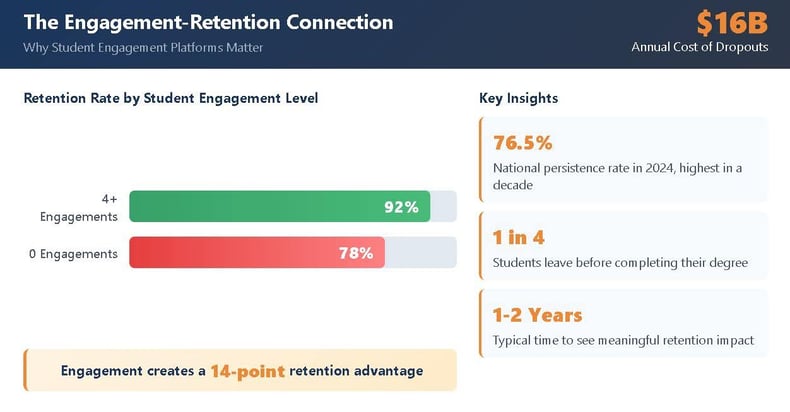
The financial implications compound quickly. When students leave, institutions lose tuition revenue and must spend additional resources recruiting replacements. Student dropouts cost colleges more than $16 billion in lost revenue annually when accounting for tuition, fees, housing, bookstore purchases and future alumni contributions.
Technology in education has evolved to address this challenge at scale. Modern engagement platforms enable institutions to reach thousands of students with personalized messages, track participation patterns across departments and intervene before small problems become departure decisions. Understanding the benefits of student engagement helps institutions recognize why overcoming implementation challenges is worth the effort.
What Are the Biggest Challenges in Student Engagement Platforms?
Implementation rarely fails for a single reason. Instead, institutions typically encounter multiple obstacles that compound when left unaddressed. The following five challenges appear most frequently across campus technology deployments, regardless of institution size or type.
Challenge 1: Integration with Legacy Systems Creates Technical Bottlenecks
Higher ed runs on a patchwork of systems accumulated over decades. Student information systems, learning management platforms, financial aid software and housing databases rarely speak the same technical language. When a new engagement platform enters this environment, integration becomes the first and often most frustrating hurdle.

Many institutions rely on a mix of legacy systems and modern tools that don't connect. This incompatibility creates inefficiencies that ripple across departments. Staff spend hours manually transferring data between systems instead of focusing on student support. Duplicate records emerge. Critical information falls through the cracks between platforms that should share data.
Security adds another layer of complexity. IT departments, rightfully cautious about cybersecurity risks, often impose lengthy approval processes before new platforms can access data. Faculty seeking to implement new engagement tools may face approval timelines stretching to two years due to cybersecurity and privacy concerns. For engagement platforms that need real-time data to identify at-risk students, these delays can render the technology ineffective before it launches.
How to overcome it: Begin integration planning when choosing a platform, not after purchase. Ask for detailed API documentation and references from institutions with similar technology ecosystems. Build relationships between IT, Student Affairs and Enrollment teams early so security reviews happen in parallel with implementation planning rather than sequentially.
Challenge 2: Faculty and Staff Adoption Hurdles Undermine Platform Value
The most sophisticated engagement platform delivers zero value if the people responsible for using it resist or ignore it. Adoption hurdles among faculty and staff are one of the most persistent challenges in student engagement platforms, often stemming from legitimate concerns rather than stubbornness.
Many educators developed their teaching and advising practices over years using methods that worked. Asking them to abandon familiar workflows for an unproven system generates understandable skepticism. Training programs, when they exist at all, often provide insufficient time for staff to develop genuine competency with new tools. A single afternoon workshop isn’t likely to transform deeply ingrained habits.
The digital readiness gap varies across institutions and departments. Urban educators demonstrate higher digital fluency scores than their rural counterparts, but the gap exists everywhere between tech-forward early adopters and colleagues who view new platforms as unwelcome disruptions. Without strategies to address this spectrum, implementation stalls as resistant users create workarounds that bypass the new system entirely.
How to overcome it: Identify and empower faculty champions who can demonstrate platform value to skeptical colleagues. Create tiered training programs that meet users at their current skill level rather than assuming uniform baseline competency. Most importantly, involve faculty and staff in platform selection so they feel ownership rather than imposition.

Challenge 3: Measuring ROI and Platform Effectiveness Remains Elusive
Administrators who approve technology investments reasonably expect measurable returns. Yet connecting engagement platform activity to concrete outcomes like retention, graduation rates and student satisfaction proves difficult. This measurement challenge creates ongoing tension between technology advocates and budget-conscious leadership.
The fundamental problem lies in attribution. When a student persists through a difficult semester, did the automated text reminders help? The early alert from the platform? The advisor intervention it triggered? Or would that student have succeeded regardless? Isolating the platform's specific contribution from countless other variables challenges even sophisticated assessments.
Engagement platforms generate impressive activity metrics: messages sent, events attended, alerts triggered and students flagged. But activity doesn't automatically equal impact. Institutions can achieve perfect technical implementation while still missing the human connections that actually change student trajectories. The metrics most platforms measure well aren't necessarily the outcomes that matter most.
How to overcome it: Establish baseline measurements before implementation so you can track genuine change rather than guessing at impact. Define success metrics collaboratively with stakeholders from academic affairs, student services and institutional research. Focus on leading indicators like advising appointment attendance and early alert response rates alongside lagging indicators like semester-over-semester retention.
Challenge 4: Student Buy-In and Technology Fatigue Limit Adoption
Institutions aren't the only ones overwhelmed by technology proliferation. Students navigate dozens of platforms, apps and portals throughout their academic journey. Each new system demands attention, passwords and mental bandwidth. When an engagement platform becomes just another ignored notification source, its potential impact evaporates.
Research shows that students overwhelmingly prefer mobile-first communication channels. Platforms that default to email often miss students where they actually spend their attention. Yet many engagement platforms default to email delivery, missing students where they actually give their attention. The gap between institutional technology choices and student communication preferences undermines even well-designed engagement strategies.
Students also bring healthy skepticism to platforms that feel surveillance-oriented rather than supportive. Systems that track every login, monitor academic performance and trigger automated interventions can feel intrusive rather than helpful. Building student trust requires transparency about how data is used and genuine value delivered in return for their participation.

How to overcome it: Prioritize mobile-first experiences that align with student communication habits. Communicate clearly about the platform's purpose and data usage. Most importantly, ensure students receive tangible benefits from engagement, whether through easier event discovery, personalized recommendations or streamlined access to support services. Learning how to enhance student engagement with technology starts with understanding what students actually want from these tools.
Challenge 5: Data Privacy and Security Concerns Create Implementation Delays
Student engagement platforms aggregate sensitive information:
-
Academic records
-
Financial aid status
-
Behavioral patterns
-
Communication history
-
Demographic details
This data concentration creates attractive targets for malicious actors and significant compliance obligations for institutions.
Recent years have seen alarming increases in ransomware attacks targeting educational institutions. Regulations continue to evolve, with requirements like GLBA mandating robust cybersecurity practices and creating audit obligations that consume IT resources. For institutions already stretched thin, adding another system that handles protected student information raises legitimate concerns.
Balancing accessibility with security creates inherent tension. Engagement platforms work best when they provide seamless, real-time information across departments. But every data connection point represents a potential vulnerability. Overly restrictive security measures can cripple platform functionality, while insufficient protections risk devastating breaches.
How to overcome it: Include security review requirements in the initial platform evaluation rather than treating them as implementation afterthoughts. Require SOC 2 compliance and detailed security documentation from vendors. Establish clear data governance policies before launch so all stakeholders understand access permissions and usage boundaries.
How Can Institutions Overcome Challenges in Student Engagement Platforms?
Successful implementation requires more than addressing individual obstacles. Institutions that achieve meaningful results from engagement platforms share common approaches that create conditions for success.
Five Proven Strategies for Successful Platform Implementation:
-
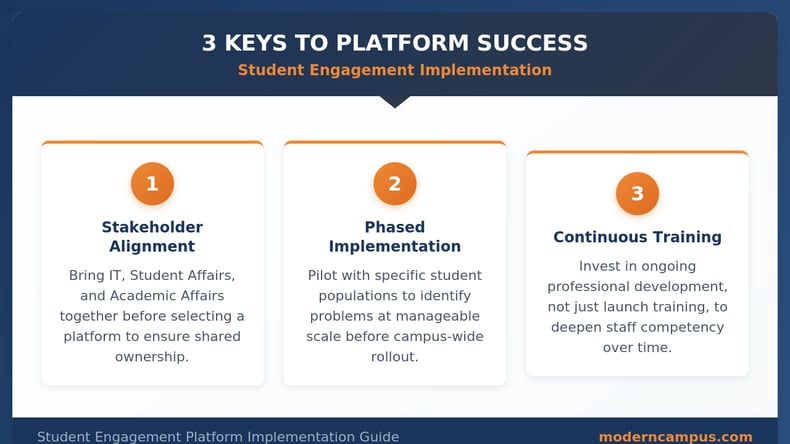
Start with stakeholder alignment. Bring together representatives from IT, Student Affairs, Academic Affairs, Enrollment and Advising before choosing a platform. Shared ownership prevents the siloed thinking that derails cross-departmental technology initiatives.
-
Implement in phases rather than all at once. Pilot programs with specific student populations allow institutions to identify problems at a manageable scale, build internal expertise and demonstrate value before campus-wide rollout.
-
Invest in ongoing training, not just launch training. Skills developed during initial implementation fade without reinforcement. Budget for continuous professional development that helps staff deepen platform competency over time.
-
Create feedback loops with students. Regular surveys and focus groups reveal whether platform features actually serve student needs or simply generate institutional data. Student voice should shape ongoing platform evolution.
-
Connect platform metrics to institutional strategic goals. When engagement data ties directly to retention targets, equity initiatives and student success outcomes, the platform becomes integral to campus operations rather than an optional add-on.
What Does Technology in Education Look Like When Implementation Succeeds?
Institutions that navigate implementation challenges effectively see transformative results.
-
Advising teams identify struggling students weeks earlier and intervene before problems compound.
-
Event attendance increases as students discover opportunities aligned with their interests.
-
Retention rates climb as personalized outreach helps students feel seen and supported.
The most successful implementations prioritize human connection enabled by technology rather than technology replacing human connection. Platforms should amplify the work of dedicated staff, not automate relationship-building into impersonal message streams. When advisors, faculty and student affairs professionals gain better tools while maintaining authentic relationships, students benefit from both efficiency and genuine care.
Understanding strategies for improving retention helps contextualize engagement platforms within broader student success initiatives. Technology is one component of a comprehensive approach that includes academic support, mental health resources, financial assistance and community building.
Frequently Asked Questions
What is the biggest barrier to successful student engagement platform implementation? Integration with existing campus systems typically creates the most significant delays and frustrations. Institutions with multiple legacy platforms face particular challenges getting systems to share data. Beginning integration planning during vendor selection rather than after purchase helps avoid extended deployment timelines.
How long does it take to see results from a student engagement platform? Most institutions see improvements in process metrics like communication response rates and event attendance within the first semester. Meaningful retention impact typically requires one to two full academic years of consistent implementation and refinement to demonstrate clearly.
How can we get faculty buy-in for new engagement technology? Involve faculty representatives in platform selection so they feel ownership rather than imposition. Identify early adopters who can champion the technology with skeptical colleagues. Provide tiered training that meets users at their current skill level, and demonstrate clear value through time savings and improved student outcomes.
What metrics should we track to measure engagement platform success? Track both leading indicators like advising appointment attendance, early alert response rates and event participation alongside lagging indicators like semester-over-semester retention and graduation rates. Establish baseline measurements before implementation to demonstrate genuine change rather than assuming correlation.
Turning Implementation Challenges Into Student Success
The challenges in student engagement platforms are real, but they're not insurmountable. Institutions that approach implementation with realistic expectations, inclusive planning processes and commitment to continuous improvement transform these obstacles into opportunities. The stakes are too high for your students to let implementation challenges derail your engagement strategy.
Modern Campus empowers 1,700+ higher education institutions to attract, engage and retain learners for life with software solutions designed specifically for the unique needs of colleges and universities.
Request a demo to see how purpose-built technology can transform your student success outcomes.
Last updated: February 18, 2026
.png)