Institutions using two-way texting for student success are seeing measurable gains in retention, engagement and degree completion.
-
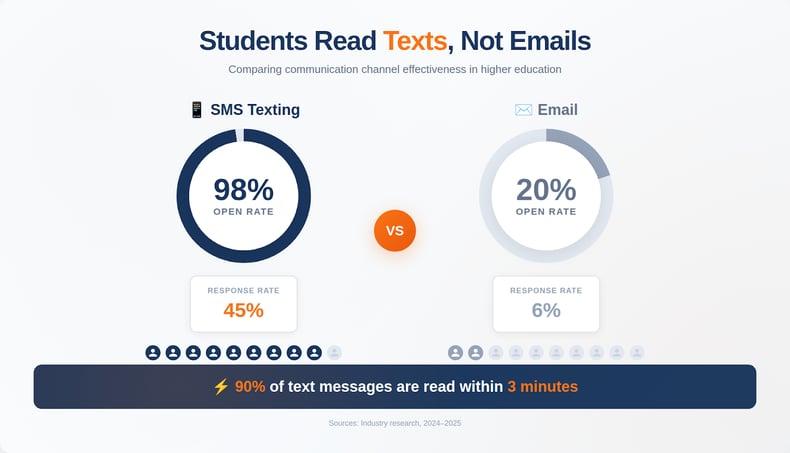
Text messages achieve a 98% open rate compared to email's 20%, ensuring critical information actually reaches students.
-
Two-way conversational texting identifies barriers to persistence before students disappear from campus.
-
Real institutions report saving dozens of students from stopping out and connecting hundreds more to financial resources within hours of sending targeted texts.
The institutions that thrive in the coming decade will be those that meet students on their preferred communication channel.
Student retention has become the defining challenge for higher education leaders. While persistence rates have rebounded to their highest levels in nearly a decade, reaching 77.6% nationally as of 2023, roughly one in four students won't make it past their first year. Behind every percentage point are real people who started with dreams of a credential or degree and walked away without one.
The problem often isn't a lack of concern from faculty and staff. It's a communication breakdown. When students miss financial aid deadlines, forget about advising appointments or struggle silently with academic challenges, it’s likely they never saw the email, ignored the phone call or didn't check their portal.
According to SMS marketing research, 83% of consumers say texting is their top mobile activity, outpacing both social media and email. For most learners, a text message is the most natural way to communicate.
Two-way texting for student success offers institutions a direct line to students who are otherwise unreachable. Unlike one-way announcements that disappear into crowded inboxes, conversational texting creates genuine dialogue. Students can ask questions, share concerns and receive personalized support without scheduling an appointment or navigating bureaucratic phone trees.
Institutions implementing strategic texting programs report higher retention rates, stronger enrollment completion and students who feel genuinely supported throughout their academic journey.
What Is the Link Between Student Retention and Two-Way Texting for Student Success?
Text messages achieve a 98% open rate, while email hovers around 20%. Even more telling, 45% of people respond to text messages compared to just 6% who respond to emails. When you're trying to reach a student about a hold on their account, an upcoming deadline or an available support resource, those numbers are the difference between connection and silence.
Students spend significant portions of their day on smartphones. They text their friends and family, and increasingly, they expect to text their institutions. Phone calls feel intrusive to many younger learners, who often screen unknown numbers or let voicemails pile up unheard. Once the gold standard of professional communication, email has become a cluttered wasteland where important messages compete with spam and promotional noise.
Text messaging for retention works because it meets students exactly where they already are.
-
A well-timed text about an unpaid balance can prevent a registration hold.
-
A quick reminder about FAFSA renewal can preserve financial aid eligibility.
-
A personalized check-in after a poor midterm grade can connect a struggling student with tutoring before they decide to give up entirely.
These small interventions, delivered through the right channel, compound into meaningful student retention improvements.
What Makes Two-Way Texting Different from Broadcast Messaging?
There's a distinction between mass texting and conversational two-way texting for student success. Traditional SMS broadcasting treats students as passive recipients of information. A blast goes out to thousands of students about a deadline, and the communication ends there. If a student has questions, concerns or barriers preventing them from taking action, they're left to figure it out on their own.
Conversational texting transforms that dynamic. When students can reply to messages, ask follow-up questions and receive personalized responses, the entire nature of the interaction changes. A student might reveal that they can't complete registration because of an unexpected financial emergency. Another might share that they're considering dropping out because of family obligations. These insights would never surface through a one-way email, but they emerge naturally through text-based conversations.

The power of two-way dialogue lies in its ability to uncover and address the real barriers to student persistence. Academic advisors and support staff can ask targeted questions, provide immediate guidance and connect students with appropriate resources before small problems become insurmountable obstacles. This proactive approach catches students in the moments when intervention can actually make a difference.
How Can Institutions Use Text Messaging for Retention?
Successful texting programs share common characteristics: they're personalized, timely and focused on removing barriers to student success. The following examples demonstrate how real institutions have leveraged SMS for student engagement to achieve measurable results.
Proactive Intervention for At-Risk Students
At Missouri State University, students with lower GPAs were at high risk of stopping out, and traditional email outreach wasn't effectively reaching them. Staff noticed that appointment reminders went unread and calls-to-action went unanswered. The intervention largely failed because the communication channel itself had failed.
When Missouri State implemented conversational texting, the results were immediate and significant. By sending targeted texts to students on academic probation and those at risk of departure, staff connected learners with academic advisors who could provide support. Missouri State boosted fall-to-fall retention by 1%during its first year of texting. That single percentage point represented 32 real students who stayed enrolled instead of becoming another dropout statistic.

Financial Aid and Deadline Reminders
Kellogg Community College discovered that eligible students were leaving money on the table because they never saw emails about available grants. Through a state-funded program, several hundred students qualified for $500 tuition grants each semester. The only requirement was completing a short form. Yet applications trickled in slowly when promoted through email alone.
Texting changed everything. When financial aid staff scheduled a text message to eligible students, the response was overwhelming. One hundred students submitted the grant application within a single hour of receiving the text. Staff members watched applications flood in at 1:01 PM, just one minute after the scheduled message went out.
This immediate response connects students with financial resources that promote greater persistence and retention. When students receive the funding they need, they're far more likely to remain enrolled and progress toward their credentials.
Course Registration and Waitlist Management
Kellogg Community College also used texting to solve a course registration puzzle. Staff noticed that students frequently added themselves to waitlists for full classes, unaware that other sections of the same course had open seats. Students simply weren't scrolling down the schedule to see all available options.
The solution was elegantly simple. Staff texted waitlisted students with good news: spots were available in another section, along with a direct link to registration. The results exceeded expectations. Over three semesters, 65% of waitlisted students registered for an open section within 24 hours of receiving a single text message. That's hundreds of students who stayed on track toward graduation because of one thoughtful, personalized communication.
What Are the Key Strategies for Effective SMS Student Engagement?
The institutions seeing the strongest results follow proven best practices for texting that maximize engagement while respecting student preferences.
Personalization transforms generic announcements into meaningful communications. Personalized messages outperform generic ones in engagement and response rates. Using the student's name, referencing their specific major or year and sharing deadlines relevant to their individual situation are examples of the right path.
-
A message that says, "Course registration opens soon," feels like spam.
-
A message that says, "Alex, registration for third-year nursing students opens Tuesday at 9 AM," feels like someone is actually paying attention.
Timing matters enormously. Students are more likely to take action when messages arrive at moments when they can actually respond. A text about registration that arrives during a Friday afternoon class will likely be forgotten by Monday. Strategic scheduling, informed by data about when students typically engage, increases response rates.
Segmentation ensures relevance. Students on academic probation need different messaging than those on the Dean's List. First-generation students may need more guidance on financial aid processes than students whose parents navigated college before them. Sophisticated audience segmentation, powered by integration with student information systems, allows institutions to deliver the right message to the right student at the right time.
Brevity keeps students engaged. The most effective texts are concise, action-oriented and focused on a single goal. Overwhelming students with multiple requests in one message leads to decision paralysis and lower response rates. Instead of listing five tasks, guide students through one step at a time.
Two-way capability is non-negotiable. Students must be able to reply, ask questions and receive responses. Texting goes from an announcement channel to a relationship-building tool. When students know a real person will respond to their concerns, they're far more likely to reach out when they're struggling.
How Do You Measure Success with Student Retention Texting?
Effective measurement starts with baseline data. Before launching a texting initiative, document current student retention rates, response rates to existing communications and completion rates for key enrollment tasks. This assessment creates a foundation for demonstrating improvement.
Key metrics to track include:
-
Message open and response rates, which indicate whether students are engaging with communications.
-
Retention improvements among texted populations compared to control groups, which reveal the direct impact on persistence.
-
Completion rates for specific tasks, such as FAFSA renewals, registration or advising appointments, which show whether texting drives desired actions.
The financial case for texting is compelling. While intensive in-person interventions can cost hundreds or even thousands of dollars per student, strategic texting programs typically cost a fraction of that per recipient. When even modest retention improvements translate to preserved tuition revenue, the return on investment becomes substantial. For institutions serving thousands of students, retaining just a few dozen additional learners can justify the entire cost of a texting platform.
What Should Institutions Consider When Implementing a Texting Program?
Compliance requirements demand careful attention. The Telephone Consumer Protection Act (TCPA) requires explicit consent before sending text messages, along with clear opt-out mechanisms. FERPA regulations govern the protection of student educational records, meaning platforms must include appropriate safeguards for sensitive information. State privacy laws may impose additional requirements depending on institutional location.
Your messaging platform should prioritize higher ed expertise. Generic business texting tools lack the specialized features institutions need, including integration with student information systems, academic lifecycle automation and FERPA-compliant data handling. Purpose-built platforms designed for higher education communication offer the segmentation, personalization and compliance capabilities that drive results.
Phased rollout allows for learning and refinement. Most successful programs begin with pilot initiatives targeting specific student populations or departments. This approach enables testing, staff training and optimization before expanding campus-wide. Starting small also builds institutional buy-in as early successes demonstrate value.
Frequently Asked Questions
What's the difference between SMS broadcasting and two-way conversational texting? Traditional SMS broadcasting sends one-way messages to large groups without enabling student responses. Two-way conversational texting platforms allow students to reply, ask questions and engage in dialogue with advisors and support staff. This conversational capability transforms texting into a relationship-building tool that can identify and address barriers to student persistence.
How does the cost of texting compare to other retention interventions? Text messaging programs typically cost under $10 per student, making them more cost-effective than intensive in-person interventions that can run hundreds or thousands of dollars per learner. When even modest retention improvements preserve tuition revenue from students who would otherwise have departed, the return on investment becomes substantial.
What compliance requirements must institutions consider for student texting? Institutions must comply with TCPA regulations requiring explicit consent and opt-out capabilities, FERPA requirements for protecting student educational records and applicable state privacy laws. Higher education texting platforms should include built-in safeguards for FERPA compliance and provide tools for managing consent documentation.
How quickly do students typically respond to text messages? The majority of text messages are read within three minutes of delivery, and many students respond almost immediately. Institutions report that financial aid grant applications arrived within one minute of texts being sent, and the majority of waitlisted students registered for available courses within 24 hours of receiving targeted messages.
Building Lasting Connections Through Conversational Communication
Two-way texting for student success is a powerful tool for creating the kind of responsive, personalized support that keeps students enrolled and engaged.
-
Retention in action: When a student receives a timely text about an open course section and registers within minutes.
-
Institutions providing support: When a struggling learner texts back about a financial emergency and gets connected to emergency aid.
-
Reaching students vs. losing them: When 100 students apply for grants within an hour because someone thought to send a text
Modern Campus empowers institutions to build these meaningful connections through conversational text messaging that integrates with existing systems and scales personalized outreach across entire student populations.
Request a demo to see how two-way texting can improve retention at your college or university.
Last updated: December 10, 2025