During our recent webinar Innovation in Action: What’s New in Schedule, we looked beyond feature updates to explore how academic scheduling is evolving to meet the day-to-day realities of higher education.
In this Q&A, we pull back the curtain on the ingenuity behind that evolution, highlighting not just what’s new in Schedule, but the people, insights, and practitioner feedback shaping our product roadmap.
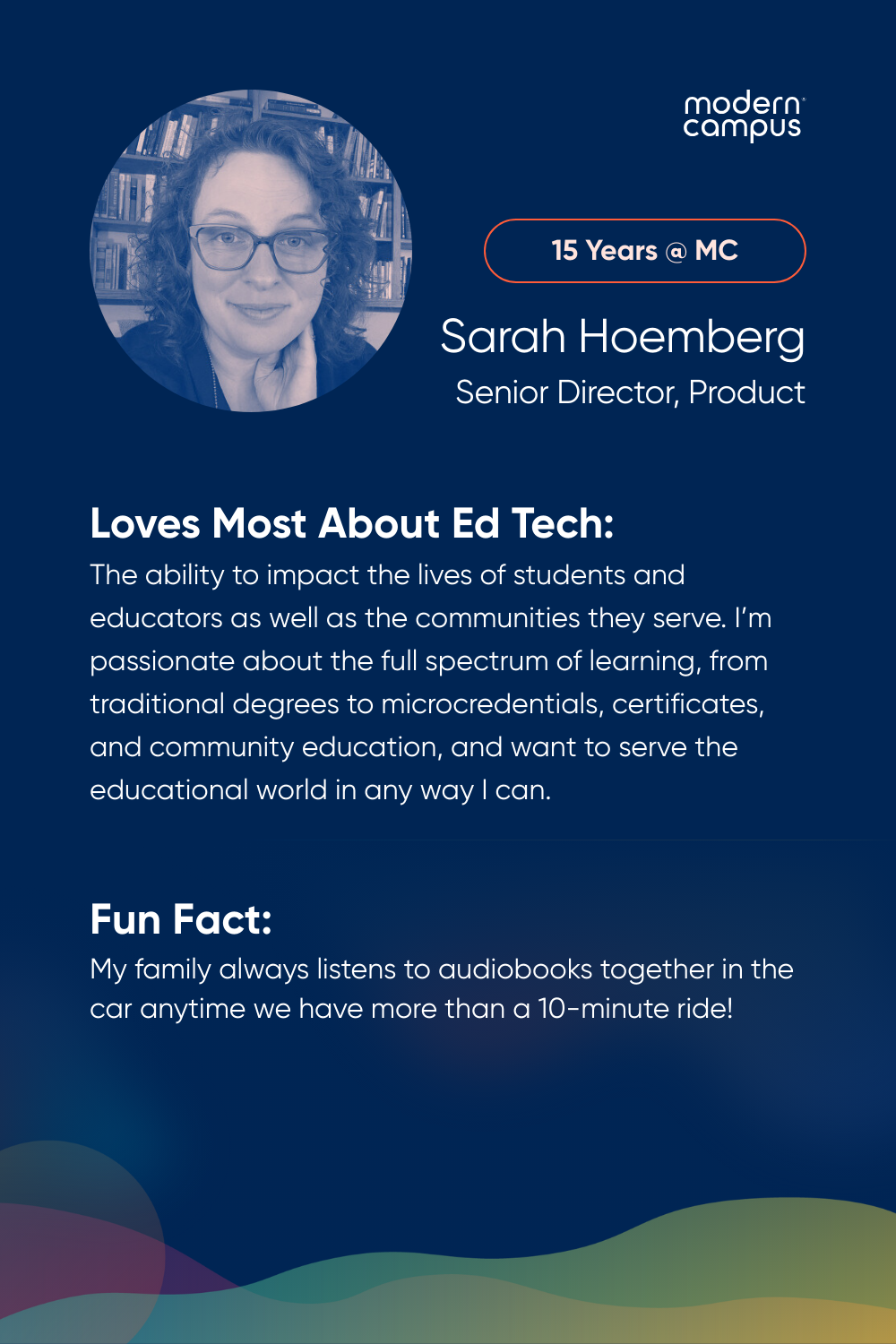
Sarah Hoemberg, Senior Director of Product at Modern Campus, shares how the latest release was driven by a clear goal: helping institutions move from manual scheduling processes to more transparent, system-supported workflows. Her perspective connects product innovation to operational readiness, showing how smarter scheduling decisions can reduce staff burden while supporting student progress.
Let's dive into what Sarah has to say.
1. What real scheduling challenges were you most focused on solving with this release?
Sarah: It boils down to efficiency, transparency, and understanding. Scheduling has historically been a fragile process, particularly in the way small changes made late in a scheduling cycle can create outsized downstream impact. Whether scheduling is centralized or decentralized, we hear one consistent message: teams are managing interdependencies such as instructor availability, room capacity, modality mix, enrollment demand, and compliance rules. Historically, these variables have been managed across spreadsheets, emails, and siloed systems.
This release was centered on reducing manual coordination and uncertainty. We focused on improving visibility into constraints earlier in the process, minimizing rework caused by late-breaking changes, and helping teams move from a reactive position of putting out fires to more proactive, confident, scenario-based planning.
2. Which enhancements are you most excited about, and how do they improve operational readiness for the term?
Sarah: Improved validation, clearer indicators of scheduling completeness, and stronger alignment between sections, instructors, and spaces allow those involved to answer three critical questions faster and with more confidence:
-
Are we truly ready to publish?
-
Where are the remaining risks/issues/conflicts?
-
What changes are safe to make and/or which ones will cascade?
This clarity and transparency ideally support earlier publishing, fewer student-facing errors, and smoother handoffs between scheduling, registration, and other downstream systems.
3. How do these updates support workload balance, transparency, and the last-minute adjustments that happen every term?
Sarah: Every term includes last-minute change; it’s truly unavoidable. The problem isn’t the change itself, but how disruptive it becomes, particularly when context is missing.
The features we’ve released improve transparency by making dependencies visible: who is affected, what else needs to be updated, and where conflicts might emerge. That visibility allows work to be distributed more evenly across teams instead of bottlenecking with a single expert who “knows how everything fits together.”
The workflow supports smooth communication and approval so that when changes occur, teams can respond faster and with more confidence because the system reflects the current reality, rather than a snapshot from weeks ago.
4. What user feedback, insights, etc., were most influential in shaping this release?
Sarah: User feedback and input are paramount to our process. Two themes consistently surfaced in user feedback:
-
First, schedulers told us they needed stronger support for real-world complexity. That includes partial data, evolving decisions, and the need to work iteratively without breaking downstream processes.
-
Second, institutions emphasized the importance of trust. They need to trust that what’s in the system reflects what will actually run. That feedback pushed us to focus less on more features and more on reliability, validation, and clarity.
In short, this release was shaped by practitioners who are responsible not just for building schedules, but for standing behind them.
5. Looking ahead, how do you see scheduling evolving, and where can automation or AI play a role in making academic operations more efficient?
Sarah: Scheduling is shifting from a manual coordination exercise to a data-driven and supported process. Automation and AI won’t replace human judgment—especially given the academic, contractual, and political nuances involved within the institution—but they can dramatically reduce cognitive load.
Our biggest opportunities are in the following areas:
-
Demand forecasting
-
Constraint detection
-
Scenario modeling
-
Impact analysis
AI can help institutions answer “what if” questions faster, identify risks earlier, and surface options that may not be obvious when working manually.
As these tools mature, scheduling teams will spend less time assembling data and more time making informed decisions. The critical outcome for these capabilities is both optimized use of resources and the tremendous impact a term’s schedule has for students and their progress toward program completion, whether it’s a traditional degree or a microcredential/certificate.
6. Where do you see the biggest opportunity for institutions to simplify scheduling complexity and improve confidence and readiness leading into each term?
Sarah: I probably sound like a broken record, but it’s really about transparency and consolidation by bringing people, data, and decisions into a shared, system-supported workflow. Institutions that rely on disconnected tools and institutional memory are inherently vulnerable to errors and burnout.
By centralizing scheduling work with a connected tool, standardizing processes, and using systems that reflect real constraints, institutions can dramatically reduce last-minute surprises. Ultimately, confidence and readiness come from knowing that your schedule isn’t just complete—it’s resilient.
Ready to put confident, robust term planning into practice?
A resilient schedule is more than just a plan on paper—it’s a critical “GO” moment that gives learners the confidence to move decisively toward their goals.
Connect with our team to see how Modern Campus Schedule can support your institution.
Last updated: January 29, 2026
.png)