Higher education texting has evolved, requiring institutions to evaluate platforms that address compliance while supporting student engagement strategies.
-
New A2P campaign regulations and intensified TCPA enforcement demand built-in compliance features and automated consent management.
-
Two-way conversational texting allows for authentic dialogue that scales personalized support without overwhelming staff resources.
-
Deep integration with campus systems (SIS, CRM, LMS) enables sophisticated automation workflows that personalize messaging based on academic status and student lifecycle stage.
-
AI-powered engagement strategies and predictive analytics support four-year student engagement planning and proactive intervention.
Smart evaluation focuses on education-specific platforms rather than generic business tools to ensure compliance, integration capabilities and long-term strategic success.
When selecting groceries, you consider freshness, flavor and cost. Your clothing purchases depend on upcoming events, weather and comfort. You research options to find the best match for your specific needs.
The same approach should guide your institution's evaluation of SMS solutions. The numbers explain why texting strategies work, with 80% of students reading text messages within minutes, and the same percentage preferring to receive SMS communications over email. Yet not every texting platform will deliver the results your students need or your institution deserves.
Texting for higher education has transformed in a matter of years. New compliance regulations, advanced two-way features and sophisticated campus integrations have revolutionized what's possible. Higher ed texting solutions now engage learners throughout their entire journey, but choosing the right platform requires asking the right questions.
Here are essential questions to guide you when evaluating texting solutions for higher ed, ensuring you select technology that supports student communication strategies, adapts to hybrid learning models and scales with your four-year student engagement planning.
What Compliance Challenges Should You Prioritize?
Regulations for higher education texting have undergone changes that directly impact platform selection. Understanding these compliance requirements is about building trust with students and ensuring long-term operational sustainability.
New SMS Compliance Requirements
Recent updates to A2P (Application-to-Person) campaign guidelines have changed how institutions can contact students. Only inquiries, applicants and admitted students who have explicitly opted in can now receive text messages, eliminating the previous practice of texting purchased contact lists or "cold leads."
TCPA (Telephone Consumer Protection Act) enforcement has intensified, with penalties starting at $500 per unauthorized message. For institutions sending messages to thousands of students, non-compliance can quickly escalate into devastating financial liability. The FCC states that unsolicited text messages violate TCPA regulations, making robust consent management essential.
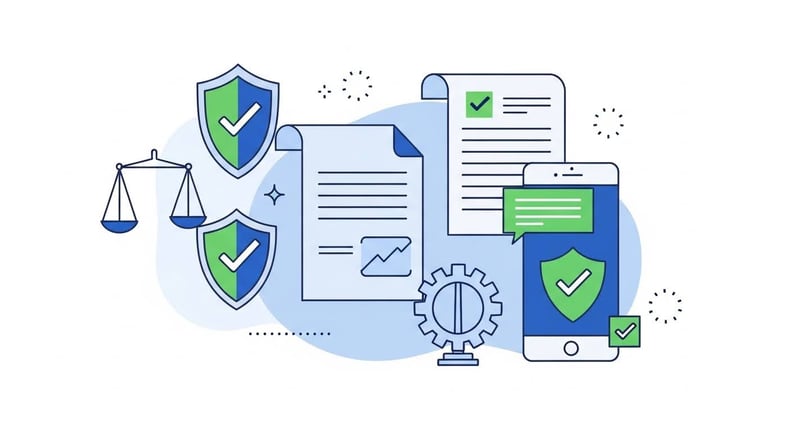
FERPA protection extends beyond traditional educational records to include how student data flows through texting platforms. Your chosen solution must demonstrate secure data transmission, access controls and audit trails that protect sensitive student information.
Platform Compliance Features to Evaluate
When evaluating texting solutions for higher ed, prioritize platforms offering built-in compliance features rather than those requiring manual oversight. Look for automated opt-in management that captures clear consent documentation, immediate opt-out processing that honors student requests within regulatory timeframes and comprehensive audit trails that provide legal protection.
Carrier compliance through CTIA guidelines shapes message deliverability. Platforms should automatically handle A2P 10DLC registration, manage carrier relationships and ensure message delivery without triggering spam filters. This technical infrastructure directly impacts whether your communications successfully reach students.
Consider platforms that provide staff training on compliance requirements, template libraries with pre-approved language and routine updates about regulatory changes that impact student communication strategies. Texting evolves, and your technology partner should actively monitor compliance developments rather than leaving institutions to navigate complex regulations on their own.
How Can Two-Way Texting Transform Your Student Relationships?
Traditional one-way messaging treats students as passive recipients rather than engaged participants. Two-way conversational texting changes this dynamic by creating authentic dialogue that builds relationships while providing immediate support when students need it most.
Beyond Broadcast: The Power of Conversation
Modern two-way texting platforms enable seamless transitions between automated responses and human interaction within single conversation threads. Students can text questions about applications, financial aid or campus resources, receiving instant automated responses for routine inquiries, while complex issues get routed to appropriate staff members.
This hybrid approach scales personalized communication without overwhelming administrative resources. Chatbots handle frequently asked questions about registration deadlines, campus hours and basic financial aid requirements, while specialized counselors focus on situations requiring human judgment and empathy.
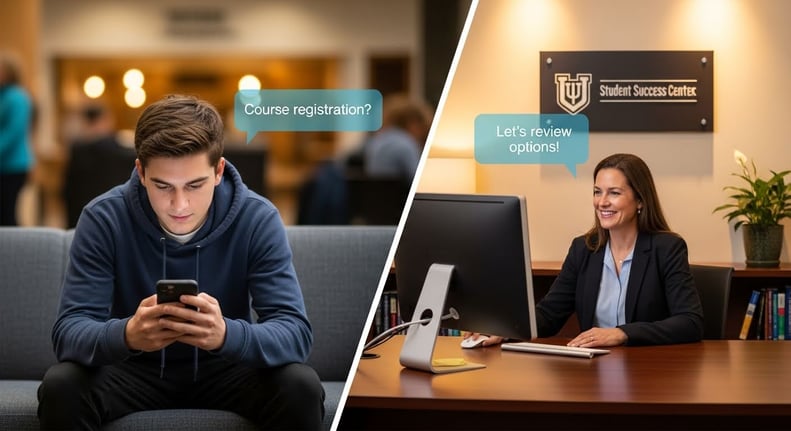
Successful implementation requires message routing that ensures conversations reach staff members with relevant expertise. Academic advising questions should connect students with their assigned advisors, financial aid inquiries should route to aid counselors, and housing concerns should reach residence life professionals.
Measuring Two-Way Engagement Impact
Student engagement improves when communication feels personally relevant. Two-way platforms facilitate personalization by allowing staff to reference previous conversations, acknowledge individual student circumstances and provide contextually appropriate guidance.
The retention benefits extend beyond immediate problem-solving, as students who engage in two-way text conversations develop stronger connections with support staff, making them more likely to seek help when facing academic or personal challenges.
Supporting Hybrid Learning Models
Two-way texting is particularly valuable for institutions offering hybrid learning models that combine online and in-person instruction. Students participating in flexible learning formats often struggle with reduced campus connection, making responsive channels essential for maintaining engagement.
Remote and hybrid learners benefit from immediate access to support through familiar communication channels. When students encounter technical difficulties during online classes, have questions about assignment deadlines or need guidance navigating campus resources, two-way texting provides instant connection to help.
When evaluating texting solutions for higher ed, prioritize platforms that integrate with learning management systems, enabling staff to provide contextual support based on student progress in specific courses. Conversations remain relevant to each student's immediate academic needs rather than generic institutional messaging.
Which Integrations Matter Most for Campus-Wide Success?
The effectiveness of any texting platform depends heavily on its ability to seamlessly integrate with existing campus systems. Generic business texting tools lack the sophisticated capabilities that higher education requires for comprehensive student support.
Essential System Integrations
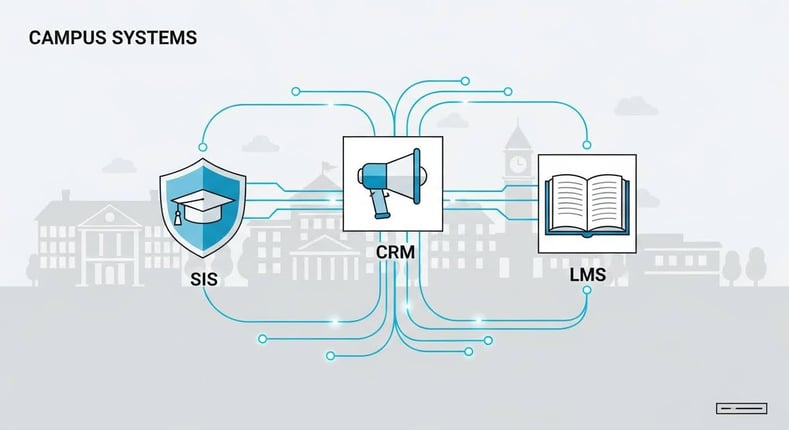
Student Information System (SIS) integration enables the personalization that makes text messaging effective. Rather than sending generic reminders to all students, platforms should leverage SIS data to create targeted communications based on academic standing, major, graduation timeline and enrollment status. A nursing student receives different messaging than a business major, and a student on academic probation gets more intensive support than one maintaining a 4.0 GPA.
Customer Relationship Management (CRM) integration streamlines recruitment and enrollment communication by maintaining consistent messaging across the entire student lifecycle. Prospective students who submit inquiry forms automatically enter communication workflows that nurture their interest through application, acceptance and enrollment.
Learning Management System (LMS) connectivity allows academic support staff to reference specific course performance when engaging with students. If a student stops participating in online discussions or misses assignment deadlines, automated systems can trigger personalized outreach that addresses academic concerns before they escalate.
Advanced Integration Capabilities
Modern platforms offer pre-built connectors for common campus systems. Evaluate whether vendors provide dedicated implementation support rather than expecting campus IT teams to manage complex integrations independently.
Financial aid system integration enables proactive communication about critical deadlines, missing documentation and award notifications. Georgia State University's pioneering texting program achieved a 21.4% reduction in summer melt by providing timely financial aid reminders that helped students complete enrollment requirements.
Housing, dining and campus safety system integration creates comprehensive student support networks. Students receive dining credit alerts, residence hall maintenance updates and emergency notifications through unified communication platforms rather than managing separate messaging systems for each campus service.
Evaluating Integration Quality
Platforms should support conditional messaging based on multiple data points, automatic list segmentation that updates as student status changes and cross-system data synchronization that maintains accuracy across platforms.
Evaluating texting solutions for higher ed from a technical standpoint should include implementation timelines, ongoing support requirements and data security protocols. Ask vendors for specific examples of integrations with systems similar to those you use, and request references from institutions with comparable technical environments.
Consider the long-term scalability of integration. As your institution adopts new technologies or updates existing systems, texting platforms should accommodate changes without requiring complete reimplementation.
What Does the Future of Higher Ed Texting Look Like?
The evolution of texting solutions for higher education continues accelerating, with artificial intelligence, predictive analytics and advanced personalization reshaping what's possible. Understanding these trends helps ensure your platform supports long-term objectives rather than just immediate needs.
AI-Powered Engagement Strategies
Modern texting platforms leverage AI to optimize message timing, content and delivery methods. Machine learning algorithms analyze student response patterns to determine optimal communication schedules for different populations, ensuring messages reach students when they're most likely to engage positively.
Predictive analytics enable proactive intervention by identifying students at risk of disengagement before problems become critical. Early warning systems analyze communication patterns, academic performance data and campus engagement metrics to automatically trigger appropriate support interventions.
Sentiment analysis helps staff understand the emotional context of student communications, enabling more empathetic responses to students experiencing stress, confusion or frustration. Emotional intelligence is valuable for supporting student mental health and wellness initiatives.
Supporting Four-Year Student Engagement Planning
Comprehensive texting platforms support longitudinal engagement strategies that evolve with students throughout their academic careers. First-year students need intensive orientation support and academic transition guidance, while upperclassmen require career preparation resources and graduation planning assistance.
Successful four-year student engagement planning anticipates the changing needs of students across different academic stages. Platforms should enable sophisticated workflow automation that adjusts messaging frequency, content focus and communication channels based on student progress toward degree completion.
Alumni engagement capabilities extend institutional relationships beyond graduation, supporting lifelong learning initiatives and professional development programs. The most effective platforms treat graduation as a transition rather than an endpoint, maintaining connections that benefit both alumni and current students.
Emerging Technology Integration
Virtual and augmented reality integration enables immersive campus experiences delivered through mobile devices. Students can access virtual tours, orientation experiences and academic program previews through links shared via text message, particularly valuable for hybrid learning models that serve students unable to visit campus physically.
Voice integration allows students to interact with campus support systems through voice commands, providing accessibility benefits for students with disabilities while offering alternative communication methods for different learning preferences.
Internet of Things (IoT) connectivity enables contextual messaging based on physical campus presence. Students receive dining specials when near cafeterias, library resource information when entering study spaces and event invitations based on their campus location patterns.
Frequently Asked Questions
How do texting platforms support compliance with student privacy regulations? Modern platforms include built-in FERPA protections through encrypted data transmission, role-based access controls and comprehensive audit trails. They automatically handle TCPA consent requirements and provide documentation for regulatory compliance.
Can texting platforms integrate with our existing student information system? Most higher education texting platforms offer pre-built integrations with common SIS platforms. Implementation typically includes dedicated technical support and data migration assistance.
What's the difference between business texting tools and higher education platforms? Higher education platforms provide specialized features, including FERPA compliance, academic calendar integration and student lifecycle workflows. Business tools lack the sophisticated segmentation and compliance capabilities that educational institutions require.
How quickly can institutions implement a new texting platform? Implementation timelines vary from two to six weeks, depending on integration complexity and staff training requirements. Most platforms offer phased rollouts that allow testing with specific student populations before campus-wide deployment.
Choosing Your Future Communication Strategy
Evaluating texting solutions for higher ed requires more than comparing features and pricing. Your choice impacts student success, institutional efficiency and long-term capabilities for years to come.
The questions outlined here provide a framework for evaluation, but your institution's specific needs should guide the final decision. Consider conducting pilot programs with leading platforms, gathering feedback from staff who will use the system daily and evaluating student response to different communication approaches.
Your texting solution should feel like a natural extension of your commitment to student success. When implemented thoughtfully, these platforms strengthen relationships between students and support staff, streamline complex administrative processes and create communication experiences that students genuinely value.
Modern Campus offers comprehensive engagement solutions designed specifically for higher education's unique challenges and opportunities. Request a demo to discover how the right texting platform can transform your institution's approach to student communication and success.
Last updated: November 26, 2025