Student engagement drives retention success, with engaged students showing higher persistence than their unengaged peers.
-
Three-dimensional approach: Cognitive, emotional and behavioral engagement strategies work together to create lasting connections.
-
Technology amplifies impact: SMS communication achieves 98% open rates versus 26% for email, while predictive analytics identify at-risk students early.
-
Community builds belonging: Students attending 10+ campus events per semester are 13% more likely to persist.
-
Personalization scales success: Customized learning pathways and individualized support increase both satisfaction and retention outcomes.
Institutions must adopt comprehensive engagement strategies that combine human connection with technological innovation to meet learners where they are.
Higher education is experiencing a student engagement crisis that's undermining the foundation of academic success. Despite retention rates reaching 68.2% nationally, nearly one in four students still don't persist to their second year. Disengaged students face lower GPAs, reduced likelihood of graduation and diminished career readiness.
The relationship between student engagement in higher education and positive outcomes isn't just anecdotal anymore. Students who participate in high-impact activities like undergraduate research, service learning and collaborative projects report higher levels of learning, development and satisfaction with their college experience.
Your institution's success depends on creating meaningful connections. This comprehensive guide explores strategies that transform passive students into actively engaged learners who thrive academically, socially and professionally.
What Are the Three Dimensions of Student Engagement in Higher Education?
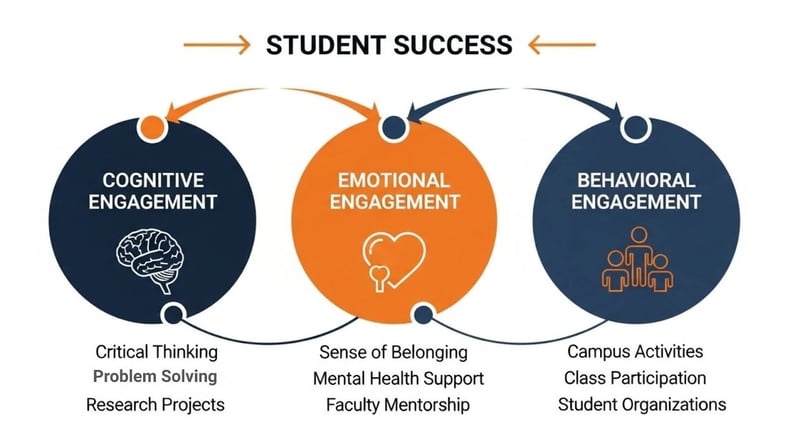
Effective student engagement in higher education operates across three interconnected dimensions: cognitive, emotional and behavioral. Your approach must address all three areas to maximize impact and create the supportive environment learners need.
Cognitive Engagement: Deepening Learning Investment
Cognitive engagement involves students' investment in deep learning, critical thinking and intellectual growth. This dimension challenges students to move beyond surface-level memorization toward meaningful understanding and application of knowledge. In your classrooms and programs, cognitive engagement manifests when students ask probing questions, make connections between concepts and apply theoretical knowledge to real-world scenarios.
Interactive learning experiences boost cognitive engagement. Consider incorporating case studies, problem-based learning and collaborative research projects that require students to analyze complex situations and develop solutions. When you provide opportunities for undergraduate research, internships and capstone projects, you're creating pathways for students to engage deeply with their chosen fields while developing critical thinking skills that serve them throughout their careers.
Emotional Engagement: Building Belonging and Connection
Emotional engagement reflects students' sense of belonging, connection to their institution and investment in their educational journey. This dimension addresses the human need for community and support that often determines whether students persist through challenges or decide to leave. Your efforts to build emotional engagement should focus on creating inclusive environments where every student feels valued, supported and genuinely cared about as individuals.
Mental health resources, peer support systems and faculty mentorship programs all contribute to stronger emotional engagement. When students feel seen and supported by their institution, they're more likely to persist through academic difficulties, financial pressures and personal challenges. Students with strong emotional connections to their colleges demonstrate higher retention rates and greater satisfaction with their overall educational experience.
Behavioral Engagement: Active Participation and Involvement
Behavioral engagement encompasses students' active participation in academic and co-curricular activities, from attending classes and completing assignments to joining student organizations and participating in campus events. This dimension is often the most visible form of engagement and serves as a strong predictor of academic success and institutional loyalty.
Your institution can enhance behavioral engagement by creating multiple pathways for student involvement that accommodate diverse interests, schedules and backgrounds. Campus organizations, intramural sports, volunteer opportunities and student government all provide avenues for meaningful participation. The key is ensuring accessibility. Students working multiple jobs or managing family responsibilities need flexible options that allow them to engage meaningfully without overwhelming their already complex schedules.
How Technology-Powered Engagement Solutions Drive Results
Digital transformation has impacted how students communicate, learn and engage with their institutions. Your success in enhancing student engagement in higher education depends on leveraging technology that meets students where they are while providing the personalized experiences they expect.
SMS Communication: The Direct Line to Student Success
Text messaging has emerged as the most powerful communication channel in higher education, with 98% open rates compared to just 26.8% for email. More impressive still, SMS messages generate 45% response rates, making them invaluable for time-sensitive communications about deadlines, financial aid and emergency notifications.
Effective SMS strategies create genuine two-way conversations. When you implement segmented texting campaigns based on academic year, major or engagement level, students receive only the most relevant information, reducing message fatigue while increasing action rates. Institutions using comprehensive texting strategies report dramatic improvements in engagement, enrollment and retention metrics.
Interactive Learning Platforms: Engaging Digital Natives
Modern learning management systems and interactive platforms transform passive content consumption into dynamic educational experiences. Features like real-time polling, collaborative discussions and multimedia content delivery cater to diverse learning styles while providing immediate feedback on student comprehension and engagement levels.
The best student engagement platform software seamlessly integrates with existing institutional systems while providing analytics that help you understand student behavior patterns. When students can access personalized dashboards, participate in virtual study groups and receive automated progress updates, they become more invested in their educational journey and more likely to seek help when needed.

Predictive Analytics: Early Intervention Systems
Advanced analytics platforms analyze multiple data points (academic performance, attendance patterns, engagement metrics and demographic factors) to identify students at risk of disengagement before problems become critical. These early warning systems enable your staff to provide targeted interventions that address specific challenges rather than generic support.
Success requires combining data insights with human connection. When your advisors receive alerts about declining engagement, they can reach out with personalized support that addresses individual circumstances. This proactive approach is one of the most effective student retention strategies, particularly for first-generation college students and those facing financial pressures.
Mobile-First Student Portals
Comprehensive mobile applications serve as centralized hubs for the entire student experience, from course schedules and grade tracking to campus event discovery and peer connections. When students can manage their entire educational journey through intuitive mobile interfaces, engagement naturally increases because barriers to participation are removed.
The most effective university engagement platforms integrate academic, social and support services into a single, user-friendly experience. Features like push notifications for important deadlines, one-click access to tutoring resources and social feeds highlighting campus activities keep students connected to their institution on a daily basis.
How to Build Community and Belonging on Your Campus
Creating authentic community experiences requires intentional design and consistent execution across all aspects of campus life. Your efforts to build belonging must recognize that students have diverse backgrounds, commitments and ways of connecting with others.

Inclusive Campus Events and Programming
Event planning should create meaningful experiences that bring diverse groups of students together around shared interests and goals. Students who attend at least 10 campus events per semester are 13% more likely to persist to the next semester, demonstrating the direct connection between social engagement and academic success.
Your programming should balance large-scale events that build campus-wide community with smaller, intimate gatherings that allow for deeper connections. Consider hosting virtual engagement opportunities for students who can't attend in-person events due to work schedules, family obligations or other commitments. The goal is to create multiple entry points for connection that accommodate different comfort levels and availability.
Peer Connection and Support Networks
Formal peer support systems, including study groups, mentorship programs and peer tutoring, provide both academic assistance and social connection. When you train upperclassmen to serve as peer mentors for incoming students, you create relationships that benefit both parties while reducing the isolation that often leads to student departure.
Learning communities organized around academic interests, career goals or shared experiences help students find their tribe within larger institutional contexts. These smaller communities provide the sense of belonging that's essential for student success while creating support networks that extend beyond graduation.
Faculty and Staff Engagement Initiatives
The quality of student-faculty interactions impacts engagement and retention outcomes. When your faculty members are trained in engagement best practices and provided with tools to connect meaningfully with students, classroom experiences become more interactive and personally relevant.
Office hours, research opportunities and informal mentoring relationships all contribute to stronger student-faculty connections. Encouraging faculty to use student engagement software for universities can help them track individual student progress and provide more personalized support throughout the semester.
Personalization at Scale: How to Meet Individual Student Needs
True personalization in higher education requires systems that can adapt to individual student circumstances while maintaining the efficiency needed to serve large populations.
Customized Learning Pathways
Adaptive course scheduling and personalized academic planning help students create educational experiences that align with their career goals, learning preferences and life circumstances. When you provide tools that recommend courses based on student progress and interests, you remove barriers to academic success while increasing student ownership of their educational journey.
Flexible delivery formats, including online, hybrid and evening options, ensure that working students, parents and other non-traditional learners can access quality education without sacrificing other important commitments. Accessibility directly impacts engagement by reducing stress and enabling students to focus on learning rather than logistics.
Individualized Communication Strategies
Personalized communication acknowledges that diverse students respond to different messaging approaches, timing and channels. Your communication strategy should segment audiences based on factors like academic standing, engagement level and demonstrated preferences to ensure maximum relevance and effectiveness.
Automated sequences that guide students through complex processes, like financial aid applications, course registration and graduation requirements, provide consistent support while reducing administrative burden on staff. When communications include specific action steps and relevant deadlines, students are more likely to follow through on important requirements.
Adaptive Support Services
Comprehensive support ecosystems that respond to individual student needs provide safety nets that prevent small challenges from becoming major obstacles. This level of support includes everything from tutoring services and writing centers to mental health resources and financial counseling that students can access based on their circumstances and comfort levels.
The key is making support services easily discoverable and accessible through university engagement platforms that students already use regularly. When help is just a few clicks away and stigma is removed from seeking assistance, more students take advantage of available resources.
How to Measure and Optimize Engagement for Maximum Impact
Successful engagement initiatives require ongoing measurement and refinement based on data-driven insights and student feedback. Your approach should balance quantitative metrics with qualitative feedback to understand what's happening and why.

Key Performance Indicators for Student Engagement
Essential metrics include participation rates in campus activities, utilization of support services, academic performance indicators and retention rates across different student populations. When you track engagement across multiple touchpoints, patterns emerge that help identify successful strategies and areas needing improvement.
Course completion rates, time to graduation and post-graduation outcomes provide longer term measures of engagement effectiveness. Regular surveying using validated instruments, such as the National Survey of Student Engagement, provides benchmark data that allows comparison with peer institutions and national trends.
Continuous Improvement Through Data Analysis
Regular analysis of engagement data helps identify which strategies are working, which populations need additional support and where resource allocation can be optimized. When you combine institutional data with feedback from focus groups and individual student interviews, you gain a comprehensive understanding of the student experience.
Feedback loops allow rapid testing and refinement of student retention strategies and engagement approaches. When you can quickly adapt programming based on student response and changing needs, your engagement efforts remain relevant and effective over time.
Real-World Success Stories: Engagement Strategies in Action
Leading institutions are demonstrating measurable improvements in student engagement and retention through comprehensive, technology-enhanced approaches that prioritize student success.
Nightingale College transformed its student experience by implementing integrated digital platforms that streamlined navigation and created personalized learning pathways. They focused on removing friction from the student journey while providing multiple touchpoints for engagement and support.
Saïd Business School at Oxford showed how world-class institutions can enhance engagement through strategic technology implementation that maintains academic rigor while improving accessibility and student satisfaction.
These success stories share common elements:
-
Comprehensive planning
-
Technology integration that serves clear pedagogical purposes
-
Ongoing assessment that enables continuous improvement
When institutions commit to student-centered approaches backed by appropriate resources and leadership support, meaningful transformation becomes possible.
Frequently Asked Questions
What is the most effective way to measure student engagement in higher education?
Effective measurement combines quantitative metrics (participation rates, academic performance, retention data) with qualitative feedback from surveys, focus groups and individual conversations. The National Survey of Student Engagement provides validated benchmarking tools that allow comparison with peer institutions.
How can institutions effectively engage non-traditional students?
Non-traditional students require flexible engagement options that accommodate work schedules, family responsibilities and varying levels of technological comfort. Successful strategies include:
-
Evening and weekend programming
-
Virtual participation options
-
Targeted support services that address specific challenges like childcare and financial planning
What role does technology play in modern student retention strategies?
Technology serves as both a communication vehicle and an analytical tool that enables personalized, scalable interventions. When implemented thoughtfully, technology reduces barriers to engagement while providing data insights that help institutions support students more effectively.
How quickly can institutions expect to see results from improved engagement strategies?
While some metrics like event attendance and communication response rates may improve within weeks, meaningful changes in retention and academic outcomes typically require one to two academic years of consistent implementation. The key is maintaining long-term commitment while celebrating incremental progress.
Boost Student Engagement at Your Institution
Enhancing student engagement in higher education requires a comprehensive approach that combines technological innovation with authentic human connection. When you implement strategies that address cognitive, emotional and behavioral dimensions of engagement while leveraging data-driven insights for continuous improvement, you create educational environments where all students can thrive.
Thriving institutions prioritize student success through meaningful engagement rather than treating symptoms after problems have already developed. Your students deserve educational experiences that recognize their potential, support their goals and prepare them for successful careers and meaningful lives.
Modern Campus empowers 1,700+ higher education institutions to attract, engage and retain learners for life with software solutions that enable modern student experiences. Schedule a demo today to discover how our integrated platform can help you create the engaging, personalized educational environment that students expect and deserve.
Last updated: December 17, 2025
.png)